“Mr. Ghost Goes to Town”
Composed and arranged by Will Hudson.
Recorded by the Hudson-DeLange Orchestra for Brunswick on June 20, 1936 in New York.
Will Hudson, directing: Harry Rausch, James O’Connell and Ralph Hollenbeck, trumpets; Edward Kolyer, trombone; George “Gigi” Bohn, first alto saxophone; Hugh Hibbert, alto saxophone; Ted Duane, tenor saxophone; Pete Brendel, alto and baritone saxophones; Mark Hyams, piano; Cliff Rausch, guitar; Edward “Doc” Goldberg, bass; Eddie O’Hara, drums.
The story:
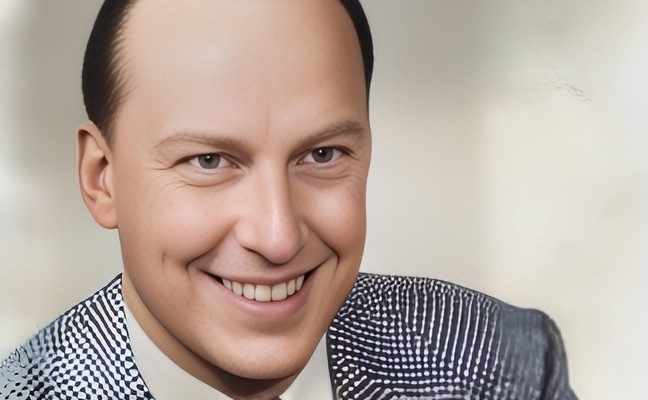
 Composer/arranger Will Hudson (1908-1981, real name Arthur Murray Hainer), is one of the interesting shadowy figures of the swing era. He was born in Grimsby, Ontario, Canada on March 8, 1908. Swing era public relations generated biographies stated incorrectly that he was born in Barstow, California. However, Hudson’s U.S. naturalization application (he became a United States citizen on April 14, 1941), indicates otherwise. Hudson, with his parents, first immigrated to the United States on November 13, 1909 at the age of 1 year 8 months. He grew up in Detroit, Michigan and graduated from Southeastern High School there in June of 1926. He lived at 1805 West Grand Blvd. in Detroit. (At right: Will Hudson in the late 1930s.)
According to U.S. Department of Labor information, Hainer remained in the U.S. until July 14, 1928, then moved back to Canada briefly, to reside at 152 Dougall Ave., Windsor, Ontario. He then apparently returned to Detroit before leaving that city temporarily (possibly working with a band) on November 7, 1929.
He changed his name to Will Hudson sometime between 1931 and 1933, after his marriage to Eleanor Radtke (born 1912) in Detroit on August 15, 1931, but before his musical compositions were copyrighted under his new name. Hainer put together his first big band in Detroit in the early 1930s. (1) (1A)
At some point during the early 1930s, Hudson became a staff arranger for Irving Mills, a well-known New York businessman who specialized in publishing music and managing talent, including Duke Ellington and Cab Calloway.

March 14, 1937 promotional party sponsored by Irving Mills and planned and executed by Helen Oakley. Ms. Oakley is at left; to her left are Duke Ellington, Irving Mills and Cab Calloway. The party was held in the ARC (Brunswick) recording studio at 1776 Broadway – fourteenth floor.
By 1933, Irving Mills was making moves that would ensure that he was an independent operator in the entertainment business: “A year after pooling their interests in artist management, Irving Mills and Tom Rockwell severed their partnership, dissolving Mills-Rockwell, Inc., which they had built into one of the top agencies among those booking radio talent. The split was an amicable one caused mainly by the complexities inherent in the many corporate entities and sub-corporations united under the Mills-Rockwell name, all carrying corporate taxes with complicated arrangements. For a while, the parties occupied the same offices until Rockwell teamed-up with F.C. “Cork” O’Keefe – earlier responsible for one-nighter bookings in the Mills-Rockwell combine – to form Rockwell – O’Keefe, Inc. In the Mills-Rockwell split, each partner regained full booking control and financial interest in the artists he had brought into the original unit, and those that had joined under either partner’s sponsorship. ”(2)
After Mills separated from Tom Rockwell, he became involved with Victor Records: “The second week of September 1933, Irving Mills was enlisted as talent scout, advisor and record producer for Victor Records, without him having to divest himself of any other of his business interests. In a first move, Mills signed Victor contracts for his three major black bands, previously exclusive Brunswick recording artists: Calloway’s, Ellington’s and the Mills Blue Rhythm Band.” (3) (3A)
Another band that Mills became involved with, at least temporarily, was Jimmie Lunceford’s. That involvement came about because the Cotton Club in Harlem, one of Mills’s major clients as an entertainment venue, needed a band to play and appear in its upcoming show. That show was: The Twenty-Fourth Edition of the Cotton Club Parade. It was set to open at the Cotton Club on March 11, 1934. The Lunceford band, after a lengthy period of scuffling and only marginal success, had become a success, after a rocky start, in a revue that ran at the Lafayette Theater in Harlem called It’s a Knockout. Among the “acts” to appear in that revue was former heavyweight boxer Jack Johnson. That show ran through the final weeks of 1933.(3B)
 Irving Mills, being who he was, set about to improve the Lunceford band’s presentation for Cotton Club audiences. What better way to do that than to have one of his house composers, Will Hudson, write and arrange a couple of new tunes for the Lunceford band that he would publish, and then get the Lunceford band to record on the Victor label. Those two tunes, both flagwavers, were “White Heat” and “Jazznocracy,” and they seemed to reflect a strong early-1930s Casa Loma band influence that had little to do with the Lunceford band’s musical personality. Nevertheless, Mills promoted them heavily, and they became more successful than any previous Lunceford band recordings. Although the Mills-Lunceford alliance was short-lived, Jimmie Lunceford retained “Jazznocracy” as his band’s theme song until 1940, when it was replaced by the smoldering “Uptown Blues,” which reflected the musical orientation of the Lunceford band much more accurately.
What became the Hudson-DeLange band was formed “…in early 1936, (by Eddie Delange). But after a few weeks, he realized that he’d need many more arrangements, so he contacted Will Hudson, with whom he’d written a few songs, and offered him a partnership in exchange for his arranging. And that’s how the band continued – Eddie as leader, Will as behind the scenes musical director who would travel with the band approximately one week per month.”(4) “Mr. Ghost Goes to Town” was one of the first tunes and arrangements Will Hudson contributed to the book of the Hudson-DeLange band.

Another photo from the March 14, 1937 promotional party hosted by Irving Mills. L-R back: Adrian Rollini, Duke Ellington, Will Hudson. In front L-R: Richard W. “Dick” Altschuler, then president of Brunswick Records, Irving Mills and Tommy Dorsey.
The music:
The Hudson-DeLange recording of “Mr. Ghost Goes to Town” shows that that band contained good musicians who were well-rehearsed. Their approach to swing reflects that of many bands, both white and black, at that time, meaning they played the music cleanly but with a somewhat stilted vertical rhythm. This verticality gradually receded in the late 1930s, in large measure in response of the playing of the early Count Basie band, which didn’t really become an influence until 1938. And of course, the Basie approach to swing was epitomized in the legato, flowing playing of tenor saxophonist Lester Young, which to this day is a primer for any musician trying to understand how to swing.

The Hudson-DeLange band onstage July 1937. The bassist is Doc Goldberg; the guitarist, Bus Etri; the pianist is Mark Hyams; the drummer Nat Pollard. The musician to Pollard’s left is lead trumpeter Charlie Mitchell. The saxophonists L-R are: Ted Duane, Gigi Bohn, Gus Bivona and Pete Brendel. The trumpeter whose instrument is visible is Jimmy Blake. Will Hudson is encouraging vocalist Nan Wynn.
Will Hudson’s arrangement on his original tune is quite good. It balances the sounds of the brass and reeds, and also includes a bit of solo tenor saxophone (probably played by Ted Duane), clarinet (possibly played by Hugh Hibbert), trumpet (possibly Ralph Hollenbeck), and a bit of solo drumming by Eddie O’Hara.
More story:
 As one would expect, Hudson and DeLange soon discovered that two bandleaders for one band is one too many. “DeLange was outgoing and full of life, his mother a former Ziegfeld follies girl and his father a songwriter who had worked on Broadway. After spending time in Hollywood as a stuntman, he returned east and opened a roadhouse before deciding to get into the band business in early 1937. The serious, bespectacled Hudson, on the other hand, could have been mistaken for an accountant. In the early 1938, the two men dissolved their partnership. Each had a different story to tell. Hudson claimed that audiences would ask for him during performances and were disappointed if he wasn’t there, as he only traveled with the band one week each month. He offered to buy out DeLange. DeLange said that the partnership was dissolved in order to get out of a booking contract. Hudson then came to him and asked to take over the band. DeLange put it to a vote of the musicians, and they choose Hudson.”(5) (Above left: Eddie DeLange in 1936.)
“Mr. Ghost Goes to Town”
Composed by Will Hudson; probably arranged by Paul Wetstein (Weston).
Recorded by Tommy Dorsey and His Orchestra for Victor on January 7, 1937 in New York.
Tommy Dorsey, trombone, directing: Bob Cusumano, first trumpet; Steve Lipkins, Joe Bauer and Bunny Berigan(*), trumpets; Les Jenkins and Artie Foster, trombones; Freddie Stulce, first alto saxophone; Joe Dixon, alto saxophone and clarinet; Clyde Rounds and Bud Freeman, tenor saxophones; Dick Jones, piano; Carmen Mastren, guitar; Gene Traxler, bass; Dave Tough, drums. (*) Berigan plays solo trumpet only.
The story:

One of the “facts” that has been handed down over the last eighty-plus years is that Bunny Berigan was a regular member of Tommy Dorsey’s band in late 1936 and into 1937. A careful review of all relevant information in the White materials and elsewhere indicates that this was not really true. Bunny undoubtedly appeared with TD’s band on a number of its weekly NBC Raleigh-Kool radio programs which aired on Monday nights, and he most certainly made some records with Tommy’s band in January and February of 1937. But Tommy’s purpose in using Berigan at this critical time in the development of his band was to spice-up their presentations, especially on the sponsored network radio show they had just begun to appear on, and on the commercial recordings they would be making for Victor. TD used Berigan as a jazz soloist, not as a regular member of his trumpet section.(6) (Above right: Probably early 1937- backstage business meeting: L-R: Tommy Dorsey, Bunny Berigan, Bob Burns, TD’s publicity flack; John Gluskin, a man who invested in bands; and Arthur Michaud, personal manager then for both Dorsey and Berigan.)
But at the same time, Bunny continued to appear weekly on the CBS radio show Saturday Night Swing Club where he was featured, and was stepping up his commitment to his own very new big band, which he was organizing then. Berigan, as usual, was a very busy man.
 The Tommy Dorsey recording of “Mr. Ghost Goes to Town” is a cover version of the tune, but certainly not the first. By the autumn of 1936, the Hudson-DeLange recording had become a modest hit, and several other bands, including Clyde McCoy’s, Woody Herman’s, Johnny Hamp’s and the Mills Blue Rhythm Band, had made cover recordings. The sheet music for the tune was published by the ever-enterprising Irving Mills, who by late 1936, had one of his in-house lyricists, Mitchell Parish, write a lyric for it. Vocal versions were then recorded by Louis Prima and Midge Williams.
TD’s instrumental version, nevertheless, captured a specific time in his band’s evolution, from a rough-and-tumble road band to a more polished radio band. Very much a part of this evolution was Tommy’s evolution as a virtuoso trombonist who excelled at playing melodies and ballads in silken fashion. Consequently, his handlers at Music Corporation of America, his booking agency, began to bill him as That Sentimental Gentleman of Swing, a reference to his ultra-melodic and super-smooth theme song “I’m Getting Sentimental Over You.” Tommy completely understood that his band’s placement on the NBC Raleigh-Kool radio show was a golden opportunity for him to move his band forward as a performing unit that was expected to play all kinds of music on each of their weekly broadcasts. Consequently, TD’s band incorporated into its own repertoire a very wide variety of music, much wider, for example, than Benny Goodman did, at least in his first couple of years on his CBS radio show, The Camel Caravan.(7)
 The arranger of the TD version of “Mr. Ghost Goes to Town,” probably Paul Weston, makes use of “spooky” musical devices in the introduction for this performance. We hear the cup-muted brass tip-toeing, along with Gene Traxler’s bass and Dave Tough’s whispering cymbals, as Tommy plays a melodic fragment on his cup-muted trombone. As chorus one begins, another layer of sound appears, the reeds, led by Joe Dixon on clarinet. They set forth the main melody over sixteen bars. On the tune’s bridge, which appears to have two distinct eight-bar sections, there is some simple call-and-response between the reeds and the now-open brass on the first half, and then a bit more complexity in the second half. The music returns to repeat the main melody to finish the chorus. (Above right: Joe Dixon in the late 1930s. Photo courtesy of Carl Carbone.)
The second chorus opens with a more dynamically intense sequence involving the clarinet-led reeds, and the low, open trombones. This is followed by the same instruments playing much softer. Dave Tough then steps out with a colorful excursion around his drum kit, played against bright open brass bursts. The band then riffs, brass against reeds, leading to the climactic solo, played by Bunny Berigan on open trumpet. Notice how he is accompanied by the ever-alert Mr. Tough, applying just the right rhythmic sheen using his China cymbal. Bunny finishes his solo by working his way up into his high-register, and stomping-off, rhythmically, as the full band riffs on.
The final tract includes a gradual return via open then muted brass to the quiet tones of the first chorus melody exposition.
“Mr. Ghost Goes to Town”
Composed by Will Hudson; Hudson arrangement modified for the Berigan band by Joe Lippman.
Recorded live in performance by Bunny Berigan and His Orchestra from a CBS radio broadcast on May 10, 1937 emanating from the Madhattan Room of Hotel Pennsylvania in New York City.
Bunny Berigan, trumpet, directing: Steve Lipkins and Cliff Natalie, trumpets; Ford leary and Frankie D’Annolfo, trombones; Sid Perlmutter, first alto saxophone; Hank Freeman, alto saxophone; Clyde Rounds and Georgie Auld, tenor saxophones; Joe Lippman, piano; Tom Morganelli, guitar; Arnold Fishkind, bass; George Wettling, drums.
The story:
 The Berigan band that opened at the Madhattan Room of Hotel Pennsylvania on April 29, 1937 had been in existence for barely four months. At that time, Bunny had been a client of the powerful personal manager Arthur Michaud for about a year. Michaud was also Tommy Dorsey’s personal manager then, and would later represent Gene Krupa and Jack Teagarden, among others. With Michaud’s guidance, Bunny had been a featured performer on the now legendary CBS network radio program The Saturday Night Swing Club, appearing weekly on that program from its inception in June of 1936 until February of 1937, when his duties as a full-time bandleader made it impossible for him to continue with SNSC. (At right: Berigan and Jerry Colonna clown in a 1936 short film called “Song Hits on Parade.” Colonna was a first-rate trombonist who Bunny worked with at CBS in the mid-1930s. Always a talented comedian, Colonna went on to much success working with Bob Hope on radio and in movies.)

Michaud, initially with the assistance of the Rockwell-O’Keefe Booking Agency (later called General Artists Corporation), had secured a place for the Berigan band on the Mutual Broadcasting System weekly radio program called Fun in Swingtime. Bunny’s association with that show lasted from mid-March to mid-October of 1937. It was a sponsored (by Admiracion Shampoo) high-level program that was aired nationwide on Sunday evenings, and would provide much exposure for Bunny and his band, and continue the process of building the Berigan name with fans of swing music across the country. It also provided a financial base that allowed him to build the band’s library of musical arrangements, and secure the services of musicians who shared his strong jazz orientation, while at the same time were able to perform written music with accuracy and verve.
 Michaud, in conjunction with Rockwell-O’Keefe, had also been working to get Berigan a deal with a record company. But due to the politics of the record business then, they could not at first sign Bunny with the Victor label, the top record label of the 1930s, where both Benny Goodman and Tommy Dorsey had been recording successfully. (Placing Bunny with Victor been the goal of everyone involved with the Berigan band’s management from the beginning.) Finally, after complicated backstage maneuvering over a period of weeks in late February and early March 1937, Berigan ended up with a one-year Victor recording contract which was signed in mid-March. An agreement was also reached for the Berigan band to follow Benny Goodman’s band into the Madhattan Room at the end of April, with frequent sustaining (non-sponsored) CBS radio broadcasts. Those would also boost the Berigan name. Lastly, Bunny would be represented by Music Corporation of America (MCA), the largest and most powerful band booking agency in the nation. Thus, the business side of the Berigan band had reached maturity before its musical side. This greatly concerned Bunny, whose primary concern was always the music. (Above left: Arthur Michaud and Bunny Berigan – 1937.)
Berigan, contrary to popular mythology, was very serious about bandleading. He had a musical vision which was to build a band that would to the degree possible, reflect his own fiery musical persona, yet at the same time be a first-rate dance band. The dance band part was essential for any big band during the swing era, because dancers were the largest consumers of the music of all big bands then. So throughout the spring of 1937 and into the summer, he painstakingly improved the personnel of his band, chair by chair. But that was in the future in early May of 1937, when the aircheck from the Madhattan Room that is presented here was made.

This is what it looked like in the Madhattan Room of Hotel Pennsylvania in 1937 when Bunny Berigan and his band played there.
The performances of the Berigan band on the recordings made while they were at the Madhattan Room reveal a solid and enthusiastic band that was in the process of finding its musical identity. The arrangements, though quite good and varied, had no discernible style, and that was precisely what Bunny wanted. The band’s style was provided in large measure by his expressive trumpet. The ensembles are a bit rough at times, and the soloists other than Bunny, though clearly in control of their instruments, had a way to go to reflect their charismatic leader’s jazz sensibilities. Berigan’s own playing however is quintessential. In these performances we hear the same inspired jazz soloist whose indelible stamp had been applied to the countless recordings he made in the early and mid-1930s. The features of his trumpet style included glissandi, slurs, scoops, rips, half-valve effects, lip vibrato, growls and rasps. He also used a wide variety of muting devices, some conventional like straight and cup mutes, some unconventional, like a felt beret and a kazoo. Also on display are his lovely warm open trumpet sound in all registers, his acute sense of musical form and drama, and above all, his irresistible, joyous swing.

The music:
This easy-going arrangement is a revision of the original Will Hudson arrangement that was recorded by the Hudson-DeLange band in mid-1936. It was written by the Berigan band’s pianist, Joe Lippman, who gradually became Bunny’s chief arranger during the early months of the band’s development. It was aimed directly at the feet of the dancers who were always strong supporters of Berigan’s various bands. Lippman’s arranging skills increased substantially in the two years he was associated with Bunny.
The rhythm section of Bunny Berigan’s band May-June 1937 on the roof of Hotel Pennsylvania. L-R: Tom Morganelli (later Morgan), Arnold Fishkind (later Fishkin), George Wettling, Joe Lippman (later Lipman). The building in the background is the Empire State Building.
“Mr. Ghost” opens with clarinets and straight muted trumpets playing alternately, stating the melody. Then there is a well-played Dixieland interlude followed by a few bars of George Wettling’s imaginative drumming, and a bit more Dixie. Tenor saxophonist Georgie Auld follows, playing a relaxed solo that indicates why Bunny featured him so generously: He clearly had a good feel for jazz and excellent command of his instrument. His jazz would improve constantly during his tenure with Berigan. Behind Auld’s playing we hear Wettling applying just the right rhythmic patina, using his China cymbal. Bunny himself plays an ultra-mellow solo which nevertheless swings mightily, with his velvety tone much in evidence. The band’s wrap-up reprises its opening.
The recordings presented with this post were digitally remastered by Mike Zirpolo.
Notes and links:
(1) The biographical summary for Will Hudson above was derived from the Wikipedia post on him.
(1A) It appears that the first arrangement written by Arthur Hainer/Will Hudson to be recorded was on “Then Someone’s in Love” (January 31, 1930), by McKinney’s Cotton-Pickers, a fine early swing band with a strong Detroit connection, led by pioneering arranger Don Redman, with assistance from arranger/trumpeter John Nesbitt. It would not be unreasonable to assume that Hudson learned a lot from Redman and Nesbitt, both of whom were in the process of developing swinging big band arrangements in the late 1920s and early 1930s.
(2) The original reporting on the Mills-Rockwell split was contained in Variety in the months of August and September of 1933.
(3) Variety, September 12, 1933.
(3A) Here is a link to a good summary of Irving Mills’s career: https://syncopatedtimes.com/irving-mills-1894-1985/
(3B) See: Jimmie Lunceford and the Harlem Express (2006) by Eddy Determeyer, 65-70.
(4) The Big Bands (1967) by George T. Simon, 258.
(5) See: https://bandchirps.com/band/hudson-delange/
(6) Dorsey also bolstered his trumpet section during this critical time by using a well-known Manhattan studio musician, Bob Cusumano, to play the first trumpet book.
(7) By 1939, Benny Goodman’s approach to his radio show was to present a wider variety of music than he had done over the previous 2 1/2 years.


Superbly written and fascinating analysis of a swing-era classic. Well done!