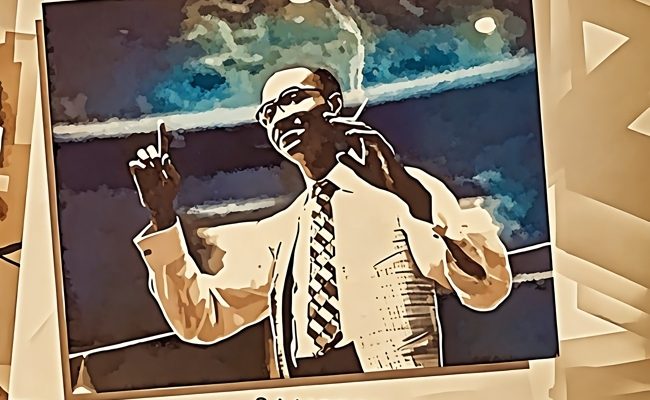
“Cool and Groovy”
Composed and arranged by Edgar Sampson.
Recorded by Edgar Sampson and His Orchestra for Decca on April 4, 1956 in New York.
Edgar Sampson directing: Charlie Shavers, first trumpet; Melvin “Red” Solomon and Jimmy Nottingham, trumpets; Lou McGarity and Tyree Glenn, trombones; Hymie Shertzer, first alto saxophone; Milt Yaner, alto saxophone; Abraham “Boomie” Richman and George Berg, tenor saxophones; Lou Stein, piano; Allan Hanlon, guitar; Beverly Peer, bass; Terry Snyder, drums.
The story:
 Arranger/composer Edgar Sampson (1907-1973) was one of the most successful composers of the swing era. His compositions, including “Blue Lou,” “If Dreams Come True,” “Lullaby in Rhythm” were much appreciated by musicians during and after the swing era because they were ideal vehicles for swinging and inspired jazz solos. In addition, Sampson wrote other compositions that had those same qualities, yet were also substantial hits with the greater public that liked a catchy melody. In this category were “Stompin’ at the Savoy” and “Don’t Be That Way.” The story of Sampson’s early career can be found in the post here at swingandbeyond.com on “Blue Lou,” which can be accessed by clicking on the link at endnote (1)
Interestingly, Sampson’s greatest successes as a composer were achieved as a result of his association with Benny Goodman, which was most active in late 1937 and into 1938, but continued indirectly for many years after that because of the copyright laws of the United States. Although he contributed a good many arrangements to the Goodman book in the late 1930s, overall there were far fewer Sampson charts in the Goodman repertoire than there were of those written by Fletcher Henderson and Jimmy Mundy. Nevertheless due to Benny’s prominence as a bandleader then, and his sponsored weekly radio show, a couple of Sampson composition/arrangements, the most notable of which is “Don’t Be That Way,” became hits on a scale that provided Sampson with substantial composer royalties for the rest of his life. “Don’t Be That Way” was one of BG’s most successful records for the Victor label on its initial release in early 1938, and for many years after. In addition, Benny selected it for inclusion in his now fabled Carnegie Hall concert, which took place on January 16, 1938. (A link to the story and music from that concert can be found at endnote 2.)  That didn’t result in much commercial activity until 1950, when recordings from that concert were released on long-playing records. Those records became a blockbuster hit, and Mr. Sampson happily received many large royalty checks for “Don’t Be That Way” as a result. Shortly after that, the feature film The Benny Goodman Story was produced. “Don’t Be That Way” has a place of prominence in that film’s story and music. Again, Mr. Sampson’s smile got brighter as mailbox money from that enterprise arrived. Consequently, Edgar Sampson’s association with Benny Goodman, though relatively brief, was very lucrative over a period of many years.
Sampson’s financial independence allowed him to work on projects that he enjoyed, when he chose to work. He was Ella Fitzgerald’s musical director from July to November of 1939. Then he worked whenever he chose in various settings through the 1940s, sometimes simply playing alto or baritone saxophone in bands in New York City and environs. He studied the Schillinger system of arranging in the mid-1940s. In the late 1940s, he began writing arrangements for various New York-based Latin American bands including those led by by Marcelino Guerra, Tito Rodriguez and Tito Puente. Sampson also led various big bands on an irregular basis for specific engagements in New York through the 1950s and into the 1960s. He began to become afflicted with diabetes in the late 1960s. Unfortunately, that condition progressed to the point where he had to have a leg amputated, and finally caused his death in 1973.(3)
The music:
“Cool and Groovy” is as swinging a chart as Edgar Sampson ever wrote. The band that he used to perform it for an LP that he made in 1956 was made up of Manhattan studio heavyweights like trumpeters Charlie Shavers and Jimmy Nottingham, trombonist Lou McGarity, tenor saxophonist Boomie Richman, pianist Lou Stein and drummer Terry Snyder, all gathered by contractor (and lead alto saxophonist) Hymie Shertzer. Also present were Sampson friends and A-grade musicians trombonist Tyree Glenn and bassist Beverly Peer. As you will hear, this ad hoc group played together like they had been doing it for a long time. Their exuberant ensemble precision and swing is a joy to behold.
 The band comes on blasting, courtesy of lead trumpeter Charlie Shavers, whose playing throughout this performance at the top of the ensemble is superb. (Shavers is shown at left.) Percolating underneath the horns is a swinging rhythm section – Allan Hanlon on guitar, Lou Stein on piano, Beverly Peer on bass and Terry Snyder on drums. This is a fast blues. The first chorus main melody exposition, such as it is, is handled by the four-man reed section, with Hymie Shertzer leading the charge on alto. The syncopations in this sequence played by the saxophones are handled brilliantly. Tart brass asides keep the mood warm and swinging. The riffy secondary melody is carried by the brass through the next sequence.
 The first soloist is Boomie Richman on tenor saxophone. His playing is both flowing yet intensely rhythmic. Notice Terry Snyder’s crackling drumming behind Mr. Richman’s two choruses. (At right: Boomie Richman with Terry Snyder behind.) Tyree Glenn follows on open trombone, on a cushion of rhythmic saxophones. His playing through his two choruses is suave and sophisticated. Trumpeter Jimmy Nottingham plays next on an open trumpet, covering much of his horn’s range and getting some interesting effects along the way. Pianist Lou Stein swings, paying tribute to one of the most imitated pianists in jazz history, Count Basie.
This performance is a great demonstration of swing by masters of the idiom.
The recording presented with this post was digitally remastered by Mike Zirpolo.
Notes and links:
(1) Here is a link to information and music from Edgar Sampson’s early career: https://swingandbeyond.com/2024/01/09/blue-lou-1936-fletcher-henderson-with-roy-eldridge-and-chu-berry-1939-metronome-all-stars-with-bunny-berigan-eddie-miller-jack-teagarden-sonny-dunham-and-benny-goodman/
(2) Here is a link to the story and music of Benny Goodman’s famous 1938 Carnegie Hall concert which includes Edgar Sampson’s “Don’t Be That way”: https://swingandbeyond.com/2017/01/01/reads-and-re-reads-benny-goodmans-1938-carnegie-hall-concert/
(3) The details of Edgar Sampson’s later life were gleaned from the Wikipedia post on him, and from Who’s Who of Jazz by John Chilton (1970), by John Chilton, 327-328.


Be the first to comment