“Turn on That Red Hot Heat”
Music by Louis Alter; lyric by Paul Francis Webster. Arranged by Joe Lippman.
Recorded by Bunny Berigan and His Orchestra for Victor on August 7, 1937 in New York.
Bunny Berigan, first and solo trumpet, directing: Steve Lipkins, trumpet, Irving Goodman, trumpet; Thomas “Sonny” Lee, first trombone; Al George, trombone; Robert “Mike” Doty, first alto saxophone; Joe Dixon, clarinet and alto saxophone; Georgie Auld, tenor saxophone; Clyde Rounds, tenor and baritone saxophone; Joe Lippman, piano; Tommy Morgan, guitar; Hank Wayland, bass; George Wettling, drums; Gail Reese, vocal.
The story:
 Bunny Berigan was one of many heroic figures to flash brilliantly across the swing era for a few years, and then meet a tragic early death. Much has been made of his alcoholism, and how it sometimes affected his playing, and how it led to the cirrhosis of the liver that killed him at age 33. But many giants of jazz were alcoholics who lived relatively long and productive lives. The overarching tragedy of Berigan’s life was that in addition to being an alcoholic, he had the extremely bad luck to be killed by the related disease, cirrhosis, at an early age. (At right: Bunny Berigan in June of 1937.)
Despite Berigan’s serious health problems at the end of his life, he functioned at a very high level as an inspired jazz trumpet virtuoso and bandleader until literally a few days before his death on June 2, 1942. At the time he made this recording of “Turn on That Red Hot Heat” however, he was still a powerful, athletic, young (age 28) man who could and did perform incredible feats on his trumpet. His band, a strong ensemble of veteran players like drummer George Wettling, and trombonist Sonny Lee, and promising young players like tenor saxophonist Georgie Auld and clarinetist Joe Dixon, was well-rehearsed and usually inspired by Berigan’s brilliant trumpeting.

The Berigan band that made the recording of “Turn On That Red Hot Heat” in the summer of 1937. L-R front: Joe Lippman, Georgie Auld, Joe Dixon, Mike Doty, Clyde Rounds; middle: Sonny Lee, Al George, Steve Lipkins, Irving Goodman, Tom Morgan(elli); back: George Wettling and Hank Wayland.
For those who want to know more about Bunny Berigan, check this website:http://www.bunnyberiganmrtrumpet.com/
The music:
 “Turn on That Red Hot Heat (and Burn Your Blues Away”), was a current pop song in mid-1937, when this splendid recording of it was made. There is nothing particularly great about the song itself, but the arrangement of it, by Berigan band pianist Joe Lippman, and the performance of that arrangement by jazz trumpet virtuoso Bunny Berigan, and his band can justly be called great.
The introduction, featuring drummer George Wettling’s pounding tom-toms, and the two trombones growling away against the wailing clarinets, is definitely creative and attention-getting. Berigan paraphrases the melody for 16 bars using a pixie straight mute in the bell of his trumpet and a plunger, getting a primitive jungly sound. He is followed by Joe Dixon on clarinet, starting out in his juicy low register, and moving on up, increasing excitement as he goes. (Above right: Joe Dixon in 1937. Photo courtesy of Carl Carbone.)
 Then the Berigan-led brass takes the lead with asides from the reeds as the arrangement moves into Gail Reese’s vocal chorus. Her singing here is on pitch and invested with some enthusiasm, reflecting the intensity of the band’s performance throughout this performance. Ms. Reese was a good-looking girl who sang adequately. She was popular with audiences and liked by her fellow band members. She also understood what it is to swing, and she does that in her vocal chorus, which is delivered with professionalism. (Above left: Gail Reese in early 1938.)
What follows her vocal chorus however is far above professionalism. It is a quintessential example of how Bunny’s playing could ignite his band. His 16 bar jazz solo on open trumpet, is rambunctious and swaggering. His huge, fat sound in all registers, low, medium and high, was unique. Hear his high-register attack in the closing bars of his solo – he doesn’t just hit the notes, he explodes them. It is a perfect example of “hot” jazz trumpet, and it clearly inspires his band members. After Berigan finishes his solo, the band riffs along for eight bars, then Bunny joins the ensemble, picking up the first trumpet part for the last few riffs, creating an electrifying effect.

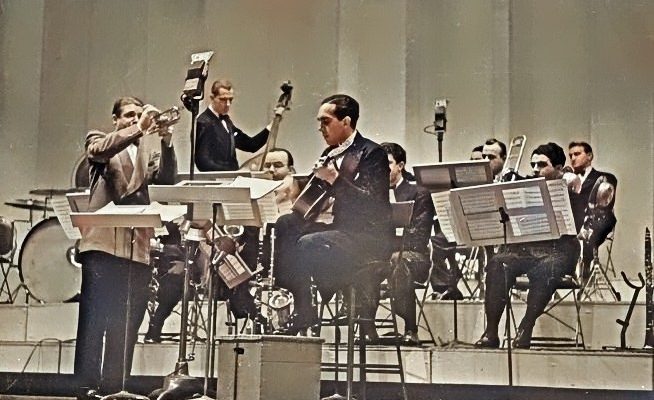
Bunny Berigan on the stage of the Paramount Theater in Manhattan December 1937. To his left: trumpeters Irving Goodman and Steve Lipkins. In the background: drummer George Wettling and bassist Hank Wayland.
No one was more favorably impressed by Berigan’s trumpet artistry than his fellow trumpeter and band member Irving Goodman, one of Benny Goodman’s younger brothers. “Steve (Lipkins) and I would sit there in the back row, night after night, set after set and watch and listen to Bunny and be totally amazed at what he could and would do. I think most jazz musicians could appreciate Bunny’s improvisations and many of the things he did, but I think you have to be another trumpet player to really, totally, understand and appreciate what Bunny was able to do on the trumpet. Oh, Bunny had his off nights and on occasion he was less than inspired, but even then his playing was far above many of us. Steve was a fine lead player; I was a less than average soloist. But night after night Steve and I would look at each other often with a nod or a raised eyebrow, etc. in acknowledgment of what we’d just heard Bunny do. Playing the trumpet is damn hard work and Bunny would often make it seem so easy! But Steve and I knew how hard it was. Bunny, being able to drink as he did and still play, was even more amazing to us. Sonny Lee in our band had played with many of the greats including Bix. He told Steve and me on a number of occasions how great Bunny really was. I know Muggsy (Spanier) told Ralph Muzzillo, another very fine lead trumpet player, how much he admired Bunny’s playing. We all did!” (1)
The recording presented with this post was digitally remastered by Mike Zirpolo.
Notes and links:
(1) White materials: June 18, 1937.
Here are some links to other great recordings by Bunny Berigan:
https://swingandbeyond.com/2018/05/13/caravan-bunny-berigan-1937/
https://swingandbeyond.com/2016/11/14/high-society-1938-bunny-berigan/
https://swingandbeyond.com/2017/03/10/the-wearin-of-the-green-1938-bunny-berigan/
https://swingandbeyond.com/2019/07/10/the-pied-piper-1938-bunny-berigan-and-ruth-gaylor/
https://swingandbeyond.com/2017/08/15/buddy-rich-at-100-moten-swing-1938-bunny-berigan/
https://swingandbeyond.com/2017/01/27/swingin-at-the-brill-building/
Here is a link to the most famous of Berigan’s recordings:
https://swingandbeyond.com/2016/10/05/i-cant-get-started-1937-bunny-berigan/

Interesting article, Mike! It’s sad that Bunny Berigan died so young. I concur with your statements about some musicians and their overindulgence of alcohol. My dad drank only a couple of beers a day in his later life, so I wouldn’t necessarily classify him as an alcoholic. He smoked cigarettes way more than he drank. Being the health-conscious individual that I was and still am, I was always on his case to quit smoking. He smoked two packs a day. The last five years of his life, he quit smoking and drinking. He gained some good weight and actually looked pretty healthy! He golfed five days a week, which also helped him live longer than I expected. My dad was involved in a bad accident one night while coming home from the Elmwood Casino. I suspect that he was drinking too much that night, which may have caused the accident on I-75. He was only in his 50s at the time, so I almost grew up without a father.