“Snowy Morning Blues”
Composed by James P. Johnson; head arrangement by Howard Alden and Monty Alexander.
Recorded by the Howard Alden Trio with Monty Alexander for Concord in April of 1990 in New York.
Howard Alden, electric guitar; Monty Alexander, piano; Lynn Seaton, bass; Dennis Mackrel, drums.
The story:
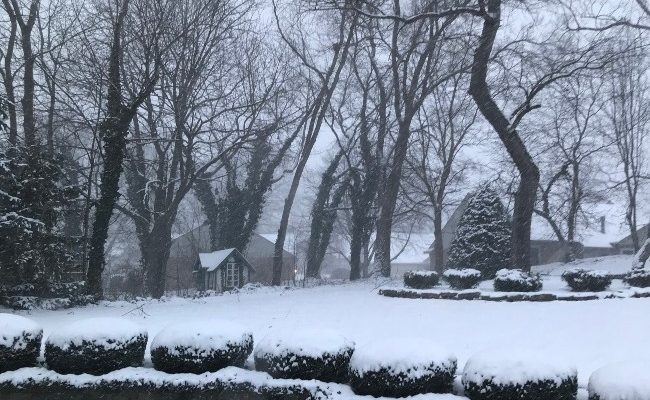
 Winter has descended upon the international headquarters of swingandbeyond.com. Here in the Midwest, gray skies begin to dominate the weather in mid-November. Snow usually begins to fall later in November, and starts to remain on the ground by December. Although we do not usually get great amounts of snow here, there have been winters when snow has been on the ground continuously from December through March. The temperatures during this current bit of winter weather have ranged from the mid-teens at night to the mid-twenties during the day.
In many places where long, cold winters dominate an area for months, folks sometimes self-medicate with various spirits, including vodka. Although I do enjoy an adult beverage occasionally, I have found that the best medicine for long winter days and nights is music. And within the general jazz category of music there is a particularly joyful idiom, the blues, which I have often found to be spiritually uplifting.
Curiously, this classic tune, composed by forefathers of jazz, pianist James P. Johnson, though titled “Snowy Morning Blues,” is not really a blues. (See below.) Nevertheless, this performance of it by two very talented jazz musicians, invests it with a lot of soul, and soul is often the main ingredient in the blues.
 The two musicians I am referring to are the guitar virtuoso Howard Alden, and the piano wizard Monty Alexander.(2) These two jazz heavyweights combined their talents in 1990 for a series of delightful recordings that were issued on the Concord Jazz label under the title: Howard Alden Trio …Snowy Morning Blues – with special guest Monty Alexander. Although all of the eleven tracks on that CD are wonderful, I have gone to the title track many times on snowy winter days (and in all of the other seasons) to get an infusion of joy. (Above left: Howard Alden.)
The music:
“Snowy Morning Blues” was written in 1927 and first recorded by its composer on March 7, 1927.(1) Thereafter, James P. Johnson recorded it several more times in various musical settings. Among the classic jazz musicians who favored this tune, we find pianist Ralph Sutton, trumpeter Henry “Red” Allen, and pianists Art Hodes, Dick Wellstood, Mike Lipskin and Don Ewell. It is easy to understand why they were attracted to it. It has a beguiling and memorable melody, as well as a harmonic structure that is like filet mignon to jazz improvisers.

Monty Alexander at the piano.
“Snowy Morning Blues” is not a blues in either form or harmonic content. When I started to analyze its form, I became confused because I assumed, given its title, that it was a standard 12-bar blues, which it definitely is not. Per my musical guru, Dennis Roden, the form is: a 4 bar introduction, then the 16-bar tune begins, consisting of two 8-bar phrases. The harmonic structure is also not of the blues variety. Nevertheless, this music is most attractive, and has fascinated listeners for almost a century.
The idea that a tune having a title that included the words “blues,” but which is not a blues is something that happened sometimes, especially in early jazz. We should remember that perhaps the most famous of all blues compositions, “St. Louis Blues” (published in 1914), had a part in it that did not follow the blues form. This is the remarkable sixteen-bar third chorus in tango rhythm, reflecting the “Spanish Tinge” (“St. Louis woman, with her diamond rings…”). Alec Wilder, in his book that examines American Popular Song, said about that sequence: “(It) is unlike anything in any blues, work song, country song or any song I’ve ever heard.”(3)
For more historical context about James P. Johnson, his peer Jelly Roll Morton, and his protege’, Thomas “Fats” Waller, see endnote 4. I am indebted to Dennis Roden for sharing his insights regarding these men with swingandbeyone.com readers.
 The Alden-Alexander performance of “Snowy Morning Blues” presented here is a series of 16-bar choruses bookended by a soulful introduction and an appropriately dramatic concluding sequence. After the intro, Howard Alden plays two choruses on his guitar that hew closely to Mr. Johnson’s melody, accompanied in the first chorus by bassist Lynn Seaton and drummer Dennis Mackrel. Then, in the second chorus, Monty Alexander joins in on piano, adding chords that provide both color and warmth. This tangy musical interplay continues through the next chorus. Then Mr. Alexander steps out with three solo choruses that highlight his swing, and his exuberant joy in creating bracing jazz. Notice his use of tremolos to build tension throughout his solo. (Above right: American music pioneer James P. Johnson in the 1920s.)
Mr. Alden takes his turn in the spotlight with two choruses, most of which is played in a flowing double-time that crosses bar lines and communicates a strong, happy yet earthy spirit most effectively. I am struck by how both of these master musicians use this tune’s harmony as a springboard to launch them into interesting and swinging improvisations.
Howard then begins gradually returning the performance to its melodic base using stop-time rhythm and breaks for a chorus, then he leads the ensemble all the way back to Father Johnson’s memorable melody, a couple of mini cadenzas and the finale.

Master guitarist Howard Alden in the process of creation.
The recording presented with this post was digitally remastered by Mike Zirpolo.
Notes and links:
(1) Actually, James P. Johnson first recorded “Snowy Morning Blues” on February 25, 1927, but the master for that recording has been lost.
(2) Howard Alden was born on October 17, 1958 in Newport Beach, California. Monty Alexander was born on D-Day, June 6, 1944, in Kingston, Jamaica.
(3) American Popular Song, …the Great Innovators – 1900-1950 (1972), by Alec Wilder, 20.
(4) Here is some valuable historical context that is relevant to James P. Johnson and others who were involved in the process of melding ragtime, the blues and the AABA popular song into what eventually became the music of the swing era, and beyond. It was shared with me by Dennis Roden, a master musician who teaches jazz history at Kent State University. Thanks Dennis!
James P. Johnson was trained in classical technique as well as immersing himself in the ragtime piano style. Yet it was his introduction to the blues sometime in the 1910s that changed the course of his music and jazz history. Blues was hardly known in New York at that time, yet somehow Johnson learned the blues while playing in Hell’s Kitchen dives from dock workers from the Carolinas. This is from Gunther Schuller’s book Early Jazz – and I ask, where did these Carolina men get the blues? I realized that my blues history has been so New Orleans and Delta centered, with a bit of the West with Blind Lemon Jefferson, that I didn’t know at all about this Piedmont Blues tradition. We’ll probably never know what the players sounded like that James P. Johnson encountered. I’ve been listening to some of the earlier musicians for that last couple of hours (late 1920s and 30s) – some players are very similar to the Delta players, but my listening to one of these players, Blind Blake, struck me. His guitar playing is very ragtime influenced and more harmonically advanced than the Delta players.
Anyhow, what I was explaining at lunch: Johnson and Jelly Roll Morton both found a way out of the ragtime tradition by infusing blues into their playing and their composing. Morton’s compositional forms are indebted to the ragtime and blues forms, and he continued using these forms throughout his career. By the time he made his celebrated Red Hot Peppers recordings, this already seemed old-fashioned, as Louis Armstrong and others embraced the popular song form of the day, the 32-bar AABA. The melody-improvisation-melody format that became standard during the swing era bored Morton as a composer. The Ragtime form, with multiple strains and contrasting sections and themes, provided the variety that he craved. Even in his blues, take Sidewalk Blues for example, Morton can’t just play melody and then have improvised solos. He presents that 12-bar form, then a different blues melody, then a 32-bar parlor song.
Johnson’s compositions also tend to be influenced by Ragtime form, although Johnson also wrote for the theatre, so he and his famous protege’, Fats Waller, embraced popular song forms as well. Schuller argues that by the early 1920s most New Orleans artists had come under the influence of the 32-bar popular song, and yet still kept close contact with the blues roots of their music. Jazz wouldn’t have survived (and thrived in the hands of the creative musicians of the swing era) had this not been the case. Instead, jazz was able to absorb the popular song style, and continues assimilating other styles to this day. Since those early days when jazz was born as a fruit of the union of ragtime and blues, the best jazz players have kept their ears wide open to the sounds around them, and the evolution continues.
Here is a link to another recording that features Howard Alden, in collaboration with his good friend, trombonist/cornetist/arranger Dan Barrett:
https://swingandbeyond.com/2016/11/23/swing-and-swing-redux-dawn-on-the-desert/


I bought this when it was new and couldn’t fathom how such a great piece of music could have remained unknown to me. But one of the delights of being a jazz fan are the discoveries you make when you think you’ve heard it all.
I think Catherine Russell is a national treasure for a nation which doesn’t deserve one. Alec Wilder notwithstanding, I’ve always preferred the disreputables, as I think of the songs which Catherine Russell tends to sing. To Wilder, Broadway songs were inherently superior, though he doesn’t ever have been able to say why. Thank God for Catherine Russell, apart from whom I might never have heard A Porter’s Love Song to a Chambermaid.