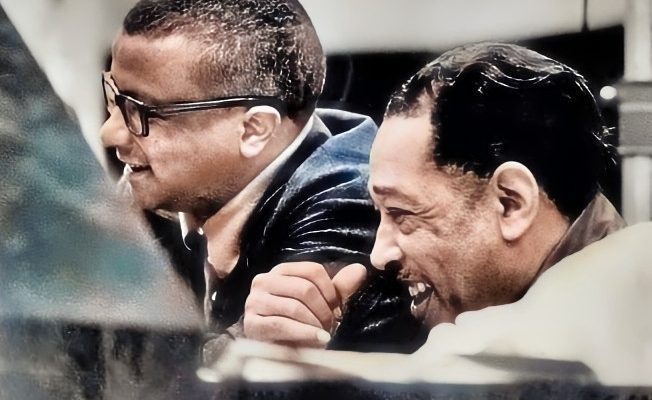
“The C Jam Blues”
Composed and arranged by Duke Ellington and Billy Strayhorn.
Recorded by Duke Ellington and His Orchestra for Victor in Chicago on January 21, 1942.
Edward K. “Duke” Ellington, piano, directing: Wallace Jones, first trumpet; Ray Nance, trumpet and violin; Rex Stewart, cornet; Lawrence Brown and Joseph “Tricky Sam” Nanton, trombones; Juan Tizol, valve trombone; Otto Hardwick, first alto saxophone; Johnny Hodges, alto saxophone; Ben Webster, tenor saxophone; Barney Bigard, tenor saxophone and clarinet; Harry Carney, baritone saxophone; Fred Guy, guitar; Alvin “Junior” Raglin, bass; William “Sonny” Greer, drums.
The story:
The Ellington band had spent most of 1941 in Los Angeles. After fifteen years of almost non-stop touring, Duke was very happy to pursue opportunities for his band to work without travel. (The story of how he did that through 1941 is told in the post here at swingandbeyond.com on the Ellington-Strayhorn composition/recording “Just a-Settin’ and a-Rockin,” which can be accessed by using the link at endnote 1 below.)
 But all good things must come to an end, and Duke’s Hollywood idyll came to an end as he and his entourage boarded a train at Union Station in Los Angeles on December 29, 1941, heading for what was supposed to be a one-week engagement at the Mainstreet Theater in Kansas City, Missouri. That gig started as it was supposed to on January 1, 1942, and proceeded for the next four days. Then, before the Ellington band took the stage on the fifth day, the management of the theater closed the venue. The vicissitudes of the road struck Ellington, as they periodically also struck all other leaders of touring bands, without notice. Left without work for three days, Duke and his band simply remained in Kansas City, then opened a two-day stay in Junction City, Kansas. After that, they played gigs in Omaha, Nebraska, Madison, Wisconsin, Waukegan, Illinois and Elkhart, Indiana. They probably set up headquarters in Chicago on January 17, before the Waukegan gig. On January 21, they entered Victor’s Studio A in Chicago to make some records, including “The C Jam Blues.”(2)
The music:
In order to demonstrate the evolution that led to Ellington’s Victor recording of “The C Jam Blues,” which started some four months earlier, I will discuss the first recording of the basic format that was developed as a prototype, “C Blues.”
“C Blues”
Composed by Duke Ellington. Informal arrangement by Duke Ellington and Billy Strayhorn.
Recorded for Bluebird on September 23, 1941 by Barney Bigard and His Orchestra in Hollywood.
Duke Ellington, piano, directing: Barney Bigard, clarinet; Ray Nance, trumpet; Juan Tizol, valve trombone; Harry Carney, baritone saxophone; Jimmie Blanton, bass; Sonny Greer, drums. Billy Strayhorn was present as well, to assist as needed.
 “C Blues,” was number conceived for a September 23, 1941 Bluebird recording session, with Duke’s clarinetist Barney Bigard as titular leader. “C Blues,” like many Ellington small group recordings before it, was fairly informal, yet it also contained input from Ellington and his collaborator, Billy Strayhorn. Both men knew what to put into a performance, and what to take out, and were masters of musical organization, contrast, pacing and balance.
 “C Blues” gives Bigard a lot to do, but largely in the ensemble passages. The recording starts (chorus one, there is no intro) with Bigard playing the minimalist melody, and the driving rhythm behind him being produced mainly by bassist Jimmie Blanton. Ellington on piano and drummer Sonny Greer are much further in the background, indeed they are barely audible. As the second chorus begins, the other instruments, Ray Nance on trumpet, Juan Tizol on valve trombone and Harry Carney on baritone saxophone perk up, playing the melodic fragment with Bigard adding woody, low register clarinet notes as a spicy, swinging obbligato. (Above right: Barney Bigard.)
 Chorus three brings Ray Nance forward, his trumpet muted to create an acrid sound. (Is it a Harmon mute, or a buzz-wow, as favored by Bunny Berigan?) Listen for Blanton’s bass accompaniment, which is the essence of swing. After this, the ensemble provides Bigard with a harmonic cushion against which he plays a few well-chosen low notes (chorus four). Harry Carney then plays two choruses of blues, with his massive sound and solid swing much in evidence. Ellington’s piano chords behind Carney are most interesting variations on the blues.
The seventh and eighth choruses spot Ray Nance, now on open horn, providing the climax to the performance, his bright trumpet sound being balanced by the lower sonorities of Tizol’s valve trombone, Carney’s baritone saxophone and Bigard’s clarinet. (Above left: Harry Carney.)
The following two ensemble choruses presents a piquant blend of instruments used to evoke the sound of the whistle of a passing train, a favorite Ducal inspiration. Then the riffing finale.
“Jam Session”
Composed and arranged by Duke Ellington and Billy Strayhorn.
Recorded by Duke Ellington and His Orchestra for Soundies on or about December 28, 1941 in Hollywood.
Edward K. “Duke” Ellington, piano, directing: Wallace Jones, first trumpet; Ray Nance, trumpet and violin; Rex Stewart, cornet; Lawrence Brown and Joseph “Tricky Sam” Nanton, trombones; Juan Tizol, valve trombone; Otto Hardwick, first alto saxophone; Johnny Hodges, alto saxophone; Ben Webster, tenor saxophone; Barney Bigard, tenor saxophone and clarinet; Harry Carney, baritone saxophone; Fred Guy, guitar; Alvin “Junior” Raglin, bass; William “Sonny” Greer, drums.
More about the music:
 The major alterations to this first full band recording of what would soon become “The C Jam Blues,” are a piano introduction followed by a chorus of blues played by Ellington, the four-bar breaks that lead into each of a succession of solos, by Ray Nance on violin; Rex Stewart on cornet (shown at right); Ben Webster on tenor saxophone; Joseph Nanton on trombone; and Barney Bigard on clarinet. In addition, this version, recorded as a part of a Soundies music video, includes a twelve-bar drum solo by Sonny Greer, and a bright ensemble finale, written by Billy Strayhorn. This Soundies music video was recorded toward the end of 1941 in Los Angeles. (A link to that video can be found at endnote 3 below.)
Minimalism was not a word that was in widespread use in 1942, but if it had been, it certainly would have applied to most of this Ellington/Strayhorn composition. The evolution of this piece, from the Bigard recording, through the Soundie recording, to what we hear in the Victor recording, reveals many things about the creative process in the Ellington band then. First of all, it reveals that Duke was not only a master of the blues idiom (many of his recordings show that), it also reveals that he was an inspired and inspiring leader. This affected his musical interactions with his greatest collaborator, Billy Strayhorn, and with the musicians in his band.
 It also reveals that Duke, ever-aware of how to adjust and adapt his music to various situations, guided the evolution from “C Blues” to “The C Jam Blues.” If one watches the Soundie video, it becomes clear that what started out as a loosely organized framework for a succession of jazz solos in the key of C, has acquired a delightful visual aspect, with each soloist being spotlighted, including a highly visual burst of drums by Sonny Greer, and an appropriately theatrical ending, which Duke had Billy Strayhorn write. “These final choruses, full of chromatic voice-leading and Strayhorn’s trademark quartal chords, became an integral part of what…” would soon become “The C Jam Blues.” (4) (Above left: Ben Webster as he appeared in the Soundie “Jam Session.”)
The Victor recording of “The C Jam Blues” was made about a month after the Soundie music video. It reveals that the Ellington band had been playing the tune during that interim to get more comfortable with it. And as was so often the case, Ellington recorded it at an optimal point in the process of its evolution. It also reveals that master editor Ellington tightened the music, eliminating the second of his piano choruses and Greer’s drum solo. The result, brilliantly performed by the Ellington band and its soloists, is a perfectly paced swing classic.
The recordings presented with this post were digitally remastered by Mike Zirpolo.
Notes and links:
(1) Here is a link to the post here at swingandbeyond.com that explains how and why Duke Ellington spent much of 1941 in Los Angeles: https://swingandbeyond.com/2023/04/24/just-a-settin-and-a-rockin-1941-duke-ellington-with-ben-webster-ray-nance-barney-bigard-and-tricky-sam-nanton-1949-duke-ellington-with-ben-webster-and-tyree-glenn/
(2) The itinerary of the travels of the Ellington band in January of 1942 come from Duke Ellington – Day by Day and Film by Film (1992), by Dr. Klaus Stratemann, 197.
(3) Here is a link to the Soundie video which presented what was then called “Jam Session,” but which soon would become “The C Jam Blues”: https://video.search.yahoo.com/yhs/search?fr=yhs-syndic8-activ8ight&ei=UTF-8&hsimp=yhs-activ8ight&hspart=syndic8&p=Duke+Ellington+Soundie+video+%22Jam+Session%22#id=1&vid=f405edcc133fddcbc611eb9de61aa5fa&action=click
(4) Something to Live For …The Music of Billy Strayhorn (2002), by Walter van de Leur, (63).


Be the first to comment