“After Hours”
Composed and arranged by Avery Parrish.
Recorded by Erskine Hawkins and His Orchestra for Bluebird on June 10, 1940 in New York.
Erskine Hawkins, trumpet, directing: Sammy Lowe, first trumpet; James Harris and Marcellus Green, trumpets; Bob Range and Edward “Captain” Sims, trombones; William “Bill” Johnson, first alto saxophone; Jimmy Mitchelle, alto saxophone; Paul Bascomb and Julian Dash, tenor saxophones; Haywood Henry, baritone saxophone; Avery Parrish, piano; William McLemore, guitar; Lee Stanfield, bass; James “Big Jack” Morrison, drums.(*)
(*) Actually, Erskine Hawkins put down his trumpet for this recording, and played drums on it. He had Big Jack Morrison stand in front of the band and relay his cues to the musicians throughout this recording. My thanks to swingandbeyond friend Jean Labaye of Limeil-Brevannes, France for guiding me to this nugget of information. For information about a comprehensive interview with Erskine Hawkins, go to endnote (4).
The story:
Pianist James Avery Parrish (1917-1959), like most other members of the Erskine Hawkins band, was born in Birmingham, Alabama. In the summer of 1932 he enrolled in Alabama State Teachers’ College in Montgomery, Alabama, where he met Erskine Hawkins, and joined a campus band known as the ‘Bama State Collegians. The Collegians toured rather extensively, being sponsored by their school for purposes of student recruitment and fund raising. This campus band evolved over the next few years into Erskine Hawkins and His Orchestra. (A detailed history of the early Erskine Hawkins band can be accessed at endnote (X) below.)
The ‘Bama State Collegians arrived in New York probably in the late summer of 1933 at the end of one of their summer tours. They decided to stay, and try their luck at becoming a working, professional band. In New York, they encountered a manager of sorts who called himself Feets Edson. Edson did help the band to get started in New York. He seems to have landed a few jobs for the Collegians from late 1933 through 1934, which provided enough money for the band to stay in New York. The Collegians also rehearsed a lot, constantly improving their musicianship and the music they played. Their first lengthy job in New York was at the Ubangi Club, 131st Street and Seventh Avenue, as a part of a floor show that included entertainer Gladys Bentley. That gig lasted from early 1936 into October of that year.

It is uncertain when Moe Gale (Moishe Galewski), who was Chick Webb’s manager and a co-owner of the Savoy Ballroom in Harlem, became the manager of the ‘Bama State Collegians. But he also owned another venue, the Harlem Opera House, aka the Harlem Uproar House, and the Collegians went into that venue from the Ubangi Club. Trumpeter Sammy Lowe, who had joined the Collegians in 1935, later recalled: “…in October of 1936, we went into the Harlem Uproar House on 50th Street, at the old Roseland, downstairs in the basement. It was a hard gig. We hit at 7 o’clock and played until four in the morning.” (WOS 219)(*) By early 1937, Moe Gale was definitely the manager of the Collegians.
As the management side of the Collegians tried various strategems to establish a public identity for the band, it was decided by Moe Gale that Hawkins, because of his ability to play audience-pleasing high-register trumpet solos, should be their leader. The band’s name was then gradually changed from the ‘Bama State Collegians to Erskine Hawkins and His Orchestra. Hawkins, as leader, began to encourage the men in the band who could arrange to start writing original tunes. This would eventually pay off in a big way for the Hawkins band, and indeed for Erskine himself. By 1937, there were three highly talented arrangers who were also members of the band: pianist Avery Parrish; lead alto saxophonist Bill Johnson, and lead trumpeter Sammy Lowe.
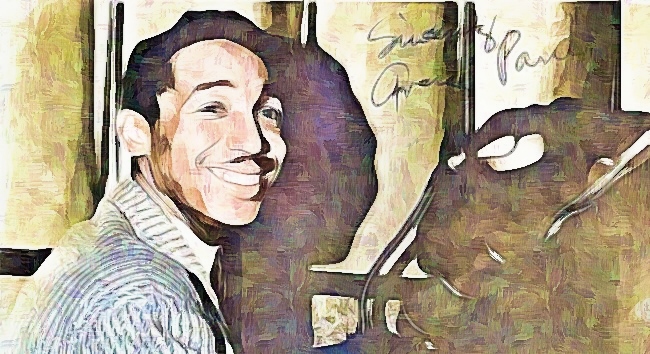
 Reedman Haywood Henry, another stalwart Hawkins sideman, recalled the early arrangements Avery Parrish (pictured at left in 1940) wrote for the Hawkins band: “Avery never studied arranging, but he could sit down and write like he was writing a letter. He could compose on the spot too. Any type of thing you wanted, he could do it. He knew the voicing of instruments, and he did most of the arrangements for the band that we didn’t record.” (WOS 209) (Note: Many of Parrish’s arrangements were in fact recorded, including: “Strictly Swing, “Swing Out” and “Rifftime.”) Hawkins trumpeter Dud Bascomb provided his own insights into this: “Avery Parrish did all of the arrangements until Sammy Lowe came into the band (in 1935). Avery liked Sy Oliver’s arrangements for Jimmie Lunceford, so a lot of his were in that pattern.” (WOS 194) (Above left: Avery Parrish in 1940.)
Slowly, the Erskine Hawkins band became successful, so successful that they were presented on the stage of that mecca of swing, the Paramount Theater in Times Square, in the summer of 1941. Their engagement at that venue was from July 30 to August 12, and it was a rousing success. As the Hawkins band was preparing their show for the Paramount Theater, they gradually selected their best tunes to present. “After Hours” was not among them. Parrish protested: “I’m Going to play my ‘After Hours,'” he declared. And he did. As Sammy Lowe later recalled, “…when he got through with it, the theater was in an uproar.” (1)

Avery Parrish and Erskine Hawkins take bows after Parrish played “After Hours” on the stage of the Paramount Theater in New York in 1941.
The music:
 Avery Parrish was not noted as a blues artist, at least not before “After Hours.” He was an excellent band pianist, and an arranger who had good musical intuition. He and the blues came together naturally as there were many blues pieces in the repertoire of the Hawkins band, including a good number of them that had been composed by Hawkins band members. “After Hours” is one such. It grew out of various piano licks Parrish had been adding to the ending of an original composition by Sammy Lowe and Hawkins that was much played (and recorded) by the Hawkins band, “Gin Mill Special.”
Curiously, the original Bluebird recording of “After Hours” that is presented with this post bears only the name Erskine Hawkins as its composer. We can speculate as to why that happened, but eventually, Parrish became recognized (and credited) as the sole composer of “After Hours.” The tune has been recorded by dozens of artists on many different instruments since 1940. A lyric was also added to the music, which resulted in many vocal renditions of the tune.
The mood evoked by “After Hours” is definitely one of late-night piano, perhaps being played in a deserted or almost deserted roadhouse. Avery Parrish used each of six twelve-bar choruses to gently advance the performance to its climax and conclusion. Basically, he plays eight bars of funky blues, then adds four bars of the melody “hook” to finish each chorus. That basic outline allows for many changes in the dynamics and register of the piano in the eight-bar sections, which lead inevitably to the four-bar hook, which drips with soul.
Post script – Avery Parrish:
At some point in late 1942 or early 1943, Avery Parrish left the Hawkins band. He had been hired by composer Hoagy Carmichael at $750 a week to play at a night club he was opening in Hollywood.(2) $750 in 1943 had the value of at least ten times that amount in today’s dollars.
 One would think that this fortuitous development would have begun a successful post-Hawkins career for Parrish as a solo pianist. Unfortunately, it started a train of tragic events that ultimately led to his death. Dud Bascomb recalled the details: “Following the success of ‘After Hours,’ he decided to stay in California and work on his own. He began to get some nice stakes out there, around $750 as a single in night clubs. The way I heard it, a friend of his came by the club, a young kid, and they decided to go in the bar and get a few drinks. One of the ruffians there came up and wanted to pick at the boy, and Avery took it up. When he turned around to take a drink, …this guy hit him across the head with a bar stool. It crushed his skull in and a piece of his brain was damaged. When I went to see him in the hospital, I learned that they had cut (that piece) off, but it seemed to be a part he needed. His hands were paralyzed, but he strengthened them by exercises, …and he did make another record of ‘After Hours.’ He started working in restaurants, washing dishes and things like that. He was still living with his mother in New York when he went to a place on 127th Street one night. He was drinking and fell down a flight of steps, hit the same spot (on his head) again, and died. He was still making good money from ‘After Hours.’ He’d just gotten a check for $800.00.” (WOS 197)
“After Hours”
Composed and arranged by Avery Parrish.
Recorded by Glen Gray and The Casa Loma Orchestra for Capitol in 1958 in Hollywood.
Glen Gray, directing: Ray Sherman, solo piano; Conrad Gozzo, Pete Candoli, Shorty Sherock and Mannie Klein, trumpets; Simon H. “Si” Zentner, Francis “Joe” Howard and Murray McEachern, trombones; Arthur “Skeets” Herfurt and Arcuiso “Gus” Bivona, alto saxophones; Irving “Babe” Russin and Jules Jacob, tenor saxophones; Chuck Gentry, baritone saxophone; Jack Marshall, guitar; Meyer “Mike” Rubin, bass; Nick Fatool, drums.
The music:
 In preparing this post, I searched my archive for the best possible source recording of “After Hours,” as played by Avery Parrish with Erskine Hawkins and His Orchestra. The ones I found (there were at least a half-dozen), ranged in sound quality from fair to poor. So to allow listeners to hear all of the nuances that are not audible on the original recording, I have also included a very well recorded performance of “After Hours” in which Avery Parrish’s classic solo is played brilliantly by Hollywood studio pianist Ray Sherman. (Ray Sherman is pictured at right in 1958.) (3)
The recordings presented with this post were digitally remastered by Mike Zirpolo.
Notes and links:
(*) The abbreviation WOS, which appears in this post refers to the book World of Swing by Stanley Dance (1974). The numbers refer to the pages cited.
(1) The Swing Era 1939-1940 (1971), notes on the music by Joseph Kastner, 56.
(2) Ibid.
Here are links to other great performances by Erskine Hawkins and his band:
https://swingandbeyond.com/2017/11/22/tuxedo-junction-erskine-hawkins-1939-and-glenn-miller-1940/
https://swingandbeyond.com/2019/06/20/norfolk-ferry-1940-erskine-hawkins/
https://swingandbeyond.com/2016/08/26/soft-winds-erskine-hawkins-1940/
https://swingandbeyond.com/2017/01/16/song-of-the-wanderer-1940-erskine-hawkins/
(X) Here is a link to a detailed history of the early Erskine Hawkins band:
(3) Here is a link to a fine interview of Ray Sherman done by Monk Rowe in 1998:
https://www.youtube.com/watch?v=QOIfeIS8M8E
(4) Here is a link to a comprehensive interview of Erskine Hawkins: https://rucore.libraries.rutgers.edu/rutgers-lib/68099/JPEG/read/


Be the first to comment