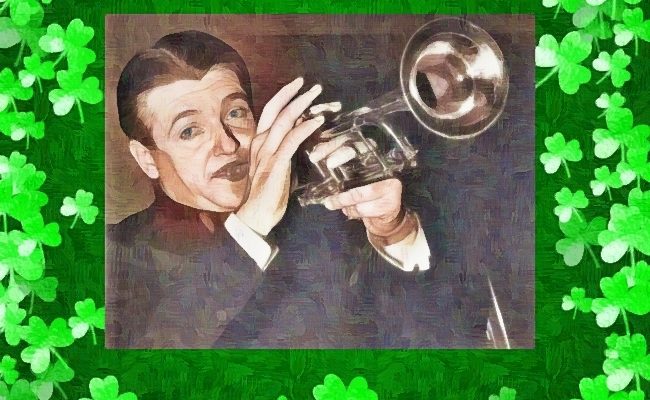
“The Wearin’ of the Green”
Irish street ballad; arranged by Joe Lippman.
Recorded by Bunny Berigan and His Orchestra for Victor on May 26, 1938 in New York.
Roland Bernard “Bunny” Berigan, solo trumpet, directing: Steve Lipkins, first trumpet; Irving Goodman, trumpet; Nat Lobovsky and Ray Conniff, trombones; Robert “Mike” Doty, first alto saxophone and bass clarinet; Joe Dixon, alto saxophone and clarinet; Georgie Auld and Clyde Rounds, tenor saxophones and clarinets; Joe Bushkin, piano; Dick Wharton, guitar; Frederick “Hank” Wayland, bass; John G. “Johnny” Blowers, drums.
The story:
 With the approach of St. Patrick’s Day, I thought we would celebrate a classic performance by one of the greatest Irish-American musicians of the swing era, trumpet titan Roland Bernard “Bunny” Berigan. Bunny’s recording of “The Wearin’ of the Green” is most colorful and very much within the swing idiom. It is also a potent reminder of the very high musical quality of so much of the music made during the swing era. Beyond that, Berigan’s trumpet performance on this recording is tremendous, and is a great example of his personal sound and instrumental effects. (Above right: Bunny Berigan does an impromptu Irish jig onstage in front of his band – 1941.)
In the spring of 1938 when Bunny Berigan recorded “The Wearin’ of the Green,” he and his band were riding a crest of popularity that had started the previous autumn with a successful tour of ballrooms and theaters, culminating with a twice-extended stand at the Paramount Theater on Times Square in Manhattan. After a long and successful residency at Manhattan’s Paradise Restaurant in April and May of 1938, they were poised to return to touring major theaters and ballrooms throughout the eastern U.S. and Midwest. But before they did that, they made a number of recordings for Victor. The Berigan band was in Victor’s 24th Street studio from 9:30 to 1:30 on May 26, but the Victor session sheets did not specify whether this was a.m. or p.m. I think this session started at 9:30 p.m. because the band apparently did not work elsewhere that night, and its next engagement was in New York City the following night. Jazz musicians are night people, and they prefer to work at night, whenever possible.
 The fourth tune to be recorded at that session, indeed the piece de resistance, was saved for last. It would be difficult to think of a more unlikely tune than “The Wearin’ of the Green” to be the point of departure for one of the most splendid arrangements and memorable performances of the swing era. But, it is a natural thing, right? Bunny Berigan and “The Wearin’ of the Green.” Could there be a more perfect combination? With the benefit of much hindsight, yes, it is a perfect combination. But what swing bands were playing “The Wearin’ of the Green” in 1938?
“The Wearing of the Green” is an Irish street ballad lamenting the repression of supporters of the Irish Rebellion of 1798. Topical lyrics have been applied to an old Irish air, and many versions exist, the best-known being by Dion Boccicault. That version proclaims that “they are hanging men and women for the wearing of the green.”
The revolutionary Society of United Irishmen adopted green as its color, and supporters wore green-colored garments, ribbons, or cockades. In some versions, the “green” being worn is a shamrock rather than fabric.(1)
It is unclear whose idea it was to pair Bunny Berigan and “The Wearin’ of the Green.” There was some comment in the press before this recording was made to the effect that Bunny was planning to record an album of Irish tunes. But this seems far less likely than Bunny simply commissioning a special arrangement on “The Wearin’ of the Green” from his top arranger at that time, Joe Lippman. However the idea got started, it developed in the ordinary course, which is to say that Bunny instructed Lippman to write an arrangement, and waited to see what Joe would come up with. When Lippman passed out his arrangement on “The Wearin’ of the Green” to the Berigan band for the first time, there had to be glee among the musicians.
The music:

The wonderful jazz writer and musician Richard M. Sudhalter (a trumpeter himself) listened carefully and analyzed this great recording: “…the opening phrases, arranged by Lippman as a kind of minuet for four clarinets (three B-flat clarinets and one bass clarinet), backed only by drummer Johnny Blowers’s (pronounced like ‘flowers’) swishing high-hats, has Joe Dixon playing lead and Mike Doty playing bass clarinet, in a passage of balanced, controlled beauty. The brass, phrasing with clipped delicacy, join in for a moment as the clarinets supply Mozartean counterpoint. (I think I hear Hank Wayland’s arco (bowed) bass under the ensemble here. MZ) Then the woodwind quartet finishes the chorus. Berigan, playing straight muted trumpet, swings in on the melody with the trombones prominent behind him. The band delivers the middle section with Berigan-inspired punch, then the leader returns on open trumpet to play out the chorus with assurance, popping out a ringing high E in the process. (He also executes a half-valve downward gliss perfectly, to thrilling effect.) (Above right: Berigan sidemen 1938: L-R: Hank Wayland, Clyde Rounds, Ray Conniff, Nat Lobovsky, Joe Dixon.)
In the next phase of the arrangement, there are solos by Georgie Auld on tenor sax, Ray Conniff on jazz trombone, and Nat Lobovsky on straight trombone. Auld is backed by the strutting brass and Blowers’s heavy back-beats. The idea of contrasting Conniff’s rugged jazz trombone with Lobovsky’s lovely melodic trombone was a very good one that Lippman would use often in coming months. Nat’s lulling solo is perfect preparation for Berigan’s electrifying re-entry.

As the band, with Steve Lipkins’s (shown at left) strong first trumpet leading the way, picks things up at the bridge, Berigan comes sailing in on an eerie, massive soaring high concert F, a full octave above. The effect is hair-raising; not only is it high and splendidly played, but it typifies Berigan’s almost supernatural sense of drama. It is improbable, unexpected, and quite beyond the capabilities of most jazz trumpeters of that era. After the reeds reprise the intro, the trombones take four bars in three part harmony! Three part harmony with only two trombones? Ah, yes. The same trumpeter who pierced the ensemble a few seconds ago with a resounding entrance at the very peak of his instrument’s range is now using his spacious low-register tone to blend with the trombones and fill out the harmony.(2)

When Johnny Blowers (at right – 1938) listened to this recording some forty-five years after it was made, after not hearing it for a long time, he was amazed: “Wow! Tremendous! He just picked that whole band up and swung it by himself. What a guy!”(3)
The recording presented with this post was digitally remastered by Mike Zirpolo.
Notes and links:
(1) The background on the tune “The Wearin’ of the Green” comes from the Wikipedia post on it.
(2) Time-Life Records Giants of Jazz-Bunny Berigan (1982), by Richard M. Sudhalter, page 45.
(3) Blowers, in Giants of Jazz: 45.
Here are links to some other great recordings by Bunny Berigan:
https://swingandbeyond.com/2018/05/13/caravan-bunny-berigan-1937/
https://swingandbeyond.com/2016/11/14/high-society-1938-bunny-berigan/
https://swingandbeyond.com/2016/10/05/i-cant-get-started-1937-bunny-berigan/
https://swingandbeyond.com/2019/07/10/the-pied-piper-1938-bunny-berigan-and-ruth-gaylor/
https://swingandbeyond.com/2017/08/15/buddy-rich-at-100-moten-swing-1938-bunny-berigan/
https://swingandbeyond.com/2017/01/27/swingin-at-the-brill-building/


My dad was also a proud Irish musician, and he liked green, too. His house was green, his favorite chair was green, etc.
That G (concert F) still had trumpet players shaking their heads in the 1960s when I took up the horn
First time I am hearing this…… Bunny was my dad’s cousin.
Welcome Molly! Please look around this blog, you will find a lot of Bunny Berigan’s music here. If you want to take a deeper dive into Bunnyworld, check out bunnyberiganmrtrumpet.com
Hank Wayland was my great grandfather! Are there any photos of him and Buddy Rich together? Bunnys rhythm section!
Hello Fletcher. Good to hear from you.
Yes, I am in possession of two photos of your great-grandfather, Hank Wayland, and Buddy Rich together while they were both members of Bunny Berigan’s band. The first was taken by a fan in the audience of an outdoor concert that took place on July 13, 1938 in Traverse City, Michigan, soon after Rich joined the band. It shows several members of the Berigan band onstage. They are Hank Wayland, Dick Wharton, Buddy Rich, Georgie Auld and Irving Goodman. The second photo was taken in late August 1938 outside the Stanley Theater in Pittsburgh. It shows: Hank Wayland, Clyde Rounds, Ray Conniff, Nat Lobovsky, Joe Dixon and Buddy Rich. I will send copies of both of these photos to you by private email.