“Sobbin Blues”
Composed by Art Kassel and Vic Berton; arranged by Joe Lippman.
Recorded by Bunny Berigan and His Orchestra for Victor on November 22, 1938 in New York.
Bunny Berigan, trumpet, directing: Johnny Napton, first trumpet; Irving Goodman, trumpet; Ray Conniff, first trombone; Bob “Brad” Jenney, trombone; Arcuiso “Gus” Bivona, first alto saxophone and clarinet; Murray “Jumbo” Williams, alto saxophone; Georgie Auld, tenor saxophone; Clyde Rounds, tenor and baritone saxophone; Joe Bushkin, piano; Dick Wharton, guitar; Frederick “Hank” Wayland, bass; Bernard “Buddy” Rich, drums. Solos: Berigan, trumpet; Conniff, trombone; Bivona, clarinet; Auld, tenor saxophone.
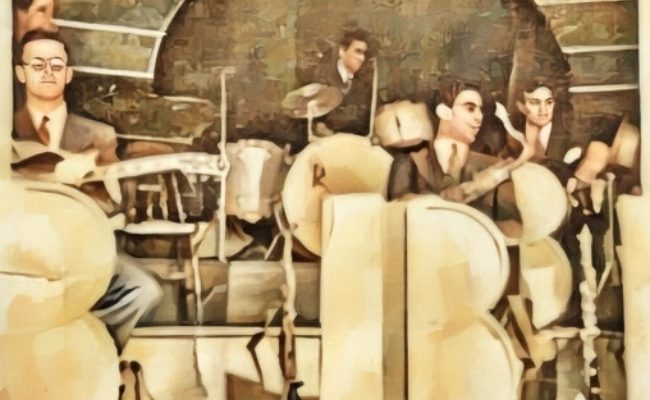
NOTE: The image at the top of this post is from a unique snapshot of the Berigan band in action at an afternoon outdoor gig in Traverse City, Michigan on July 13, 1938. That evening, they played for the National Cherry Festival Ball in Traverse City. They then opened a week-long engagement at the Fox Theater in Detroit on July 15. Shown L-R: Hank Wayland, (rear); Dick Wharton, Buddy Rich, Georgie Auld and Irving Goodman.
The story:
After completing the Stanley Theater engagement in Pittsburgh (1), the Berigan band traveled to Detroit once again, and building on its previous successes at the Fox Theater there (July 15-21), they opened a one-week stand at one of that city’s top dancing spots, Eastwood Gardens, on September 2. It was a profitable engagement. After weeks of back-breaking touring and grueling work, Bunny finally had a little leisure time in one place to enjoy by playing golf and doing other things not related to leading his band. Clarinetist Joe Dixon remembered this brief interlude: “In addition to playing nightly, we had a so-called Jitterbug Jamboree for three hours on Sunday afternoon. We stayed at the Detroiter Hotel and I remember one early morning around 3 a.m., after we’d finished the job, Bunny was to be seen casually knocking golf balls out of his hotel room window with an 8 or 9 iron!” (1A)

A night of dancing at Eastwood Gardens on U.S. 25 in suburban Detroit.
After absorbing the rather spectacular lifestyle of the Berigan band for several months, trombonist Ray Conniff had formed some opinions: “Yeah, it was quite an experience working with the Berigan band. It was a tight little band, just like a family of bad little boys, with Bunny the worst of all. We were all friends. In fact, Bunny wouldn’t hire anybody he didn’t like. All of us would take turns rooming with him. Oh, it was a mad ball. You should have seen those hotel rooms! Ribs, booze, and women all over the place. As a musician we all idolized him. Even when he was drunk, he’d blow good. And when he was sober—man! Whenever we’d play the Savoy up in Harlem, if we’d walk along the streets or go into a rib joint they would say, ‘Hey Pops, them’s Bunny’s boys.’ They loved him up there. He had that beat.”(2)
After closing at Eastwood Gardens on September 9, the Berigan band headed east. They likely played a one-nighter in Pennsylvania on Saturday, September 10, and then appeared on Sunday evening, September 11 at Lake Compounce, Bristol, Connecticut. The trade press gleefully reported what ensued. From Billboard: “One of the biggest mixups in memory occurred here (Bridgeport) at Pleasure Beach Ballroom, where Bunny Berigan was booked to play the closing dance of the season. Berigan, giving a ‘Corrigan’ twist to the directions, went up to Lake Compounce Ballroom, Bristol, CT, instead. The Berigan boys had their equipment set up after arriving early, when in walked Gene Krupa and his men, who were booked there. Hurried explanations followed, with Krupa staying and Berigan packing and quickly getting underway for Bridgeport, where they arrived several hours late. Meanwhile, Pleasure Beach had turned out the lights and those who didn’t return home went over to the Ritz Ballroom, where Ina Ray Hutton was holding forth.” (3)

Pleasure Beach amusement park – Bridgeport, Connecticut. The oblong building at right was the ballroom. One of the largest in New England, it could easily accommodate 3,500 dancers.
The front page of Metronome in a block under “Bungled Booking” had this account: “The best boner of the season occurred in Bristol, Connecticut, on Sunday, September 11. Bunny Berigan’s band had just set up for its one-nighter, when in walked Gene Krupa and his crew ready to play the same place. Hasty consultation revealed that Bunny and the boys were supposed to be over in Bridgeport. Result: Krupa worked, while Bristol dancers had fun. Berigan couldn’t make the job, while Bridgeport hoofers cried.” (4) Orchestra World reported it this way: “Crossed Wires: Bridgeport, Connecticut—Pleasure Beach Ballroom booked Bunny Berigan for the final, expected-to-be-record-smashing closing attraction. The crowd showed up—but not Berigan. All the money was refunded, the lights turned out and Berigan appeared. Due to an error the band had gone up to Bristol, where Gene Krupa already was set up and playing. They hurried back to Bridgeport too late, and everyone had gone over to the Ritz to hear Ina Ray Hutton.” (5)
 Clyde Rounds offered a bit more insight as to why the mix-up had occurred: “It wasn’t really Bunny’s fault, but MCA’s. When we got there, Gene Krupa’s boys were already starting to set up and as we said our hellos, we realized that there was only one bandstand and guessed something was wrong. The ballroom manager said we certainly weren’t booked in there, and since it was a Sunday, it took quite a few frantic phone calls to locate someone at MCA’s office who knew anything about our itinerary. Meanwhile, we all pitched in to get the instruments re-packed and loaded back on to the truck. Eventually, we got instructions to drive to Bridgeport as fast as we could! That was a journey of about 60 miles and when we finally got there, cars were coming away and the place was closed. It really was a terrible humiliation and for ages after, Bunny was nicknamed ‘Wrong Way Berigan,’ after the famous flight of Doug ‘Wrong Way’ Corrigan, which had started from Long Island, New York. The papers had a field-day with the story!” (6)
Bunny had to be livid. As a result of the increasing conflict of interest at MCA and with Arthur Michaud, his (and Gene Krupa’s) personal manager involving his band and Krupa’s, he was once again the victim of a fiasco not of his making, the second such mess in three months. He was not only denied the opportunity to play what would have been a very profitable dance date, and was humiliated in the press, but he now had the very angry operators of Bridgeport’s Pleasure Beach Ballroom to deal with because of the blown date. And of course throughout this debacle his band’s overhead continued unabated. The full consequences of an earlier blown gig at Old Orchard Beach, Maine had fallen squarely on Berigan, and now this. (6A) These two incidents were extremely costly for Bunny, and they created substantial financial difficulty for him. (6B)
Shortly after the Bridgeport incident, the great hurricane of 1938 blew the Berigan band out of a prime two-week engagement at the Ritz-Carleton Hotel in Boston leaving them shaken and without gigs. Then he broke his ankle, and it was set in a plaster cast. This happened when the Berigan band, instead of playing a week full of one-night dance gigs in New England, all of which had been cancelled because of the destruction wrought by the hurricane, was forced to take from September 24 to October 1 off. He rebroke the ankle a bit later when his casted foot slipped off the place where he had propped it while he was riding on the band bus. This required more painful medical treatment, and a yet longer period for healing. On gigs, Bunny had to play while seated on a tall stool.
Then a number of his sidemen, sensing Bunny’s difficulties, gave notice to him and joined other bands, seeking more security. This was the most disturbing development for Berigan. He had worked nonstop for over a year and a half to build his band’s personnel and library of music, and felt with justification that the band he led in the fall of 1938 was a great one. Fortunately, many of the best young musicians on the swing scene wanted to work with Bunny, so he was able to secure solid, talented replacements. Nevertheless, the fall of 1938 was a challenging time for Bunny Berigan and his band.
 They worked their way through a patchwork of hastily booked and widely-scattered one night stands in October and into November. Fortunately, Bunny was able to land a series of gigs at Manhattan’s Roseland Ballroom in October. (Four successive Wednesdays starting on October 5, with broadcasts.) (See endnote 7 for a link to a great airshot from that venue.) They also played a memorable battle of music at the Savoy Ballroom in Harlem against one of the up-and-coming young groups that played there regularly.
It must have been a deeply tired Berigan band that returned to Manhattan on Sunday, November 4 from their latest skein of widely-scattered dance dates. But tired or not, they were in for a major challenge: they were to battle Erskine Hawkins, “The Twentieth Century Gabriel,” and His Orchestra at the Savoy Ballroom that night. Hawkins was a very good trumpet player who had an extraordinary high register. He was more of a first trumpet player than a jazz soloist, but jazz or not, he could handle his trumpet very well. Hawkins’s secret weapon however, was another trumpet player in his band, the vastly underrated jazz soloist Wilbur “Dud” Bascomb. In addition, Hawkins had an exciting tenor saxophone soloist, Julian Dash, and the crowd-pleasing blues-drenched pianist Avery Parrish. The Hawkins band was an excellent dance band, and had made a lot of friends in their many engagements at the Savoy Ballroom. Bunny and his band would have their hands full at the Savoy.
They proved to be equal to the task. As Haywood Henry, who played saxophone and clarinet for Hawkins, recalled: “There were only three bands that stole the show from us at the Savoy: Duke’s, Lionel Hampton’s and Bunny Berigan’s. Bunny took us by surprise. Usually we’d prepare in advance by rehearsing or working over one of their specialties, just to make it more exciting. We didn’t prepare for Bunny, because we thought we had him. But Buddy Rich and Georgie Auld were with him, and the house came down! We had a number with a ‘Rhapsody in Blue’ ending, but when our drummer’s foot pedal broke, we sounded so horrible after Buddy Rich had got through. As for Bunny, I’ve no doubt he was the best white trumpet player. And something else— he sounded like himself!”(8)

At least one other trumpet player was there to watch the action that night. Dick Wharton, Berigan’s guitarist, remembered: “I recall Harry James, apparently on an off night, coming to the Savoy and standing only a few feet in front of the bandstand to hear Bunny and the band. He stood there set after set.”(9) (At left: Harry James – 1938: He was one of Berigan’s idolators.)
After the excitement of battling Erskine Hawkins at the Savoy Ballroom, the Berigan band had to be a little let down to return to the road to play more one-night dance dates. Some of the places they played then included: Laurenceville Preparatory School, Laurenceville, New Jersey, on November 11; Cornell University, Ithaca, New York, on the 12th; Princeton University, Princeton, New Jersey, on the 18th.
Personnel changes continued to occur in the Berigan band. Alto saxophonist Murray “Jumbo” Williams replaced Milton Schatz (who replaced Gigi Bohn who had replaced Mike Doty), who wanted to get into studio work in New York; and Bob “Brad” Jenney, younger brother of trombone virtuoso Jack Jenney (who had replaced one or two other trombonists), replaced Andy Russo, who returned to studio work in New York. Pianist Joe Bushkin, who like everyone else in the band was exhausted from the endless one-night stands, took a job in New York with Pee Wee Russell. Unlike many of the other musicians in the Berigan band, he was a native New Yorker, and had a Local 802 card that allowed him to work where he pleased in New York City. It is unclear who replaced Bushkin on piano in the Berigan band. The White materials suggest that Joe Lippman returned to play piano in the band, but I doubt that. He was by this time a successful free-lance arranger, and was contributing scores to a number of bandleaders in addition to Berigan. That kept him very busy, and it allowed him to remain in New York. In fact, at that very moment he was working on a special arranging project for Berigan that undoubtedly occupied much of his time.
 On Saturday November 19th, Bunny appeared on the CBS Saturday Night Swing Club. Also on the program was Lee Wiley. He played “I Can’t Get Started” with the CBS band, and then led a contingent of nine musicians from his band through Joe Lippman’s new arrangement of Bix Beiderbecke’s composition “In a Mist.” Lippman explained Bunny’s thinking behind this experiment: “We were always looking for something different to record and Bunny had the devil of a time selling the idea of doing a batch of tunes associated with Bix Beiderbecke to the powers-that-be at Victor. So we introduced ‘In a Mist’ on the CBS Saturday Night Swing Club program to show what could be done. I guess the main idea was to have a little band within the big band, which was quite popular then, and we felt it was successful.” (A link to a recording of that performance can be found at endnote 9A.) (This appears to be the last time Bunny guested on the Saturday Night Swing Club. This show, which he had a major part in starting in June 1936, was taken off the air in mid-1939).(10) After appearing on the Swing Club, Bunny gathered the rest of his musicians and played a dance date that same night at Hotel St. George in Brooklyn.
 On the following day, Sunday, November 20, 1938, Artie Shaw, Bunny’s colleague from CBS and the Manhattan recordings studios in the mid-1930s, began appearing on a sponsored CBS network radio program with his band. It was called Melody and Madness, and it was sponsored by Old Gold cigarettes. Shaw provided the melody; comedian Robert Benchley provided the madness. In addition, Shaw’s first record for Victor’s thirty-five cent Bluebird label, “Begin the Beguine,” was quickly proving to be the largest selling disk produced by Victor in many years. Shaw’s band was also about to make a Warner Brothers/Vitaphone movie short, and open an engagement with almost nightly NBC radio broadcasts at the Blue Room of Hotel Lincoln in New York City. In short, Artie Shaw and His Orchestra were now on a big roll, after over two years of struggle and relative failure. Shaw was now in a position to be able to afford to really strengthen his band. He began replacing a number of his sidemen at this time. Unfortunately for Berigan, Shaw’s gains in the personnel department would soon become Bunny’s losses. First, Shaw induced Georgie Auld to join his band for more money than he was earning with Berigan. Then Georgie began touting Buddy Rich to Shaw, who was just then needing to replace his drummer. As 1939 began, Buddy Rich was Artie Shaw’s new drummer.
 Meanwhile, through the first half of November, the Berigan band returned to the road again, playing a couple of one-night dance jobs near New York City. In spite of the recent turnover of some of its musicians, the Berigan band that entered the Victor recording studio on November 22 sounded very good. In addition, they finally had four excellent arrangements on four tunes that seemed to fit the style of the band, to record. Bunny’s old friend Leonard Joy was back in the control room that day to supervise the session, and as a result, there was very good karma in the studio. It seems that Bunny’s luck, if only temporarily, was back in a positive phase. The recordings he made on this date, including “Sobbin’ Blues,” are among his finest. (Above right: Leonard Joy and Berigan in Manhattan’s Victor recording studio.)
The music:
“Sobbin’ Blues” was hardly a current pop tune in late 1938. Bunny undoubtedly was familiar with the recording of this Art Kassel–Vic Berton tune made by the New Orleans Rhythm Kings in the early 1920s. He very likely told Joe Lippman to do a straight-ahead swing arrangement on it with lots of room for jazz solos, and the result is what is heard in this splendid recording.
 The Berigan band is tight in this performance, yet very relaxed – the magic combination for great swing. Bunny’s solo in the first chorus on Harmon-muted (or buzz-wow muted) trumpet sounds very good. When he returns with an open horn, we hear the glorious burnished sound for which he is renowned. Ray Conniff follows with a fluid and swinging jazz solo on trombone.
Then Gus Bivona (who also plays the first alto saxophone part in this arrangement), takes his turn, playing jazz on his clarinet. It is clear from his sound here that Bunny had had the same talk with him that he had had with Joe Dixon about adjusting his clarinet mouthpiece to get a brighter sound. Bivona definitely did not sound this way in his many recordings with the Hudson-De Lange band of which he was a member before he joined Berigan. Georgie Auld is up next with a flowing, cogent jazz solo on tenor saxophone that would have been unimaginable for him a year before. The jazz influences of Herschel Evans (one of Count Basie’s two great tenor soloists in 1938, the other being Lester Young), and Bunny Berigan had finally sunk in. (Below right: Bunny’s G-men in late 1938, Gus Bivona and Georgie Auld.)
 Some antiphonal riffs follow, played perfectly by the brass and reeds (hear Clyde Rounds on baritone adding just the right touch of testosterone) with Buddy Rich’s drums kicking the ensemble along. It is evident that the new first trumpeter Johnny Napton had become completely comfortable in the Berigan band by the time this recording was made. His brilliant sound and deep swing are exactly what Bunny wanted and needed for this band. (Note: Berigan himself plays the first trumpet part in the riffs and finale coming after Georgie Auld’s solo.)
This is a prime Berigan record and a quintessential example of swing at its best.
The recording presented with this post was digitally remastered by Mike Zirpolo.
Notes and links:
(1) This was the engagement when Bunny, unsteady from too much drinking between shows, walked off the lip of the stage at the Stanley Theater and fell into the canvas-covered orchestra pit. He was not injured physically, but this incident damaged his professional reputation. In retrospect, It also marked the beginning of the decline of the business side of the Berigan band. But at the time, this was not apparent. The Berigan band, in good shape musically, continued to swing most effectively into and through the autumn of 1938.
(1A) White materials: September 2, 1938.
(2) Hear Me Talkin’ to Ya—The Story of Jazz as Told by the Men Who Made It, by Nat Shapiro and Nat Hentoff , Dover Publications, Inc. (1955), 324.
(3) Billboard: September 24, 1938, cited in the White materials: September 11, 1938.
(4) Metronome: October 1938, cited in the White materials: September 11, 1938.
(5) Orchestra World: October 1938, cited in the White materials: September 11, 1938.
(6) White materials: September 11, 1938.
(6A) Bunny was later sued by the operators of the Pleasure Beach Ballroom for the loss of the profits they would have made on the date the Berigan band missed.
(6B) The two blown gigs in the summer of 1938 were a part of a fact pattern that indicated that MCA, Bunny’s booking agency, and Arthur Michaud, Bunny’s personal manager, were devoting more time to the development of Gene Krupa’s band and less to the day-to-day management of the Berigan band. Although Bunny and Gene were and remained friendly, Bunny nevertheless began to become increasingly frustrated with this situation. The result was that he fired Michaud in January of 1939. He did this without any legal assistance, and Michaud continued collecting commissions from him while doing no work. MCA, knowing what a steady income generator Bunny was for the agency, mollified him, but did not provide him with the personal management he so desperately needed to keep his career as a bandleader on track. By September of 1939, Bunny was deeply in debt, and almost lost his band.
(8) The World of Swing, by Stanley Dance, Da Capo Press, (1979) 210
(9) White materials: November 4, 1938.
(9A) Here is a link to Bunny Berigan playing “In a Mist” on the Saturday Night Swing Club broadcast of November 19, 1938, along with Bix Beiderbecke’s performance of it on piano: https://swingandbeyond.com/2022/09/15/in-a-mist-1927-bix-beiderbecke-1938-bunny-berigan/
(10) White materials: November 19, 1938.


Be the first to comment