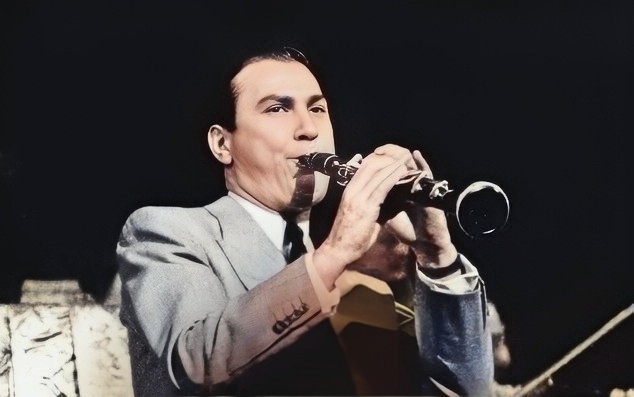
“Frenesi”
Composed by Alberto Dominguez Borras; arranged by William Grant Still.
Recorded by Artie Shaw and His Orchestra for Victor on March 3, 1940 in Hollywood.
Artie Shaw, clarinet, directing: Charlie Margulis, first trumpet; Manny Klein and George Thow, trumpets; Babe Bowman, Randall Miller, Bill Rank, trombones; John Cave, French horn; Blake Reynolds, alto saxophone, clarinet; Bud Carlton, alto saxophone, clarinet; Dick Clark tenor saxophone, clarinet; Jack Stacy, tenor saxophone, clarinet; Joe Krechter, bass clarinet; Martin Ruderman, flute; Phil Nemoli, oboe; Mark Levant, Harry Bluestone, Peter Eisenberg, Robert Barene, Sid Brokaw, Dave Crakov, Jerry Joyce and Alex Law, violins; David Sterkin, Jacques Ray, Alex Law, violas; Stanley Spiegelman, Irving Lipschultz, and Julius Tannenbaum, celli; Stanley Wrightsman, piano; Bobby Sherwood, guitar; Jud De Naut, bass; Carl Maus, drums.
The story – Part One – A Shavian Interlude:
 After Artie Shaw left his band at the Cafe’ Rouge of Hotel Pennsylvania, he began driving from Manhattan to Acapulco, Mexico, starting on November 21, 1939. The previous five days he had not appeared with his band, but was engaged in extensive and intensive discussions with various people who were involved in operating the business side of his band. They tried everything to get him to return to leading his band, but ultimately were unsuccessful. Shaw’s stated reasons for leaving were that he was physically and emotionally exhausted, and basically tired of being a matinee idol (although he didn’t use those words). He wanted to get away from the worlds of swing and show business, and he wanted peace and quiet.
Although Artie had made a lot of money through 1939, for various reasons he did not have a great deal of savings to draw upon when he left his band. But he did have his contract with Victor Records, which by late 1939 was paying him substantial sums in performer’s royalties each month. “Artie Shaw’s recording contract (signed in March of 1939) calling for $1,000 per side is not disturbed by his exit and (expected) return to the band business. Figure holds true, along with the royalty agreement of 8% of the retail price of his records, for the six sides he will cut in Los Angeles on March 3. Including these six, the leader has 13 months and 56 more sides to go before the contract expires March 14, 1941. “According to letters Shaw has written to some of the men from his old band, he intends staying on the west coast permanently and do nothing but records, pictures and possibly radio. Letters note 13 fiddles, four rhythm, five saxes and four woodwinds as his instrumentation. (Note that this instrumentation does not include trumpets and trombones.) “Shaw’s 8% royalty on the 35 cent Bluebird disc figures 2.8 cents; if on the Victor label, it comes to 6 cents.”(1)
 This blurb, which appeared in Variety a few days before Shaw would enter Hollywood’s Victor recording studio to record “Frenesi,” provides some insight into what Artie was dealing with in early 1940, after he returned to Los Angeles to receive medical treatment for the broken knee he had suffered while rescuing a young woman from the surf in Acapulco. The actual date he returned was probably in early or mid-January. After he received the medical care his injury required, he settled into the house he bought the previous summer, when he had been in Hollywood working. (Above left: Artie Shaw’s house at 1426 Summit Ridge Drive in Hollywood.)
While he convalesced, he was busy devising a plan which would allow him to return to the band business, but on his terms. Central to his plan was that whatever he did, he had to resume recording for Victor (1A), and begin creating new “product” for them. (A detailed explanation of what Shaw was doing to create new music to be recorded can be found at the post here at swingandbeyond.com on his recording of William Grant Still’s “Blues.” A link is at endnote 2.)
Shaw was sufficiently recovered from his knee injury to be haunting the MGM studio lot in early February of 1940 with his friend, comedian Phil Silvers. In their wanderings, they came upon a sound stage where Lana Turner was working. Shaw and Ms. Turner had worked together somewhat uneasily in the summer of 1939 in the MGM film Dancing Coed. Much later, in 1998, Shaw recalled the next time he encountered Lana: “I went over to Metro-Goldwyn-Mayer with Phil Silvers. He didn’t tell me what he was doing, but he took me to a set where they were shooting “The Ziegfeld Girl,” and that was Lana’s (first starring) picture. (Lana came off the set) …in a green satin gown that was molded to her body so that you could see every pore. She came over and introduced herself (again). We talked a little and got along. We had a dinner date. That was the night that I married her. It was a dare. We played chicken. We got a plane and flew to wherever it was and got married. We didn’t know what to hell we were doing. It was very stupid.”(3) The date of their marriage was February 13, 1940.

Artie Shaw and Lana Turner enjoying the Hollywood life – spring 1940.
The story: Part Two – Hollywood – 1940:
Hollywood. Although Hollywood, California is definitely a place, it is now as it always has been since its founding in the early years of the Twentieth Century, more of a state of mind than anything else. Hollywood is a realm of illusions, dreams and fantasies. People have flocked to Hollywood (really Los Angeles) for over a century to pursue those illusions, dreams and fantasies. (For a marvelous montage what Los Angeles looked like in 1940, check out the video I have provided a link to at endnote (4). (Below right: Griffith Park Observatory and Planetarium atop Mount Hollywood around 1940.)
 The mainspring that has driven the Hollywood illusion from the beginning is the film industry. That industry began to catch the fancy of America in the 1910s, quickly evolved into an economic force in the 1920s, and then exploded into a cultural and economic powerhouse in the 1930s. The production of illusions, dreams and fantasies on celluloid was the business of the film studios of Hollywood, and it was big business. Those studios were really factories that employed thousands of people. The two largest film studios then were MGM (Metro-Goldwyn-Mayer), and Warner Brothers. Smaller, though very competitive studios were Paramount, Twentieth Century Fox, Columbia and Universal. The runt of the litter was RKO, but even there, an occasional blockbuster movie was produced. Finally, there were “poverty row” studios that specialized in what “the Industry” referred to as “bottom-feeding” movies, mostly serials and westerns produced on shoestring budgets.
The advent of feature films with soundtracks at the end of the 1920s (talkies in 1930s Hollywood jargon), greatly enhanced the experience of movie audiences. In addition, that technology opened up an immense opportunity for music to be used in films. In the 1930s and for the next several decades, that music required actual living, breathing, well-trained and experienced musicians to be composed, arranged, rehearsed and recorded as an integral part of the soundtrack of feature films. The music industry in Hollywood starting in the 1930s and continuing into the 1970s, was busy creating music for feature films, radio, recordings, and after World War II, television. This required thousands of musicians.

Hollywood also required special actors from time to time. The Munchkins arrive at MGM to work on the film The Wizard of Oz – 1938.
Much of the musical talent that found gainful employment in Hollywood starting in the 1930s had moved there from New York. Network radio, also a large consumer of music in the 1930s, was centered in New York, and it employed hundreds of musicians, including many composers and arrangers. For purposes of this post, it can be said that there was a through-line from 1930s network radio in New York to Hollywood that included these musicians: Johnny Green, Lenny Hayton, William Grant Still, Artie Shaw and Manny Klein. They all worked together in New York in radio in the 1930s, and all had relocated to Los Angeles by 1940. They were professional colleagues, and each one knew what the others were capable of musically. It was inevitable that they would work together there.
The music:
Despite all of his other activities in the late winter of 1940, Artie Shaw was most focused on making recordings for Victor. He understood that his contract with that company was his primary source of income while he was a bandleader without a band, while he figured out with his management team how best to move his career ahead without a standing, organized band of musicians to support and keep gainfully employed. He realized quickly that he could make recordings for Victor without forming a new band, and without dealing with myriad headaches involved in touring with that band and keeping it working full-time.
In February, he began making moves that would ensure that he created new “product” for Victor. His first decision was to decide what tunes he wanted to record. After some to-ing and fro-ing, he settled upon six titles, only one of which could be regarded as a “pop” tune, the witty “Don’t Fall Asleep,” which he had recently co-composed with his colleague from mid-1930s dance bands, Arthur Quenzer. The other tune that he recorded at the March 3, 1940 recording session that was somewhat in the category of “pop” was “My Fantasy,” which was composed by Paul Whiteman and his vocalist Joan Edwards, with an assist from Jack Meskill.(5) The other four tunes were clearly outside of the mainstream of American pop music. These included Edward MacDowell’s “A Deserted Farm”; a song by the composer Marcos A. Jiminez called “Adios, Marquita Linda”; and a melody by the Mexican composer Alberto Dominguez Borras, called “Frenesi.” (Below left: Alberto Dominguez visits Artie Shaw backstage – 1941.)
 His next move was to get the tunes arranged in a manner that he though would reflect his musical orientation at that time, which was definitely different from what it had been only a few months before, when he was leading his very successful swing band. Now Shaw wanted to pursue a decidedly more concert hall approach for his music. He eventually decided that composer and master arranger William Grant Still was the man who could help him realize his musical vision. (Check the link at endnote 2 for much more information about William Grant Still.)
The four bar introduction to “Frenesi,” warm strings and soft tom-tom rhythm, is a perfect evocation of Hollywood in early 1940 – pre-smog and freeways, warm and sunny. Artie appears as the first chorus begins to do what he always did so well, plays a gently swinging exposition of the main melody, his lovely clarinet sound swathed in strings. The tiny interlude between the two eight bar segments of Shaw’s solo are filled by quiet woodwind sonorities. On his second eight bars, Shaw improvises a bit, with the sound of a flute appearing in the background with the strings.
 The secondary bridge melody is taken by John Cave on French horn. In this sequence we hear how masterfully William Grant Still did his work: the horn plays the melody in a colorful dialogue with the straight-muted brass and strings at first, then the woodwinds are added to the sonic mix increasing the density of the harmony and the dynamic level of the music.
Artie returns to finish chorus one, again improvising against those warm strings. “Frenesi” is a standard 32 bar song containing four eight-bar sections, AABA.
An interlude of strings played without any rhythm section accompaniment begins the second second chorus. Then the open brass appear, playing a bit more forcefully, leading to a charming tract of music wherein Mr. Still presents the various sections of the orchestra playing a marvelously singing and gently swinging paraphrase of the secondary melody. The tenor saxophone solo by Dick Clark. (Clark was an excellent musician, who could also play jazz. He left Benny Goodman’s band in the summer of 1936, settled in Los Angeles, and began doing anonymous studio work. He came up through the Joe Haymes band of the early 1930s, along with such fine musicians as Pee Wee Erwin, Johnny Mince, Mike Doty and Les Jenkins.) His solo here, sixteen bars long, is played with rhythm section accompaniment only, a contrast from what had come just before, with a couple of dramatic dense orchestral chords to add spice.
Pianist Stan Wrightsman then plays a brief solo on the B melody that employs a subtle bit of Latin harmony, in dialogue with flutist Martin Ruderman, and finally the rhythmic strings. Trumpet virtuoso and studio ace Manny Klein plays a gently swinging eight bar improvisation on the A melody using a cup mute. Again, arranger Still provides him with an uncluttered background to work against.
 The saxophone section is then heard as the music builds, creating a gently dramatic transition back to Artie’s solo clarinet, and another gently melodic paraphrase, and the finale, a tag ending capped by John Cave playing a sustained note on his French horn.
Artie Shaw’s recording of “Frenesi” is an example of a lilting melody which proved to be very attractive to swing era audiences, arranged in masterful fashion by a virtuoso arranger who brilliantly utilized all of the instrumental resources of the orchestra he had to work with. In addition, it presented the clarinet of Artie Shaw in a way that his fans would recognize, in a cohesive performance by a group of talented musicians who brought to every note and beat the best of their skill. (William Grant Still is pictured above left with his wife/musical assistant Verna Arvey.)
Here is a version of “Frenesi” performed by the band Artie Shaw organized in the summer of 1940 to play on the NBC Burns and Allen radio show, and to appear in the Paramount feature film Second Chorus.
“Frenesi”
Composed by Alberto Dominguez Borras; arranged by William Grant Still and revised by Lennie Hayton on August 3, 1940
Recorded from a radio broadcast by Artie Shaw and His Orchestra emanating from the Palladium in Hollywood on January 22, 1941.
Artie Shaw, clarinet, directing: Charles William “Billy” Butterfield, George “Jumbo” Wendt, Jimmy (Jack) Cathcart, trumpets; Truman Eliot “Jack” Jenney and Vernon “Red” Brown, trombones; Les Robinson and Neely Plumb, alto saxophones; Clarence “Bus” Bassey and Jerry Jerome, tenor saxophones; John A. “Johnny” Guarnieri, piano; Alton Reynolds “Al” Hendrickson, guitar; Jud De Naut, bass; Nicholas “Nick” Fatool, drums; Truman Boardman, Ted Klages, Bill Brower, Bob Morrow, Alex Beller, Eugene Lamas, violins; Allen Harshman and Keith Collins, violas; Fred Goerner, cello.
More story and music:
The story of why and how Artie Shaw formed a new band in the summer of 1940 is told in detail in the post here at swingandbeyond.com on his great recording of “Star Dust.” That post can be accessed using the link to be found at endnote (6).
By the summer of 1940, it had become obvious that Artie Shaw’s new ideas about presenting his music were being accepted by the public. His recording of “Frenesi,” a new tune, performed by a large ensemble that contained woodwinds and strings in addition to the basic instrumentation of a swing band, was well on its way to becoming a major hit. In addition, Artie’s management team had been working hard to get him and his band into another feature film. This came to fruition at about the same time as it was announced that Shaw and company would be featured on the NBC Burns and Allen radio show, which would be starting on July 1. With a lot of lucrative work now lined up, Shaw began hiring men in June of 1940.
 Artie was forced to compromise somewhat when it came to the instrumentation of his new band simply because of the cost of paying 32 musicians on an ongoing basis. In addition, the subtle and often quiet sonorities of woodwinds would easily be overwhelmed by the volume of a swing-style brass section and a powerful drummer. These were essential features for a top grade swing band. The band Shaw had organized by July was remarkably cohesive and swinging right from the beginning. Artie hired a number of musicians from Benny Goodman’s band in July, as Benny was then forced to break up his band because of the chronic back problems he was then having, which required surgery. This nucleus included: lead alto saxophonist Les Robinson, a particular Shaw favorite, who had led Artie’s saxophone section from 1937 through 1939; tenor saxophonists Bus Bassey and Jerry Jerome, trombonist Vernon Brown, pianist Johnny Guarnieri and drummer Nick Fatool. Shaw had signed Billy Butterfield to a contract a bit earlier, and would use him as his lead and jazz trumpet soloist. The rest of the musicians Artie hired were from the Los Angeles area. (Above right: Nick Fatool with Jerry Jerome and Neely Plumb at the Palladium.)
It is clear that this band had considerable rhythmic punch, provided in large measure by drummer Nick Fatool, one of the best drummers to emerge during the swing era. The nine man string section did not in any way impede the swing of the band.

Artie Shaw and his band at the new Palladium in Los Angeles – December 12, 1940 – January 22, 1941. The swing musicians in the band were: L-R: front – Bus Bassey, Neely Plumb, Les Robinson, Jerry Jerome, Johnny Guarnieri, Shaw, and Al Hendrickson; middle: Vernon Brown, Ray Conniff and Jack Jenney; back: Jack Cathcart, George Wendt, Billy Butterfield, Nick Fatool and Jud DeNaut. The girl singer is Anita Boyer.
This off-the air recording starts the broadcast without Artie Shaw’s famous theme song, “Nightmare,” because that tune was an ASCAP composition, and the ban prohibiting it and all other ASCAP compositions was in effect when this performance took place.
 The tempo Artie set for this rendition of “Frenesi” is a bit faster than on the Victor recording, and this band attacks the music slightly more aggressively than the studio orchestra that made the Victor recording did. Shaw’s melody exposition is bright, swinging and joyous. The woodwind bit in this sequence is handled expertly by the four saxophonists playing their clarinets. The unison saxophones and brass on the bridge (Butterfield in command) is also hotter than on the Victor disk.
The strings take the lead in the next tract, sounding quite comfortable in this swing context. The interplay between the various sections of the band which comes next is delightfully swinging, as is the tenor saxophone jazz solo by Jerry Jerome. Pianist Johnny Guarnieri plays the Latin-tinged dialogue with the reeds with relaxed virtuosity. Butterfield plays the cup-muted jazz with considerable zest. (Above left: tenor saxophonist Jerry Jerome.)
The recordings presented with this post were digitally remastered by Mike Zirpolo.
Notes and links:
(1) Variety, February 28, 1940, 3.
(1A) As a part of the inducement that Artie Shaw received to return to making records, Victor moved him up to the full-price Victor label, which in 1940 began selling for 50 cents a disk (previously it had been 75 cents) from their 35 cent Bluebird label.
(2) Here is a link to the story and music of Artie Shaw’s and William Grant Still’s “Blues”: https://swingandbeyond.com/2021/06/16/blues-from-lenox-avenue-1940-artie-shaw-william-grant-still/
(3) This information comes from chapter 7 of the 13-part radio series called The Mystery of Artie Shaw, produced in 1998 by Ted Hallock.
(4) Here is a link to a short but evocative video of Los Angeles in about 1940: https://www.youtube.com/watch?v=Lop4IZF05aQ
(5) The main melody of “My Fantasy” draws heavily on the melody composed by Alexander Borodin that is a part of his “Gliding Dance of the Maidens,” from the Polovtsian Dances in the opera Prince Igor (1890). In 1953 this melody reappeared as the popular song, “Stranger in Paradise” in the Broadway the musical Kismet, credited to Robert Wright and George Forrest.
(6) Here is a link to Artie Shaw’s classic recording of “Star Dust.” The story in that post describes why and how Shaw formed a new band in Hollywood in the summer of 1940: https://swingandbeyond.com/2017/10/21/star-dust-1940-artie-shaw/


Merry Christmas, Mike and to all of the readers of Swing & Beyond. I hope the coming new year finds you happy, healthy, and listening to lots of great Big Band music!
This post on Frenesi was a nice early Christmas present. It’s one of Shaw’s best and remains a delightful recording. Still’s arrangement is brilliant. It’s easy to see why it was such a sensation when it was released in 1940, as there really hadn’t been anything like it before.
That March 3 recording session was quite an historic one, as it produced multiple excellent sides. I’ve always been very fond of Adios, Marquita Linda, which alternates between haunting and upbeat passages. (Shaw’s addition of strings to the band gave it the ability to produce many different kinds of moods.) The fine arrangement is by Artie’s old bandmate, Jerry Gray. It was backed by Frenesi and, interestingly, the original record had Marquita Linda as the A side! Obviously, that was switched when Frenesi became such a smash hit, but it’s kind of funny that either Shaw, the Victor executives, or both, had more faith in Marquita Linda when they were both released.
The other March 3 song I like is the one you didn’t mention, Gloomy Sunday, with the vocal provided by Pauline Byrne. This is a remarkable number about someone contemplating suicide, following the death of their lover. Once again, the band does a great job, both on the instrumental portions and in backing Byrne’s singing. The Shaw recording was released a full year prior to Billie Holliday’s far more famous version of the song. I much prefer how Artie handled it. As an aside, Shaw’s release did not include the third verse that Holliday added, where the singer declares that it was all a bad dream. The listener therefore must conclude that the singer goes through with the suicide. It’s a very eerie and memorable song.
I’m looking forward to many more interesting posts from you in the coming year, Mike. Thanks again for all you do!
Thanks HOF for your kind words. More posts are in the pipeline, so we will definitely be getting 2026 off to a swinging start.
Your comments about some of the other tunes recorded at Shaw’s March 3, 1940 Victor session are most appreciated. One point I must clarify however: The arrangement on “Adios, Marquita Linda” was written by William Grant Still. The saxophone soli within that arrangement was written by Artie Shaw.
Aha! Thanks for the correction. It did seem strange that Gray would be doing an arrangement for Shaw while he was busy working for Glenn Miller, but that was the information I received when I asked AI about it. Then again, I’d much rather get my facts from MZ than AI!