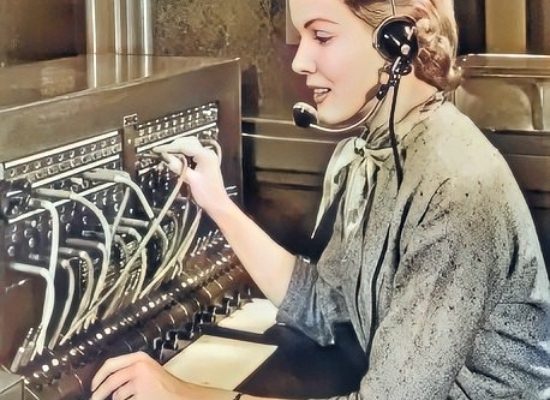
Composed and arranged by Jerry Gray.
Recorded by Glenn Miller and His Orchestra for Bluebird on April 28, 1940 in New York.
Glenn Miller, trombone, directing: John Best, first trumpet; Rubin “Zeke” Zarchy, Clyde Hurley, Legh “Lee” Knowles, trumpets; Paul Tanner, Jimmy Priddy and Frankie D’Annolfo, trombones; Hal McIntyre, first alto saxophone; Wilbur Schwartz, alto saxophone; Gordon “Tex” Beneke and Al Klink, tenor saxophones; Ernesto “Ernie” Caceres, baritone saxophone; J.C. “Chummy” MacGregor, piano; Jack Lathrop, guitar; Rowland “Rolly” Bundock, bass; Maurice “Moe” Purtill, drums.
The story:
One of the many wonderful things about the great bands of the swing era was that they were miniature musical laboratories in which experimentation was happening constantly. This process of musical experimentation was a creative one that was made possible by each band’s constant need for fresh, new material. The level of musical creativity varied in each band, depending on the musicians involved, and on the commercial success of the band.
 One band where there were both very talented musicians and great commercial success was Glenn Miller’s. The Miller band, from the beginning of 1940 until the end of September 1942, worked as hard as any band during the swing era. During that time, they were either appearing on their thrice weekly radio show which was sponsored by Chesterfield cigarettes, or playing in major theaters across the nation, or playing one-night dance dates, or playing at and broadcasting from their virtual home base, the Cafe’ Rouge of Hotel Pennsylvania in Manhattan. Last but certainly not least, they made many recordings for the Bluebird label of Victor Records. Consequently, the Miller band devoured music and constantly needed new material.
None of this would have been possible without the inspired leadership of Glenn Miller himself. Although Miller was a capable trombonist, he recognized early in his career that no matter how much he might try, he would never be able to play as well melodically as Tommy Dorsey, or as well jazzwise as Jack Teagarden. This is not a criticism of Miller in any way: those two were unique virtuoso performers whose playing stood above that of almost every swing era trombonist. So instead of concentrating on increasing his ability as a trombone soloist, Miller focused his very powerful mind on other aspects of bandleading. He was masterful in putting together musicians and then shaping them into a cohesive, expressive band. As an arranger, he was quite capable technically of writing professional-level charts. But again, he recognized that other arrangers, including veterans like Fletcher Henderson, Eddie Durham, Bill Challis, and younger men like Jerry Gray, Bill Finegan, Billy May and George Williams had that magical musical ability to make arrangements that were personal and reached audiences on a deeper level than most anything he could create. (Miller’s composition/arrangement/ theme song “Moonlight Serenade” is an obvious exception.)  Consequently, instead of writing arrangements from scratch, he revised the work of other arrangers when he thought that was necessary, to better reflect the musical orientation of his band, and he encouraged the arrangers he employed to write, write, write. (At left: Editor-in-Chief Glenn Miller.)
The two staff arrangers Miller employed in the years 1940 to 1942 were Bill Finegan and Jerry Gray. Finegan had come into Miller’s employ a bit before that in 1939, and Glenn quickly recognized that the 22-year-old was very talented, and capable of writing distinctive arrangements that fit the Miller band well. The only drawback was that Finegan worked slowly. This created some tension between Miller and Finegan, because Glenn need quantity as well as quality, especially after he began appearing on his Chesterfield radio show at the very end of 1939. Fortuitously for Miller, Jerry Gray, a superbly talented arranger who had been responsible for writing the arrangements for many of Artie Shaw’s hit records in the years 1938 and 1939, including the blockbuster “Begin the Beguine,” became available at the very same time as Miller was preparing to start broadcasting for Chesterfield. (Shaw had left his band in late November 1939, and they limped along for a time without him, but after it was clear that Shaw would not return to that band, they disbanded.)
 Jerry Gray was born Generoso Graziano in East Boston, Massachusetts on July 3, 1915. His father, Alberto Graziano, was a music teacher who began giving his son violin lessons at age seven. As a teenager Generoso studied with Emanuel Ondricek and was a soloist with the Boston Junior Symphony Orchestra. In the summer of 1936, Graziano, by then calling himself Jerry Gray, joined Artie Shaw, then billed as “Art Shaw,” as lead violinist for the band Shaw had just started that was built around a string quartet. During the time Shaw’s string quartet band existed (September 1936 through February 1937) Gray quickly absorbed the basics of arranging for that Shaw ensemble under the tutelage of arranger Joe Lippman, another Bostonian, who likely recommended Gray to Shaw, and who wrote many arrangements for the Shaw string quartet band. After Shaw reorganized his band with the basic instrumentation of a mid-1930s swing band in March of 1937, Gray remained as a nonplaying full-time arranger, working collaboratively with Shaw, and two other Bostonians who were playing members of the early Shaw band, but who also arranged, trombonist Harry Rodgers and guitarist Al Avola. (Above right: Jerry Gray – far right, as a violinist in Art Shaw’s band, late 1936. The girl singer standing in front of Shaw is Peggy La Centra.)
When in late November 1939, the swing era trade papers began reporting the situation that was developing around the Shaw band in the wake of Artie’s departure, Miller moved decisively to secure the services of Jerry Gray as an arranger for his band. The payroll records for the Miller band indicate that Gray joined Miller on December 22, 1939.(1)
In addition to being very talented, Jerry Gray was also a fast worker. Miller would need every arrangement Jerry Gray could write.
 Glenn Miller and his band made their first sustaining broadcast from the Cafe’ Rouge of Hotel Pennsylvania on Thursday January 4, 1940 on the NBC Blue radio network. The broadcast started at midnight and ran until 12:30 a.m. Their radio broadcast schedule at that time was as follows: Monday: 12:00 – 12:30 a.m. NBC Blue – Cafe’ Rouge; Tuesday: 10:00 p.m. – 10:15 CBS – Chesterfield show; Wednesday: 10:00 p.m. -10:15 CBS – Chesterfield show; Thursday: 10:00 p.m. -10:15 CBS – Chesterfield show. Friday: 11:30 – 12:00 p.m. NBC Red – Cafe’ Rouge; Saturday: 12:00 – 12:30 a.m. NBC Blue – Cafe’ Rouge.(2) This saturation of the radio waves would move the Miller band from the category of successful, to the category of preeminently successful over the following few months. (Above left: Hotel Pennsylvania in Manhattan – Seventh Avenue at West 32nd Street, across Seventh Avenue from the grand Pennsylvania Station, around 1940.)
The music:
My informed speculation is that when Glenn Miller hired Jerry Gray in December of 1939, he had Gray sign a contract that would keep Jerry as his captive arranger for a specified period of time, probably for a base term of one year, with options for Miller to extend the term of the contract for additional one-year periods. I suspect that this contract ensured Gray a weekly salary, plus incentives to deliver more arrangements each week. In addition, to give Gray the incentive to write original tunes for the Miller band, Miller allowed Gray to retain full composer’s copyright ownership for the originals he wrote for the Miller band. (Miller did not put his name on Gray’s original compositions as co-composer.) This was of considerable monetary value to Jerry Gray because the Miller band was becoming more popular by the week in 1940 (something that continued through 1941 and 1942), and if Miller recorded any originals composed by Gray, even if they were only modestly successful in terms of record sales, Gray would make a considerable amount of extra cash. The first of these bonuses came in the spring of 1940 as a result of Jerry Gray’s enduringly popular musical salute to Hotel Pennsylvania, specifically to the Cafe’ Rouge, where the telephone number was PEnnsylvania 6-5000.
 Various people have heard various things as musical antecedents to “PEnnsylvania 6-5000.” Some have heard it as a descendent of that deathless ditty popularized by Kay Kyser, “Three Little Fishies,” which was recorded in April of 1939. Others have discerned a resemblance to Larry Clinton’s “The Dipsy Doodle.” Wherever Jerry Gray found his inspiration, “PEnnsylvania 6-5000” is a most effective swing vehicle for the 1940 Miller band.
The Bluebird recording, made on April 28, 1940, was not the first time the Miller band played it. The first documented performance was on a Chesterfield radio show on March 26, 1940. It was played again, on the Chesterfield show of April 23, 1940. Then came the Bluebird commercial recording of it five days later.(3)
“PEnnsylvania 6-5000 opens with a bright brass-led introduction which diminishes in volume as the first chorus begins with the saxophone quintet playing Gray’s simple main melody in unison for eight bars. The “hook” that Gray used to keep audiences interested was that there then was an imitation of the the ring of a 1940 telephone, followed by the band chanting Pennsylvania 6-5000! Audiences loved this bit of “business.” After this there is a repeat of the unison saxophone eight-bar sequence and bell-ringing and chant.
 The secondary bridge melody is carried by the brass-led ensemble (John Best on first trumpet), with saxophone section asides. The final eight-bar tract of the first chorus is a third playing of the main melody by the unison saxophones.
The second chorus begins with a warm, relaxed open trumpet solo by John Best. Notice how arranger Gray uses the open trombones playing harmonic pads to provide a velvety background for Best’s burnished trumpet sound. Also take note of drummer Moe Purtill’s use of what was then called a “top” cymbal (later, when they were larger, they were called a “ride” cymbal), to create a rhythmic sheen for the music in this sequence. (At left: trumpeter John Best in 1940.)
A brief brassy burst springs tenor saxophonist Tex Beneke into his solo. As Best played a bit behind the beat, achieving relaxed swing, Beneke leans into the beat, resulting in less swing. Beneke was a master technician on his tenor saxophone, and had some good ideas jazzwise (especially on ballads). Unfortunately, his use of rhythm at medium or faster tempi sometimes detracted swingwise from the quality of his playing. Nevertheless, with the oo-ah brass behind him, Tex fashions a good sixteen bar solo here.
A reprise of the main melody by the unison saxophones, the ringing bell, and the band chant (done here with a twist: Pennsylvania 6-5 oh, oh,oh!), sends the band into the riffing and brassy ending sequence.

“PEnnsylvania 6-5000”
Composed and arranged by Jerry Gray.
Recorded in performance on the CBS Moonlight Serenade Chesterfield radio show by Glenn Miller and His Orchestra on August 13, 1940 in New York.(4)
Glenn Miller, trombone, directing: John Best, first trumpet; R.D. McMickle, Rubin “Zeke” Zarchy, Charlie Frankhauser, trumpets; Paul Tanner, Jimmy Priddy and Frankie D’Annolfo, trombones; Hal McIntyre, first alto saxophone; Wilbur Schwartz, alto saxophone; Gordon “Tex” Beneke and Al Klink, tenor saxophones; Ernesto “Ernie” Caceres, baritone saxophone; J.Chalmers “Chummy” MacGregor, piano; Jack Lathrop, guitar; Rowland “Rolly” Bundock, bass; Maurice “Moe” Purtill, drums.
A bit more story:
Glenn Miller and his band’s stand at the Cafe’ Rouge of Hotel Pennsylvania in early 1940 ran from January 4 through April 4. It was very successful. After that, the Miller band embarked on a highly lucrative tour that would last, with a few interruptions, until October 7, when they settled in for another long engagement at the Cafe’ Rouge.
The personnel of the Miller band was stable in April of 1940 because as Miller himself said: “Everybody’s making more money than they ever made in their lives. We pay more money than any other band in the business.”(5) If any changes in personnel were to be made, they would be made by Miller replacing someone, not by a musician quitting.
 For reasons that are not entirely clear, Glenn began to become disenchanted with the playing of trumpeter Legh Knowles in the spring of 1940. He approached the well-known lead trumpeter Rubin “Zeke” Zarchy about replacing Knowles. Zarchy, who was then playing in Bob Crosby’s band, and making good money there, turned Miller down, probably because he didn’t want to take Knowles’s job. Then, in late April, lead trumpeter Mickey McMickle began to suffer from a cyst on his lip, making it impossible for him to play. Zarchy later recalled: “…When Mickey got that cyst, Glenn really went after me. He offered me a hundred and seventy-five a week, plus extra for recordings, which was very good money in those days. So I took the job.” (5) McMickle returned to the band on May 17, and Miller then fired Knowles. This irritated trumpeter Clyde Hurley, who intemperately expressed his dissatisfaction, so Miller fired him. By May 31, Charlie Frankhauser was Hurley’s replacement. The sidemen in the Miller band took all this in, and were careful to keep their opinions on personnel matters to themselves.(6) (Above right: Mickey McMickle and Zeke Zarchy – summer 1940.)
The music:
This recording presents the Miller aggregation performing in front of an appreciative audience of young fans in Manhattan who had come out on a steamy summer night to see and hear what was rapidly becoming the most popular band in the country. The night before, Miller had played a one-night dance date at Lakewood Park, Mahanoy City, Pennsylvania before an audience of more than 5,000 dancers.(7) This Chesterfield show emanated from the CBS studio on Broadway at 53rd, and ran from 10:00 p.m. to 10:15. As usual, it was packed with music: In addition to Glenn’s opening and closing theme “Moonlight Serenade” (played partially), there were four tunes included, with “PE 6-5000” being the last one.
Notable differences between this recording and the Bluebird commercial disk are a slightly faster tempo, a fine additional sixteen-bar jazz trumpet solo by John Best, a short saxophone section soli, and an overall more lively performance, enhanced by the resonant acoustics of CBS Radio Theater #3. Another difference is drummer Moe Purtill tapping his top cymbal in lieu of the electric phone bell. Tenor saxophonist Tex Beneke plays a different solo, and he shows how well he could handle his instrument, albeit with less than optimal swing. Purtill drives the ensemble ride-out with strong back-beats and cymbal crashes.
The CBS announcer who is heard on the introduction with Glenn is Paul Douglas who later had considerable success in Hollywood as an actor.
The recordings presented with this post were digitally remastered by Mike Zirpolo. NOTE: I have recently received questions of what is meant by this statement. For an explanation, please go to endnote (8).
Notes and links:
(1) Moonlight Serenade …A Bio-Discography of the Glenn Miller Civilian Band (1972), by John Flower, 106. Hereafter Flower.
(2) Flower, 112.
(3) Shortly after Jerry Gray composed the music for “PEnnsylvania 6-5000, the publisher of the sheet music for the tune, Robbins Music Corporation, had Carl Sigman write a lyric for it. Consequently, the composer credit on the instrumental Glenn Miller Bluebird recording of the tune reads: (Carl Sigman – Jerry Gray).
(4) This recording is a part of the recently released CD set The Historic Chesterfield Moonlight Serenade Broadcasts 1940-1942, Volume 2. GMA 1002-2, courtesy of the Glenn Miller Birthplace Society and the Glenn Miller Estate with source materials owned by the Glenn Miller Estate.
(5) Glenn Miller and His Orchestra (1974), by George T. Simon, 215.
(6) Miller was not heartless when he fired Legh Knowles. He facilitated Knowles’s entry into Charlie Spivak’s band, where he worked quite contentedly well into 1942. Changes in Miller’s trumpet section continued until Billy May was hired by Glenn as a jazz soloist in early November 1940.
(7) Flower, 201.
(8) This explanation will help people to understand what I mean when I say: The recordings presented with this post were digitally remastered by Mike Zirpolo.
First a couple of definitions:
“Digital transfer” of sound recordings refers to the process of converting audio from an original, often obsolete, physical format (such as vinyl records, magnetic reel-to-reel tape, or cassettes) into a modern digital file format (like WAV, FLAC, or MP3). This process, often called digitization or archiving, is used to preserve sound quality, prevent further degradation of physical media, and make audio more accessible for modern playback devices.
I rarely do digital transfers, and did not do a digital transfer of the “live” Glenn Miller recording of “PE 6-5000” presented with his post. I worked with the commercial release recording identified above in endnote (4).
“Digital remastering” of sound recordings refers to the process of taking a previously released, finished mix of a song or album and reprocessing it using modern digital technology to improve its sonic quality. Unlike a remix, which changes the balance of individual instruments, a remaster works with the final, 2-track stereo master to clean up, enhance, and optimize the sound for contemporary listening formats (e.g., streaming, high-res audio, 180g vinyl).
Over the last two-plus decades, using digital equipment and tools that have expanded and continue to expand what is possible in cleaning-up and refreshing recordings that were made over the last century, I have developed considerable expertise in remastering vintage recordings. I digitally remaster every recording that I present in posts here at swingandbeyond.com. I do this because over that last six decades, I have acquired and listened to literally tens of thousands of recordings from the swing era and beyond. In addition, I have listened in-person to hundreds of live performances of music of all sorts, including many performances by big bands. Consequently, I have learned what music performed by a big band sounds like in its most pristine, unaltered sound quality, that being in live performance. Many very talented sound engineers have not listened to much, if any, big band music live, or indeed on recordings. Consequently, they have little or no orientation as to what might be an optimal representation of the sound of a big band on a recording.
I use my decades long experience in listening to big band music in live performance, and sometimes, on recordings that have achieved optimal sound quality to guide me when I work with digital tools to seek optimal sound quality for the vintage recordings I present with my posts here at swingandbeyond.com. This process of digital remastering is not an exact science. Sometimes, I am able to achieve a better result with one recording than I am with another. If the source recording I start with has good sound quality and balance among the instruments, and does not have excessive extraneous noise like hiss, clicks, pops or hum, I can usually achieve a better final result when I remaster it.
I will not go into the specific tasks I perform or describe the tools that I use in the process of digitally remastering a vintage recording. I will however say that most often, I will remove as much extraneous sound (non-music) from the recording as possible, and then by using equalizers adjust the low, medium and high frequencies to achieve what to my ears is an optimal representation of the sound of the music on the recording. I will also adjust the relative volume (gain) between the various sections of instruments of the band, and the soloists, seeking a better overall balance between them.
My objective is always to present the best sounding recordings I can here at swingandbeyond.com.


Hi, Mike! Great post as always! I seem to recall reading an interview with Jerry Gray somewhere in which he said that “PEnnsylvania 6-5000” had its basis as the countermelody that he had added to an arrangement of “The Dipsy Doodle” for the “borrowed” song in a Miller medley earlier in 1940. Glenn liked it and suggested that Jerry turn it into a complete song. If you listen to an aircheck of the medley (Whispering/Ooh! What You Said/The Dipsy Doodle/The Birth of the Blues), you can definitely hear it.