“Boogie Blues”
Composed and arranged by Gene Krupa and Remo “Ray” Biondi. The lyric is a traditional blues.
Recorded by Gene Krupa and His Orchestra for Columbia on August 21, 1945 in New York.
Gene Krupa, drums, directing: Joe Triscari, first trumpet; Tony Russo, Vince Hughes and Don Fagerquist, trumpets; Pullman “Tommy” Pederson, Bill Cully and Leon Cox, trombones; Johnny Bothwell, first alto saxophone; Charlie Kennedy, alto saxophone; Charlie Ventura and Adrian Tei, tenor saxophones; Stuart Olson, baritone saxophone; Teddy Napoleon, piano; Edward Yance, guitar; Irv Lang, bass; Anita O’Day, vocal.
The story:
The story of the interruption of Gene Krupa’s successful career caused by various sinister forces and people is told in the post here at swingandbeyond.com on Gene’s theme song, “Star Burst.” That story and music can be accessed at endnote 1.The story of Anita O’Day’s early career is told in the post on “Opus One,” which can be accessed at endnote 2.

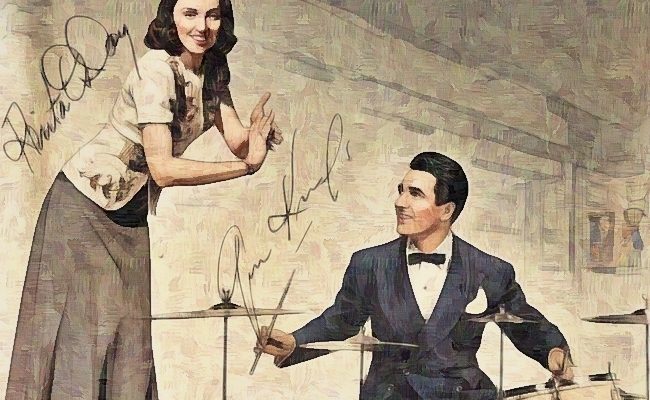
Anita O’ Day with Gene Krupa in 1941.
Anita O’Day was a unique singer. When she first appeared with Gene Krupa’s band in 1941, “…her singing was something quite new, representing a radical break from the basic prevailing concept. Even among the best singers (then, including) Mildred Bailey, Ivie Anderson, Jimmy Rushing, Frank Sinatra (and a bit later), Mel Torme’, singing was interpretation of a lyric, of a melody and words, a story, via traditional vocal techniques. For Anita, singing was a quasi-instrumental creative expression, in which words and text would become secondary, and indeed at times would be eliminated altogether. It was a whole new way of thinking about singing – and about using the voice – that derived from jazz as an instrumentalist’s art rather than the vocalist’s art of communicating words and stories.”(3)
 “Anita’s singing (with the Krupa band) at first confused audiences, but she was soon able to win them over by concentrating her repertory on …often humorous novelty songs, many of which she sang with trumpeter Roy Eldridge…” (3), typified by their hit recording with the Gene of “Let Me Off Uptown.” Many years later she told an interviewer: “‘Skylark’ and ‘Georgia on My Mind’ were the only ballads I did with Gene Krupa. Gene hired me because he liked my rhythm. He never told me I was a good singer. I was the novelty singer. The boy singer would do the ballads.”(4)
Anita joined Gene Krupa’s band in early 1941. By that time, Gene’s band was beginning to move up in popularity after three years of only modest success. Trumpeter Roy Eldridge was added to the Krupa band in mid-April of 1941. These two definitely shook-up the band, as each was a dynamic performer. By early May, they had recorded their duet on the novelty tune “Let Me Off Uptown,” which quickly rose to hit status. In early 1942, Anita O’Day came in fourth in the annual Down Beat popularity poll as female band vocalist. The year 1942 was one of increasing success for the Gene Krupa band, and their featured performers Anita O’Day and Roy Eldridge. Ms. O’Day left the band as 1942 ended, on good terms. She was simply exhausted after two years of non-stop touring, and had married for a second time.
In late January of 1943, Gene’s legal troubles began as the result of an apparent set-up involving marijuana. Soon thereafter, the first Gene Krupa band (1938-1943) ceased to exist.
Ms. O’Day worked briefly with Woody Herman in 1943, then as a soloist for the balance of that year and into 1944. She joined Stan Kenton’s band in April of 1944, and stayed for a year, making several best-selling records with Kenton. She rejoined Gene Krupa’s new band in July of 1945, and remained through January of 1946. As a result of Anita’s successes with Stan Kenton, whose band was one of the most popular of that time, she had a much higher profile in her second stint with Krupa.
The music:
 Many years after this recording was made, Gene Krupa provided some background for it: “Originally, this was called ‘Tympani Boogie,’ and it was supposed to feature me on the tymps. But we never recorded it. Anita expressed a desire to sing it, so I forsook my tymps. I don’t know where she got those lyrics – she dug them up from somewhere.” Ms. O’Day finished the story: “We were at a recording session, and there was time left over, so Gene said, ‘Let’s try it now Anita. Sing some blues – four choruses.’ I took some blues that I’d heard, ‘He’s got a face like a fish, shape like a frog…”’ (5) (At left: Remo Biondi and Gene Krupa – early 1940s.)
“Boogie Blues” in some ways is a successor to Krupa’s novelty hit “Drum Boogie,” which was recorded in early 1941, just before Anita O’Day joined the Krupa band. The vocal on that recording was done by Irene Day, however Anita sang “Drum Boogie” hundreds of times with Gene’s band, and she is strongly identified with it.
This performance (in a 12 bar blues format) begins with no introduction. We hear the saxophone quintet, led by the robust alto saxophone of Johnny Bothwell, play the melody in a gliding unison. The boogie rhythm behind them is provided by the quietly played but rhythmically intense open brass. All of this rests on a flowing 4/4 base laid down by the rhythm section.
 A burst of rhythmic brass brings Bothwell forward for a two-chorus solo. His sound is big and bright, and he definitely knew how to swing. He was referred to in the mid-1940s as “the white Johnny Hodges,” and like most such generalizations, there is some truth in it. But Bothwell used a more aggressive rhythm in his playing than Hodges, and his sound was more edgy and florid. Everything about Hodges’s playing, at any tempo, was the epitome of smooth. Nevertheless, Bothwell’s solo here is excellent.(7) (Johnny Bothwell is shown above right in the mid-1940s.)
 Anita follows Bothwell with the four choruses of blues that Gene requested, and her performance is quintessential. She sings with minimal vibrato, excellent pitch control, and maximum swing. The quality of her voice and her phrasing project a hipness that strongly suggests that she was a jazz soloist, with her instrument being her voice. The tasty buzz-like trombone obbligati behind her vocal were played by Leon Cox.
The final choruses are handled with casual aplomb by the Krupa band, riffing and building to a tag ending where Anita sings “…you hear the drummer boogie!” a reminder for Krupa audiences of Gene’s earlier boogie-based hit.
“Boogie Blues”
Composed and arranged by Gene Krupa and Remo “Ray” Biondi. Original arrangement reconstructed by Sammy Nestico.
Recorded by the Billy May and the Swing Era Orchestra for Capitol on October 11, 1971 in Hollywood.
Billy May, directing: John Audino, first trumpet; John Best, Uan Rasey, Mickey Mangano and Chuck Findley, trumpets; Dick Nash, first trombone; Lloyd Ulyate, Gil Falco and Francis “Joe” Howard, trombones; Les Robinson, first alto saxophone; Justin Gordon, alto saxophone; Don Lodice and Don Raffell, tenor saxophones; Chuck Gentry, baritone saxophone; Ray Sherman, piano, Jack Marshall, guitar; Eddie Safranski, bass; Nick Fatool, drums; Anita O’Day, vocal.
The story:
“In the late1940s, Anita O’Day struck out on her own. She teamed up with drummer John Poole, with whom she played for the next 32 years. Her album Anita, which she recorded on producer Norman Granz’s new (in the mid-1950s) Verve label, elevated her career to new heights. She began performing in festivals and concerts with such illustrious musicians as Louis Armstrong, Dinah Washington, Georg Shearing and Thelonious Monk. O’Day also appeared in the documentary filmed at the Newport Jazz Festival in 1958 called Jazz on a Summer Day, which made her an international star.”
 “Throughout the ‘60s Anita continued to tour and record while addicted to heroin and in 1969 she nearly died from an overdose. O’Day eventually beat her addiction and returned to work. In 1981 she published her autobiography High Times, Hard Times which, among other things, talked candidly about her drug addiction.”(8)
At the time this recording was made, Billy May extended a helping hand to Anita. She was singing as well as ever, but was emerging from a difficult time in her life. Nevertheless, she had demonstrated over and over again that no matter what difficulties she encountered, and she had created a good many of those difficulties herself, Anita was incredibly resilient. Fortunately for her fans, what motivated her more than anything else was the joy she had singing, which never diminished.
Anita O’Day died November 23, 2006 at age 87. She lived a full life.
The music:
This performance definitely captures the spirit of the original. The band of musicians Billy May led to make this recording was comprised of top-grade Hollywood studio players, most of whom had established their professional reputations as sidemen with the classic bands of the swing era. The presence of Anita O’Day at this session, and her performance, undoubtedly inspired them.
The ensemble plays the opening chorus with that perfect blend of discipline and relaxed swing that sets the stage for what follows. Justin Gordon is the alto saxophone soloist. His edgy, bright sound and swing are a fitting homage to Johnny Bothwell. Note the tasty comping Gordon gets from pianist Ray Sherman.
Ms. O’Day’s vocal choruses are the epitome of swing and wit. The trombone bits we hear were played with zest by Joe Howard. Once again, Ray Sherman provides inspired accompaniment. He is assisted by bassist Eddie Safranski’s buoyant bass.
The recordings presented with this post were digitally remastered by Mike Zirpolo.
Notes and links:
(1) Here is a link to the story of how and why Gene Krupa’s career as a successful bandleader was interrupted:
(2) Here is a link to the Gene Krupa/Anita O’Day recording of “Opus One”:
(3) The Swing Era …The Development of Jazz – 1930-1945 (1989), by Gunther Schuller, 725. Hereafter Schuller.
(4) A Mellow Time for Jazz Singer Anita O’Day, by Francis Davis, Philadelphia Enquirer October 26, 1989.
(5) The Swing Era …Encore! (1971), notes on the music by Joseph Kastner, 59.
(6) An alternate take of “Boogie Blues” is extant. It is obviously an earlier attempt, and it reveals all of the soloists organizing and focusing their thoughts for what became the final take, which is what is presented with this post.
(7) Here is more information about and music from Johnny Bothwell: https://swingandbeyond.com/2022/01/29/to-a-wild-rose-1946-johnny-bothwell/


Be the first to comment