“Blue Rhapsody”
Composed by Bill Challis and Paul Rickey; arranged by Bill Challis.
Recorded by Glen Gray and the Casa Loma Orchestra for Decca on February 14, 1946 in New York.
Glen Gray directing: Ray Grien, Bob Kennedy, Kenny Williams and Bobby Hackett, trumpets; Otto Alburn, Walter Robinson and Jay Kelliher, trombones; Gabe Gelinas, John Beatini, George Stuyvesant and Teddy Lee, saxophones; Fats Daniels, clarinet; Charlie Queener, piano; Peter Barton, guitar; Ray Barlow, bass; Bob Varney, drums.(1)
The story – part one – Glen Gray:
The story of how the Casa Loma band in many ways paved the way for the successful swing bands of the 1930s is told in the post here at swingandbeyond.com on their theme song, “Smoke Rings,” which can be accessed at the link at endnote 2.
This post will attempt to provide some background on the tune “Blue Rhapsody,” as recorded by Glen Gray and the Casa Loma Orchestra and their featured performer, the French-Canadian (by heritage) clarinetist Fats Daniels. His playing on the original Decca recording from 1946 is a most impressive display of virtuosity, as you will hear.
In my research as I was beginning to organize this post, I was frustrated by not being able even to obtain even the most basic biographical information on Fats Daniels. As I suspected, “Fats” was not his first name, and as I learned, “Daniels” was not his last name. So I turned to my colleague, swing era historian and researcher par excellence David Fletcher, to help me out. In short order, David sent me a good bit of information about Fats Daniels, whose real name was Armond Clovis Gelineau (1916-1996). I deeply appreciate the research David did (see below), as it will enable swingandbeyond.com visitors to learn a bit more about this somewhat shadowy, but very talented swing era musician. Thanks David!
 By the time the 1946 recording of “Blue Rhapsody” was made, Glen Gray had been a bandleader for some fifteen years. As a result of the Casa Loma band’s tenure (1933-1936) as the featured band on the sponsored network radio show The Camel Caravan, the Casa Lomans were one of the top-level bands of the swing era through the balance of the 1930s and through almost all of the 1940s. Although the band operated through the 1930s and into the forties as a cooperative unit, owned by various of its members, Gray, a canny businessman, bought out all of the original members by the early 1940s. This was the time of World War II, and Gray, who was past forty by then and not in liable to be drafted, resolved to operate his band as long and as successfully as he could, through and after the War. (At right: Glen Gray in the mid-1940s.)
Through the time the band was a cooperative, band booking executive Francis “Cork” O’Keefe was also a part owner of the Casa Loma band. It appears that Gray also bought out O’Keefe’s interest in the band in the early 1940s, with his objective to become sole owner and operator of the Casa Loma band. He then switched booking agencies, from Rockwell-O’Keefe/General Artists to MCA (Music Corporation of America). He also founded his own music publishing enterprise, Plymouth Music, Inc., and signed as many composers and arrangers as he could with that company, including Bill Challis and Ray Conniff. He then made sure to broadcast and record as many compositions published by Plymouth as possible so that he could collect publisher’s royalties for them, as well as performer’s royalties.
From the early 1940s through 1949, Gray continued leading a successful band, though, like almost all other bandleaders then, after 1945 he was experiencing an ever-shrinking demand for his band’s services. But he had prudently saved and invested the money he made as a bandleader and music publisher, and by the time he broke up his final road band, he was a wealthy man.

Glen Gray shown here in the dressing room of a theater in July of 1946. Among his personal effects shown: a briefcase which undoubtedly held important business-related documents, and a gun, to protect the large sums of money Gray was making and carrying then. He probably carted the golf clubs around to remind himself that some day, he would have time to use them.
Gray spent the early 1950s basically in retirement in Plymouth, Massachusetts, one that was richly deserved after spending over 25 years as a touring musician and bandleader. In the mid-1950s, Gray was contacted by Larry Wagner, an arranger who had worked for the Casa Loma band before World War II, about participating in some fashion in a Capitol Records project that would recreate the hits of the old Casa Loma band in high-fidelity sound, using Hollywood studio musicians who were veterans of the classic swing bands of the 1930s and 1940s. Gray lent his name and image to the project, and may have attended (but apparently did not conduct) the June 1956 recording sessions in Hollywood. The resulting LP, Casa Loma in Hi-Fi, was very successful, as was a follow-up, Casa Loma Caravan. They were so successful in fact that Capitol Records expanded the concept to include the music of many famous swing bands, to be recorded (starting in 1958) in the newly arrived stereophonic sound. Gray participated fully in this project. It was also very successful, and the series of LP albums that were produced exceeded a dozen, and continued to be produced even after Gray’s death in 1963.
The story – part two – Fats Daniels (per David Fletcher):
“Fats Daniels” was in fact Armand Clovis Gelineau of Holyoke, Massachusetts. His brother was keyboardist and entertainer “Eddie Daniels” (Edward Achille Gelineau). They were the two musical children of Clovis and Rose Gelineau. Their mother was also a musician of some local renown, an organist. Dad was a traveling salesman.
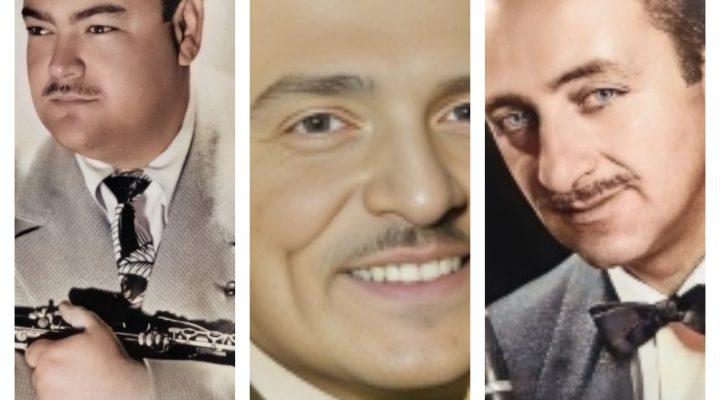
 From what I’ve gathered, it was his older brother Eddie who adopted the “Daniels” performing name first, and there was a story to that. I’ve attached an article from the Holyoke Daily Transcript and Telegram for Thursday 1Oct36 p20 that fills in many of the gaps in narrative fashion–including a mention of Armand “Fatso” Gelineau. Also attaching another article from the same paper a couple of years later (Saturday 28Jan39 p12) that echoes some of the above, but also for some reason gave Fats a nod as a drummer?? with Henry Biagini. Oh well… (These articles can be located at endnotes 3A and 3B.) He did play with Biagini’s band in ’38 and ’39–sang as well. The Biagini/Daniels connection continued when Henry took over the running of the Joe Venuti band in 1941–which included Daniels on clarinet and alto saxophone, and vocalist Kay Starr. Daniels led his own band in Florida briefly prior to going with Venuti. (Above left: Armond Clovis Gelineau, aka Fats Daniels in the mid-1940s.)
I have also so attached obits for both father Clovis and Armand “Fats Daniels” Gelineau–from the Springfield, Massachusetts Republican for Saturday 8Feb69 p19 (Clovis) and 17May96 p10 (Fats) respectively. (These can be located at endnotes 4A and 4B.)
“Fats” came by his nickname honestly. He and brother Eddie were both around 5-7, but Armand “Fats” Gelineau outweighed his older brother by around 70 lbs.
The Gelineaus (I guess properly pluraled as “Gelineaux”) were among the many Quebequois who moved to New England. Fats’s father, Clovis Leon Gelineau, was from North Adams, while grandfather, Godfroi Norbert Achille “Archie” Gelineau, was the immigrant who first settled in Massachusetts. Grandfather “Archie” did everything from selling real estate to working as an optician.
Fats’s mother, the former Rose Blanche Gelineau (also “Gelino”), may have been a cousin of his father’s… somehow. (I could probably run that to earth.) Her brother, Delphis Gelineau, played the violin at her wedding to Clovis. Needless to say the musical genes ran high on Fats’s mother’s side. Rose also had a brother Armand, who I suspect was Armand “Fats Daniels” Gelineau’s namesake. (Thanks again David Fletcher.)
MZ NOTE: Fats Daniels joined Glen Gray and the Casa Loma Orchestra in late 1943, replacing Clarence Hutchenrider, and remained with Gray until the final tour of the Casa Lomans in 1949.

The Casa Loma band in early 1944 at the Cafe’ Rouge of Hotel Pennsylvania in Manhattan. L-R rear: Tony Briglia, Ray Grien, Gerry Brooks, Fritz Austin, Red Nichols; middle: Stan Dennis, Herb Ellis, Ottie Alburn, George Jean, Jack Pegler; front: Gil Parks, Lon Doty, Gus Jean, Fats Daniels, Bunny Bardach. The girl singer is Eugenie Baird. Not shown: pianist Lou Carter. Glen Gray is in the inset at upper left.
The music:
This arrangement on “Blue Rhapsody,” by the pioneering swing arranger Bill Challis, was designed to provide a showcase for the clarinet playing of Fats Daniels. Glen Gray found it to be particularly effective in theaters. The introduction is a brief curtain-raising ensemble fanfare, followed by a clarinet flourish that starts in the low register then moves up, with Daniels soaring off into chorus one. (This is a twelve bar blues format.) The first chorus has Daniels swinging away, backed by undulating saxophones and solid rhythm. The second sequence is enlivened by brass bursts.
 The juxtaposition of a clarinet and tom-toms was a popular feature during the swing era because audiences loved the contrast between the high-register sound of the clarinet and the lower sounds and rhythms of the drums. If the clarinetist involved was a virtuoso, as Mr. Daniels clearly was, musical fireworks often ensued. His duet with drummer Bob Varney here continues through three choruses, with Fats spending a good bit of time meandering delightfully through his juicy low register, then ascending as he is rejoined by the band.
The final choruses start with the robust and rhythmic saxophone quintet (Teddy Lee on baritone prominent) behind Daniels, then the trombones join in, and finally, the trumpets as the music builds to a powerful climax, with Daniels on top.
Bill Challis, who knew George Gershwin and worked with Paul Whiteman, was later asked if “Blue Rhapsody” was inspired by “Rhapsody in Blue.” Here is what he said: “I don’t recall thinking about Gershwin (and “Rhapsody in Blue”), but maybe it was in the back of my mind. I was with Whiteman for three years in the late 1920s, and I heard “Rhapsody in Blue” nightly, of course.”(5)
“Blue Rhapsody”
Composed by Bill Challis and Paul Rickey; arranged by Bill Challis.
Recorded by Glen Gray and the Casa Loma Orchestra for Capitol on August 15, 1959 in Hollywood.
Glen Gray, directing: Conrad Gozzo, first trumpet; Clarence F. “Shorty” Sherock, Walter “Pete” Candoli, Uan Rasey and Mannie Klein, trumpets; Simon H. “Si” Zentner, first trombone; Milt Bernhart, Francis “Joe” Howard, Pullman “Tommy” Pederson, tenor trombones; George Roberts, bass trombone; Arthur “Skeets” Herfurt, first alto saxophone; Wilbur Schwartz, alto saxophone; Irving “Babe” Russin and Plas Johnson, tenor saxophones; Chuck Gentry, baritone saxophone; Ray Sherman, piano; George Van Eps, guitar; Meyer “Mike” Rubin, bass; Nick Fatool, drums. Clarinet soloist: Arcuiso “Gus” Bivona.
The music:
This performance of “Blue Rhapsody,” in high-fidelity stereophonic sound, is rendered by the band of heavyweight Hollywood studio musicians that Glen Gray used when he made the Capitol recordings of swing era hits and classics. The ensemble is large and muscular, yet remarkably nimble. These musicians all understood swing, and made it happen. The clarinet solo is handled expertly by Gus Bivona, whose swing era credentials included associations with Bunny Berigan, Benny Goodman and Tommy Dorsey. Bivona, like many other swing era sidemen, located permanently to Los Angeles in the late 1940s, and kept very busy over the next several decades doing all kinds of studio work, including films (he was on staff at MGM for many years), television (he had a long association with Steve Allen) and recordings. He also found time to put together bands of his own and record them.
 Listeners should note that Bivona’s solo, though similar to the one Fats Daniels played on Glen Gray’s 1946 Decca recording, is slightly different, though equally compelling. The support he gets from the rhythm section of Ray Sherman, piano, George Van Eps, guitar, Mike Rubin, bass, and especially Nick Fatool on drums, is exceptional, and inspiring. This performance definitely captures the spirit of the original. (Above left: Glen Gray makes sure there is positive karma on the recording date that produced “Blue Rhapsody,” as he jokes with Gus Bivona (center) and Skeets Herfurt.)
The recordings presented with this post were digitally remastered by Mike Zirpolo.
Notes and links:
(1) There is some uncertainty about the personnel of the Casa Loma band that recorded “Blue Rhapsody” on February 14, 1946. The listing posted above comes from The Swing Era …Encore, a set of recordings issued in 1971. That set included the recording Glen Gray conducted in 1959 as a recreation of the original, but in stereophonic sound, as well as the personnel for the 1946 recording, which Gray himself may have provided in 1959.
(2) The story and music of Glen Gray and the Casa Loma Orchestra’s theme song “Smoke Rings” can be found here: https://swingandbeyond.com/2017/06/17/smoke-rings-1937-glen-gray-and-the-casa-loma-orchestra/
(3A)

(3B)

(4A)

(4B)

(5) The Swing Era – Encore (1971), notes on the music by Joseph Kastner, 58.


“Blues Rhapsody” always reminded me of certain portions of Artie Shaw’s “Concerto for Clarinet.”
Definitely. Whilst no direct quotes, the whole groove is in Artie’s space.