“Bluesette”
Composed by Jean-Baptiste “Toots” Thielemans.
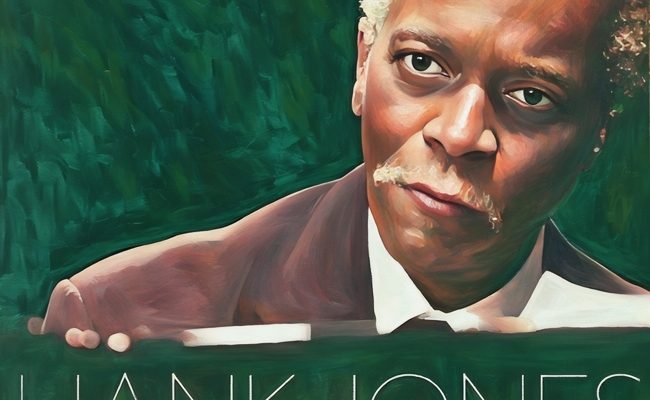
Recorded by Hank Jones on November 11, 1991 for Concord Jazz in performance at Maybeck Recital Hall in Berkeley, California.
Hank Jones, solo piano.
The story:
Henry Jones Jr. (July 31, 1918 – May 16, 2010), known to all as “Hank,” was an accomplished pianist, and a fine jazz improviser. Although he had a very successful career in music that spanned over seven decades, and played with most of the giants of jazz of the Twentieth Century at one time or another, perhaps the most celebrated performer he accompanied was not a jazz musician. Indeed, she was not even a musician. She was Marilyn Monroe, and he accompanied her for a brief medley of two songs, sung to President John F. Kennedy at an event at Madison Square Garden in Manhattan on May 19, 1962.

Here is what he had to say about that: “She did 16 bars. Eight bars of ‘Happy Birthday’ and eight bars of ‘Thanks for the Memory’. We rehearsed those 16 bars for eight hours. So I think that’s something like a half-hour for each bar of music. She was very nervous and upset. She wasn’t used to that kind of thing. And I guess who wouldn’t be nervous singing ‘Happy Birthday’ to the president (at Madison Square Garden)? She actually was a very good singer. However, on this particular occasion I think she was somewhat hampered by having imbibed rather freely. And it was very interesting.” (1)

Hank Jones (center) at a musical salon at the home of Mary Lou Williams in the late 1940s. Among the other attendees L-R: Dizzy Gillespie, Tadd Dameron and at far right, Jack Teagarden. Ms. Williams is in front.
It seems that Hank Jones possessed that magical combination of qualities as a pianist that placed him in high demand throughout his career. From the late 1940s through the late 1950s, he often worked as a free-lance musician in New York. Although he worked occasionally with Benny Goodman in those years (and after), his most notable associations then were as the accompanist for Ella Fitzgerald (1948-1953), and then as the pianist in Artie Shaw’s last Gramercy Five, from mid-1953 to mid-1954.(1A)  From 1955 to 1959, Jones was the “house pianist” for Savoy Records, and as such accompanied many different artists, as well as making a couple of his own LP records.
In 1959, he went on-staff at CBS in New York, and continued that employment on a practically full-time basis until 1975, when the major American television and radio networks basically eliminated their corps of staff musicians. By the late 1970s, Hank worked as pianist and conductor for the Broadway musical Ain’t Misbehavin’, based on the music of Fats Waller. This activity “informed informed a wider audience of his unique qualities as a musician.”(2)
 From about 1980 until shortly before his death in 2010, Hank Jones worked as a free-lance pianist in many settings, often as the leader of the groups he performed with. In addition to being a masterful musician, he was a most thoughtful and articulate man, with a subtle, ironic sense of humor. Here are some of his comments about his own playing: “When you listen to a pianist, each note should have an identity; each note should have a soul of its own. I try to play evenly. I don’t take too many excursions. I don’t go too far away from the melody, I don’t go out into the deep water. I want the listener to understand what I’m doing. I try to stay pretty much right down the middle and yet keep it interesting.”(3) The Concord Jazz label, for which Jones recorded various albums as both a leader and a sideman, adds, “Although his (jazz) sensibility was rooted in the Swing Era … he had no trouble adapting to bop’s more rigorous harmonic and rhythmic requirements, and evolved a lucid style which ingeniously synthesized swing and bop into an approach that was personal and flexible. He could play with just about anyone.”(4)
NOTE: Hank Jones had two younger brothers, Thad and Elvin, who also had successful careers as musicians.
The music:
 “Bluesette,” a jazz waltz, was composed by the Belgian jazz musician Toots Thielemans, who first recorded it in 1963. A bit later, a lyric by Norman Gimbel was added, and the song became an international hit. It has since been covered by over a hundred artists. Thielemans (1922-2016), was most widely known for playing the chromatic harmonica, in addition to guitar and whistling.
“Bluesette” is a 24-bar major blues in 3/4 meter. Harmonically, it contains descending chord progression rather than the standard I-IV-V blues sequence. Some musicians have discerned a similarity between “Bluesette” and Charlie Parker’s “Blues for Alice.”
In this performance, he plays an ascending rhythmic figure for four bars then paraphrases the melody, which is both delightful and memorable. He then glides gracefully into his improvisation, which lasts for several choruses. Toward the end of his jazz excursion, notice how he uses a cadence as a convenient place to remind the listener of the melody. Then he gradually and elegantly brings the performance to a conclusion in much the same way as it began.
This recording was digitally remastered by Mike Zirpolo.
Notes and links:
(1) “Hank Jones: Pianist whose collaborators included Miles Davis, Ella Fitzgerald–and Marilyn Monroe when she sang to JFK”. Independent.co.uk. May 19, 2010. Hereafter Independent.
(1A) Hank Jones contributed greatly to Artie Shaw’s last Gramercy Five recordings. Here are links to some examples:
https://swingandbeyond.com/2022/02/05/sposin-1954-artie-shaw-and-his-gramercy-five/
https://swingandbeyond.com/2019/02/09/my-funny-valentine-1954-artie-shaw/
(2) “Hank Jones”. AllAboutJazz.com. April 15, 2025. Retrieved May 22, 2025.
(3) Independent.
(4) “Hank Jones”. Concord.com. Concord Jazz is a record company founded in 1973 by Carl Jefferson, the former owner of Jefferson Motors Lincoln Mercury dealership in Concord, California. The label was named after that city which is located in the East San Francisco Bay area. Concord Jazz is now owned by Alchemy Copyrights, LLC, doing business as Concord, is an independent American entertainment company.
For an example of Hank Jones doing a bit of free-lance studio work, check out this link: https://swingandbeyond.com/2017/11/17/u-m-m-g-1960-music-of-billy-strayhorn-dizzy-gillespie-with-clare-fischer/
Here is a link to a lengthy piece written by the late Gene Lees about Hank Jones that has recently been made available at CerraJazz Substack:
https://cerra.substack.com/p/hank-jones-one-of-the-jones-boys


Be the first to comment