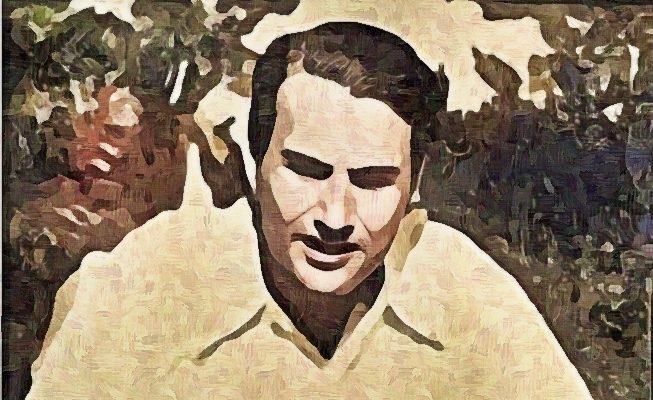
“Monsoon”
Composed and arranged by Art Shaw.
Recorded by Art Shaw and His New Music for Thesaurus Transcription Service on December 15, 1937 in New York.
Art Shaw, clarinet, directing: Norman Ayers, first trumpet; Chuck Peterson and Max Kaminsky, trumpets; George Arus and Harry Rodgers, trombones; Les Robinson, first alto saxophone; Hank Freeman, alto saxophone; Fred Petry and Tony Pastor, tenor saxophones; Les Burness, piano; Al Avola, guitar; Ben Ginsberg, bass; Cliff Leeman, drums.
The story:
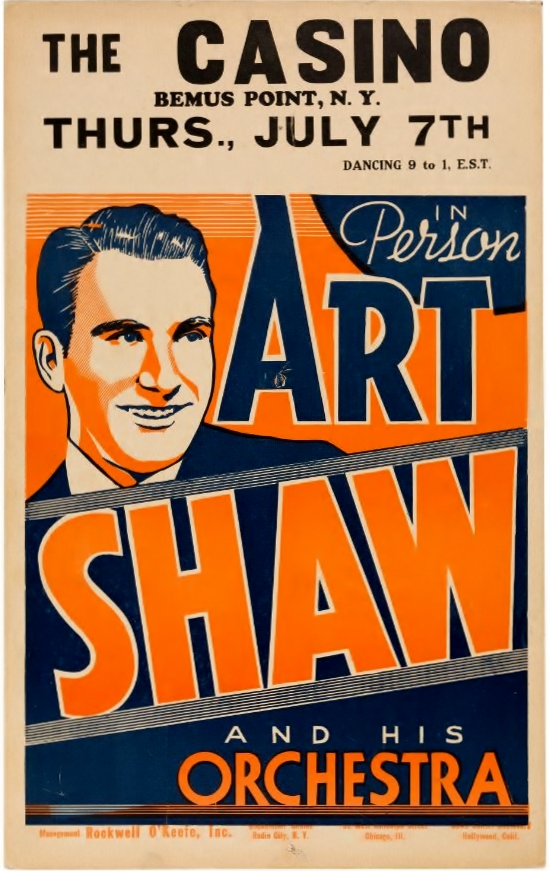 Artie Shaw became a bandleader somewhat reluctantly in the summer of 1936. He was ambivalent about the whole business of being a bandleader. On the one hand, he had become one of the most successful free-lance musicians in New York by 1936, with near virtuoso levels of skill on both clarinet and alto saxophone. But he was deeply bored and resentful of what he had to do with those skills in the radio and recording studios of Manhattan to be successful. Basically, he had to play a lot of bad music within stopwatch time parameters every day, often for many hours. As much as anything, what drove Shaw to lead his own band was his desire to govern at least to some degree the music he would be performing. This led him to create not an orthodox saxophones-brass-rhythm swing band, but rather an unorthodox jazz-oriented dance band built around a string quartet.
Shaw also very much liked the part of bandleading that allowed him to shape the music that his band would be playing. He relished collaborating with the arrangers who worked with him, and exercised an uncommon amount of editorial control over the music they wrote. Although Shaw, like a number of other bandleaders including Duke Ellington and Glenn Miller, was able to arrange, he was never noted as an arranger. Nevertheless, in his early years as a bandleader, he could and did on occasion write an arrangement and composition from scratch. “Monsoon” is one such, and it is a fine example of Shaw’s talent in those areas.
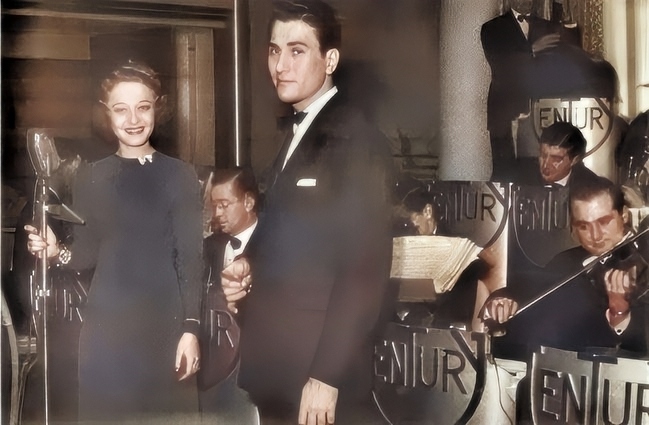
Art Shaw with his string quartet band – late 1936. The girl vocalist is Peg La Centra; behind Shaw are two musicians who would be very important to his band over the next couple of years – violinist Jerry Gray, who would soon emerge as one of the best arrangers of the swing era, and tenor saxophonist Tony Pastor, who would enliven many Shaw performances with his singing.
Shaw’s string quartet band existed from the summer of 1936 to early March 1937, when he was forced to disband it because it had been commercially unsuccessful. In the month of March 1937, he assembled another band, this one a more conventional swing era ensemble, its instrumentation being three trumpets, two trombones, four saxophones, piano, bass, guitar, and drums, to support his featured clarinet and a girl singer. Over the next seventeen months, this band evolved into the band that broke through to large commercial success as a result of their recording of “Begin the Beguine” that was made for Victor/Bluebird on July 24, 1938. This transitional band, billed as Art Shaw and His New Music, started out as a fairly rough-hewn ensemble, but with Shaw’s inspired rehearsal techniques and almost non-stop performing before dancers, grew into one of the most polished and swinging bands of the late 1930s.
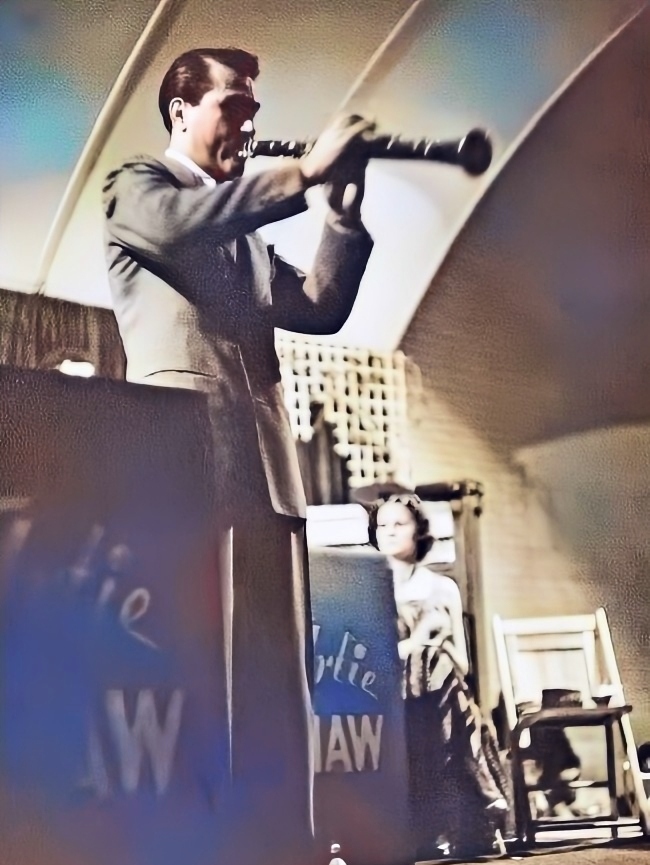 Art Shaw and His New Music worked through the balance of 1937, but despite whatever Shaw, his bandsmen and his management team tried to achieve, nothing greater than marginal success in the dance band marketplace actually happened for them. In the commercial sense, the band seemed to be running in place. But at the same time, in the musical sense, the band was slowly and continuously improving. Shaw’s clarinet-playing also was advancing, moving toward a personal sound and a recognizable style. (He changed instruments several times during this time period.)
By the end of 1937, spurred by his perception that his band was not as successful as he thought it should be, Artie began a process of highly critical self-evaluation of his efforts as a bandleader. He was as committed as possible to being a successful bandleader, and was now examining each and every aspect of that to determine, if possible, what he was doing that was working successfully, and what he was doing that wasn’t working successfully.
He first decided that he was dissatisfied with his relationship with Brunswick Records, which stretched back to his earliest days as a bandleader, in June of 1936. He opted not to renew his contract with Brunswick. That company did not terminate him, he terminated them, despite the fact that the records he made for them were steady if not spectacular sellers. It is not clear if any steps were taken by his management team to sign him with another label at that time. I suspect not because both Artie and his handlers were aware that they had very little bargaining power as 1937 ended. His band was musically good, his clarinet playing was excellent, but not much more than that was happening in the Shaw band then. Artie (then still Art) and his managers resolved to continue to build the band musically, and see what would happen. That process eventually stretched over a period of six and a half months, to mid-July 1938, when the Shaw band had reached a point where it was undeniably a potent musical force. It was at that point that Artie signed with the Bluebird subsidiary of Victor Records. At that same time, Victor/Bluebird had embarked on a program to sign several promising swing bands to record for Bluebird. Other bands they snagged then were Larry Clinton’s, Les Brown’s, Erskine Hawkins’s and Glenn Miller’s. Victor’s summer 1938 swing band initiative would soon yield huge financial dividends. After two years of being at the wrong place at the wrong time with the wrong music, by July of 1938, Artie Shaw was at the right place at the right time with the right music.
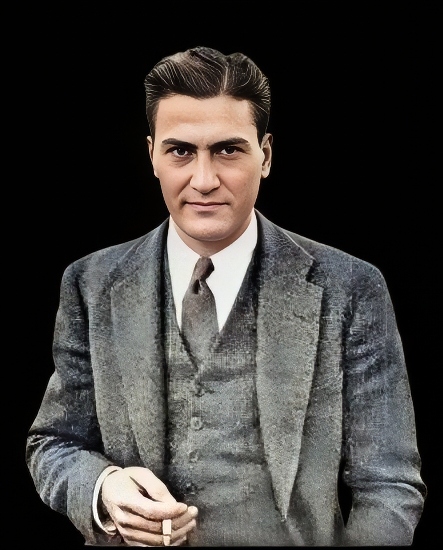 The second decision he made was to correct an earlier mistake that had been made on the business side of his band’s operation. Sometime in 1937, Shaw terminated his relationship with band booking agency Rockwell-O’Keefe/General Amusement Corporation (GAC), and signed with Music Corporation of America (MCA). His thinking was that under the direction of GAC, he and his string quartet band had failed, and things were not progressing much better with his New Music band. MCA, after all, was the largest and most powerful booking agency in the business. Unfortunately, Shaw apparently did not consider that MCA represented the by then very successful clarinetist Benny Goodman, and that the agency was not going to do anything that might undermine the success of Goodman. Thus, Shaw’s success with MCA would always be governed by what the agency was doing with Benny Goodman – it was a zero-sum situation where Shaw’s gains would be regarded by Goodman and MCA as Benny’s losses. This was untenable for Art. He returned, as a prodigal son, to GAC in February of 1938.(1)
Here is how Shaw later described what was going on in him as a person then: “I was a wild man, a crazy man …all I knew was that I had started something and I wasn’t going to quit until I’d either licked it or it licked me. It was one long battle, one big rat race – with me as the head rat. And talk about tension – at about that time I began to develop a little thing called migraine. But even that didn’t matter too much. I learned to depend on aspirin – and later, when that got too weak to do the job, I began to keep large bottles of Empirin compound with codeine in my clarinet case, right where I could get it…”(2) Great success always comes at a price. In 1937 and 1938, Art Shaw was beginning to pay that price. (Above right: crazy man Art Shaw in early 1938.)
The final major decision Artie and his handlers made was to hire the exciting singer Billie Holiday in March of 1938. This decision would eventually have a very salutary effect on the Shaw band’s music and presentation to audiences.
 The music:
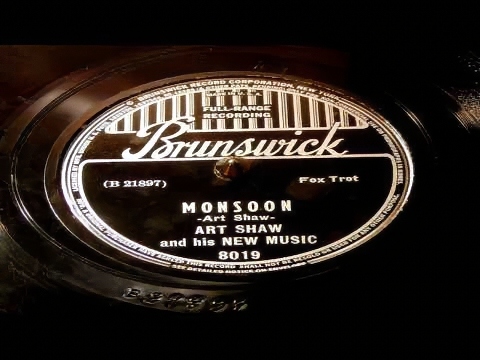
On October 18, 1937 Art Shaw and His New Music made some commercial records for Brunswick. One of the tunes recorded that day was “Monsoon,” which was composed by Shaw. The original title for this composition was “Triads.” (Both Les Robinson and John Best told me in the 1980s that this tune was known as “Gonads” in the Shaw band.) Although it has been suggested that the arrangement on “Monsoon” was written by Russell Brown, a trombonist who played in Shaw’s band in 1938 for a few months (and who also worked on rare occasions as an arranger, but mainly as a copyist for Shaw in 1937-1938), I am skeptical of that. “Monsoon” is cast in the mold of one of Shaw’s most memorable and strikingly original compositions and arrangements—“Nightmare,” which Shaw used throughout his career as a bandleader as his theme song, and which of course was arranged by Shaw himself. I think that absent compelling evidence to the contrary, it can be assumed that Art Shaw arranged “Monsoon.” It is possible however that Russell Brown copied Shaw’s score, extracting the parts for the various instruments in the Shaw band.
The Brunswick recording is quite good, except for a few fluffed notes in the trumpet parts that I’m sure annoyed Art. He nevertheless allowed the performance to be issued, and moved on. But being who he was, he did not miss the opportunity to record “Monsoon” again, a few months later, for the Thesaurus Transcription Service. That performance, which is presented with this post, is once again excellent, and has no noticeable blemishes.
It begins with a quiet piano introduction played by Les Burness, undergirded by drummer Cliff Leeman’s soft tom-tom beat.
 The first chorus contains the musical features that characterize this unusual work: cup-muted trumpets played against a background of moaning, low saxophones and open trombones playing pedal notes, creating something of an ostinato drone, supported by beat provided by the entire rhythm section (8 bars). Shaw’s glowing clarinet sound suddenly and dramatically pierces this dark sonority with the secondary melody. This is a very effective musical contrast. Art then plays a solo in the high register of his instrument (16 bars), swathed in warm saxophone section and low open trombone sounds. The muted trumpets return for another eight bars as before to complete the first chorus.
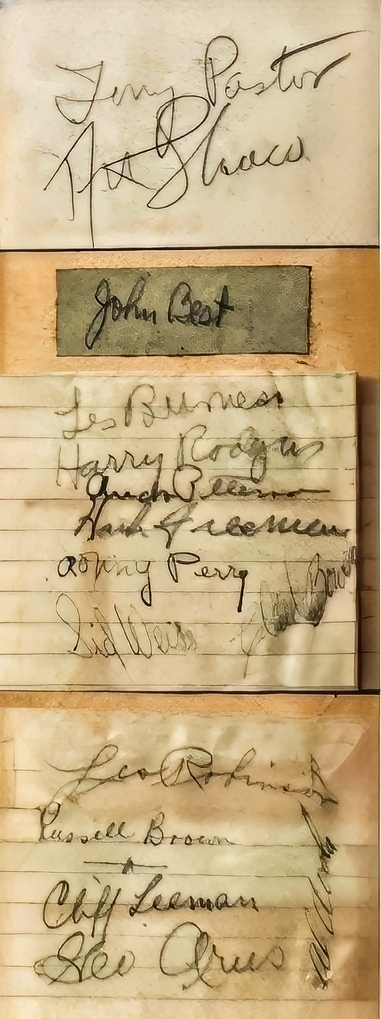
The second chorus contains a new sound, that of the four saxophones harmonized with the main melody, alternating with the cup-muted trumpets. This rests on a base provided by the low, open trombones and rhythm continuing the ostinato. Another contrast occurs when Shaw leads the saxophones with his clarinet in robust fashion. Art had made his reputation in the early and mid 1930s as a lead alto saxophonist, and his orientation in that direction came out brilliantly whenever he chose to lead his various saxophone sections with his clarinet. (Above right: a collection of autographs from the member of Art Shaw’s band in the spring of 1938, a few months after the recording presented here was made.)
The trumpets, now open, appear, followed by the saxophone quartet, led with distinction by 23-year old Les Robinson who, under Shaw’s tutelage, was rapidly developing into one of the premier lead alto players of the swing era. The open trombone ostinato continues through this sequence. Shaw reenters the music playing a perfect upward glissando followed by a passionate solo during which he is backed at first by open brass then the saxophones.
The final tract has the band returning to the opening cup-muted trumpets atop the saxophone/trombone drone.
This is a masterful composition/arrangement by Art Shaw, indeed one of the best he ever produced, in a class with “Nightmare.” But for whatever reasons, it disappeared, regrettably, from the Shaw presentation in early 1938.
The recording presented in this post was digitally remastered by Mike Zirpolo.
Notes and links:
(1) Artie Shaw …A Musical Biography and Discography (2000), by Vladimir Simosko, 56.
(2) The Trouble With Cinderella (1952), by Artie Shaw, 333.
Here are some links to other great early performances by Artie Shaw’s band:
https://swingandbeyond.com/2024/11/06/one-song-1937-artie-shaw-with-nita-bradley/
https://swingandbeyond.com/2020/09/19/any-old-time-1938-artie-shaw-and-billie-holiday/
https://swingandbeyond.com/2019/06/13/i-surrender-dear-1937-and-1939-artie-shaw/
And finally, a link to the most famous of all Artie Shaw recordings:
https://swingandbeyond.com/2016/09/05/begin-the-beguine-1938-artie-shaw/

Art Shaw was in the very best way “a loose cannon”, both musically and personally. His creative character has always fascinated me. That drive towards the elusive goal of artistic fulfilment always led to yet another path, sometimes commercially driven, often personally, and many times misunderstood.
Who else could have written a theme for his own band, which could equally have served as a harrowing soundtrack to a documentary about the still-to- happen Holocaust?
I would have cherished the opportunity to work with him, as a feel I could have understood him.
But for that same reason, we’d probably have struck sparks off each other.
Great Song choice today, loved it. These songs always bring back memories of my father, thank you.