“Rhapsody in Blue”
Composed by George Gershwin; arranged by Bill Finegan.
Recorded in 1958 by Bobby Byrne and His Orchestra for Grand Award in New York.
Bobby Byrne, trombone, directing: R.D. “Mickey” McMickle, Steve Lipkins, Bernie Privin and Bobby Hackett, trumpets; Frank D’Annolfo, Al Mastren and Harry DeVito, trombones; Hank Freeman, alto saxophone; Michael “Peanuts” Hucko, clarinet; Al Klink and Gordon “Tex” Beneke, tenor saxophones; Manny Thaler, baritone saxophone; Lou Stein, piano; Carmine “Carmen” Mastren, guitar; Herman “Trigger” Alpert, bass; Maurice “Moe” Purtill, drums.
The story:
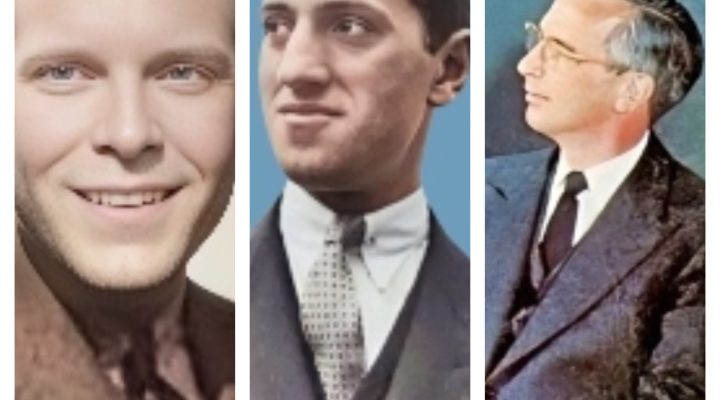
 Bobby Byrne (1918-2006) was a fine trombonist. He began his professional career at age 17 by replacing Tommy Dorsey in the Dorsey Brothers Orchestra in mid-1935. Being a professional trombonist in the world of swing in the late 1930s and through the 1940s, Bobby Byrne was immersed not only in his own playing, but in that of Tommy Dorsey as well. Tommy’s music was ubiquitous then, and all trombonists, consciously or unconsciously, were affected and influenced by it. Indeed, musicians who worked outside of the world of swing, like the famous conductor Arturo Toscanini, were drawn to Tommy’s playing because it was so excellent. Even though Bobby Byrne enjoyed a very positive relationship with Tommy from 1935 until TD’s premature death in 1956, Tommy’s trombone virtuosity became a bugaboo for Byrne. Try as he might, he never could play as well as Tommy Dorsey. This bothered Bobby (and many other trombonists). (At right: bandleader Bobby Byrne in the early 1940s.)
After Tommy departed the Dorsey Brothers Orchestra, that band was known as Jimmy Dorsey and His Orchestra, and it was very successful through the late 1930s and well into the 1940s. Byrne remained with Jimmy into 1940, then struck out on his own as a bandleader, with help from JD. The Byrne band was good, and Bobby’s trombone playing was good, but Bobby, still only in his early twenties, pushed himself ever-harder to become a great trombone player and bandleader – like Tommy Dorsey. He also drove his sidemen hard to get the kind of musical results Jimmy Dorsey got without driving his sideman. But here again, Bobby was channeling Tommy Dorsey who could on occasion drive his sidemen quite hard. The Byrne band had enough success to keep operating into the early part of World War II. Bobby struggled to keep his band going then, constantly needing to replace band members lost to the military draft. In 1943, while touring Florida, he gave up and joined the Army Air Corps. His band continued for a time under the leadership of trombone virtuoso Jack Jenney.
 Byrne returned to civilian life in late 1945, and began working as a free-lance musician in New York. He also dabbled in leading big bands intermittently through the late 1940s, and seemingly had come to terms with who he was as a musician. Tommy Dorsey, it now seemed, was no longer living rent-free in Bobby’s mind. Consequently both he and his bands were much more relaxed. Nevertheless, by the early 1950s, Byrne was no longer leading a touring band – he was deeply involved in working in the recording studios and in the new mass medium, television, in New York. (At left: Bobby Byrne in the 1950s as a busy Manhattan studio musician.)
By the mid-1950s, Bobby began a business and musical relationship with bandleader/record producer and entrepreneur Enoch Light. Light began operating his own record label in 1955, calling it Grand Award records. At first, Byrne acted as a bandleader/producer for Grand Award, and a number of big band tribute albums in the then new stereophonic sound format resulted.  Light founded Command Records a bit later, and immersed himself in experiments with stereophonic recorded sound. Byrne remained associated with Light, but began moving away from performing and conducting on recording sessions. By the early 1960s, Bobby was basically a producer of recordings, along with his mentor, Enoch Light. (Enoch Light is shown at right in the 1960s.) They remained together at Command Records until the mid-1960s, even though Command had been purchased by ABC-Paramount in October of 1959. After leaving Command, Light founded yet another record label, Project 3 (his third record label), and operated that enterprise successfully for several years. Byrne then began working in other areas of show business apart from Light, and eventually moved to Los Angeles. He died in Irvine, California on November 25, 2006, which coincidentally was fifty years and one day after Tommy Dorsey’s death.(1)
The music – part one – Glenn Miller’s Victor recording.
Anyone familiar with the music of the swing era is aware of Glenn Miller’s July 16, 1942 recording of Bill Finegan’s arrangement of George Gershwin’s “Rhapsody in Blue.” (A link to the story and music about that can be accessed at endnote 2.) That recording is justly famous because of Finegan’s great arrangement, and the excellent performance of it by the Miller band. But what is interesting is that what was recorded by the Miller band was actually a cut-down version of Bill Finegan’s arrangement. In essence, the lengthy introductory portion Finegan wrote was edited-out by Glenn Miller. Why this was done has been the subject of some speculation.
 Let’s start with some facts: 1) The complete Bill Finegan arrangement of “Rhapsody in Blue,” which is heard in the performance by Bobby Byrne presented in this post, runs three minutes and forty-five seconds; 2) A live recording of the almost complete arrangement was made by the Miller band the day before the Victor recording. That recording has about 15 seconds of Finegan’s introduction removed, and it runs three minutes and twenty-three seconds. 3) The Miller-Victor recording runs three minutes and one second. So it appears that Glenn Miller cut approximately forty-five seconds of introductory music from Bill Finegan’s arrangement when he made the famous Victor recording. More facts may yield an explanation as to why he did this.
To say that Glenn Miller was busy at the time he recorded “Rhapsody in Blue” would be an understatement. He and his band were nearing the end of a ten-day engagement in the Panther Room of Hotel Sherman in Chicago. In addition, they broadcast their thrice-weekly Chesterfield radio show from that venue on Tuesday, Wednesday and Thursday nights.
Also, they had been notified that an impending musicians’ union strike against the three major record companies, Victor, Columbia and Decca, would be starting at midnight on August 1, 1942. Consequently, they would not be able to make any commercial recordings after that date for an indefinite time. As a result, Victor was pressing Miller to record as many sides as possible while he was in Chicago to create a stockpile of new recordings that could be released periodically during the strike. The Miller band recorded four sides on July 14, four more on July 15, and finally five more on July 16. “Rhapsody in Blue” was the very last side recorded by the Miller band on July 16, 1942. I think it reasonable to assume that Glenn Miller was a very tired man by the time that recording was made.
 Miller was then also in the midst of trying to create an exit strategy for himself from his career as a civilian bandleader. He had applied to join the U.S. Navy, but his application would soon be denied.(3) He then began sending out feelers to the U.S. Army. By early September, the Army appointed him as a captain. From that date, he began wrapping-up his business as a civilian bandleader.(4)
My informed speculation against this background of facts is that Glenn Miller cut-out approximately forty-five seconds of Bill Finegan’s introduction in his arrangement of “Rhapsody in Blue” primarily because in that tract of music there was a solo trombone part that Glenn didn’t want to contend with when he was very tired at the end of a lengthy recording session. Of secondary consideration was that he didn’t want to have to tinker with the arrangement to get it to fit comfortably on a ten-inch 78 rpm Victor disk. The cuts he made ensured that the timing of the recording would not be a problem, and he wouldn’t have to play a high-register solo on his trombone. (Above right: a tired looking Glenn Miller.)
The music – part two – Bill Finegan.
Bill Finegan was hired by Glenn Miller in early 1939, and remained a part of the Miller band until Glenn’s last performance with his civilian band, which was on September 27, 1942, at the Central Theater in Passaic, New Jersey. After that, Finegan joined the musical aggregation of Horace Heidt, writing “some pieces for the band that immediately sent its musical stock skyward.”(5) Finegan began a highly successful musical collaboration with Tommy Dorsey in the mid-1940s which lasted through that decade and into the 1950s.
 In 1947-48 Finegan studied with Stefan Wolpe in New York City, then lived in Europe from 1948-1950, where he studied with Darius Milhaud and Valerie Souderes, a pianist and composer who premiered Bela Bartók’s Third Piano Concerto, in Paris. After returning to the United States in 1952, Finegan and master arranger Eddie Sauter, whom Finegan had met in 1939, formed an ensemble called the Sauter-Finegan Orchestra, which initially was used by RCA-Victor Records to record adventurous music that would utilize and demonstrate the rapidly developing high-fidelity recording techniques that were available through the mid-1950s. That orchestra, which toured sporadically in the mid-1950s, remained active until 1957.(6) Finegan’s arrangement of “Doodletown Fifers” was one of the Sauter-Finegan Orchestra’s most popular originals. (At left: Bill Finegan in the 1950s.)
Following this collaboration, Finegan found work in the advertising industry, writing music for television and radio commercials. From the 1960s through 1980s, his arrangements, both old and newly-created, were played by many big bands, including those of Les and Larry Elgart, Gerry Mulligan, and Mel Lewis. He taught at the University of Bridgeport (Connecticut) in the 1980s. He wrote arrangements for jazz cornetist Warren Vache’ (with the Scottish String Ensemble) in 2004, and the vocal group Chanticleer until shortly before his death in 2008. Over the years a number of vocalists, including Carole Sloane and Judy Holliday (with Gerry Mulligan), commissioned arrangements from him. (A link to Carole Sloan’s recording of Finegan’s arrangement on “Deep Purple” can be accessed at endnote 7.)
Finegan made sure to retain in his files the scores for his arrangements, and found that through the years, many bandleaders would purchase from him copies of these for recording and other purposes. One such bandleader was Bobby Byrne, who in 1958 was delighted to learn that Finegan had the original, uncut score for the arrangement on “Rhapsody in Blue” that he had written for Glenn Miller.
The music – part three – the uncut version.
 In Bobby Byrne’s recording of Bill Finegan’s arrangement on “Rhapsody in Blue,” we hear the entire introduction, which has a “curtain-going-up” theatricality about it. The sequence that features the saxophone quintet contains a lead alto part that Finegan wrote for Skip Martin, the lead alto in the Miller band in 1942, whose robust, singing sound was one of many attractive features of that band. Here, that part is played masterfully by Hank Freeman, who played lead alto in Miller’s Army Air Force band. This introduction also contains the high-register trombone solo that Miller backed away from in his 1942 recording, which is handled with aplomb by Bobby Byrne.
The open trumpet solo, which Finegan wrote for cornetist Bobby Hackett in the Miller recording, and the later muted trumpet solo, were probably played played by Bernie Privin in this performance. And the tenor saxophone solos, played by Tex Beneke originally, are played here by Al Klink.
The recording presented with this post was digitally remastered by Mike Zirpolo.
Notes and links:
(1) Information about the careers of Bobby Byrne and Enoch Light was extracted from the Wikipedia posts on them.
(2) Here is a link to the story and music of Glenn Miller’s recording of “Rhapsody in Blue”: https://swingandbeyond.com/2024/10/30/rhapsody-in-blue-1942-glenn-miller-bill-finegan-with-bobby-hackett-tex-beneke-and-john-best-henry-mancini-1963-with-jimmy-rowles-and-ted-nash/
(3) Glenn Miller Declassified by Dennis M. Spragg (2017), 27. Hereafter Spragg.
(4) Spragg, 31-34.
(5) The Big Bands by George T. Simon (1967), 241.
(6) Finegan led a reconstructed Sauter-Finegan orchestra for a series of recordings on the United Artists label in June of 1961. Information about the career of Bill Finegan was extracted from Wikipedia, then expanded upon by Mike Zirpolo.
(7) Here is a link that contains Carole Sloane’s recording of Bill Finegan’s arrangement of “Deep Purple”: https://swingandbeyond.com/2017/11/10/in-finegans-wake-a-salute-to-master-arranger-bill-finegan-part-1/


Since Bobby Hackett played on that recording date, is there a known reason as to why Bernie Privin would have assigned to play a solo that he made famous? In other words, are you sure Hackett is not playing at least the open solo?
Good question Michael. I asked myself that same question. Bobby Hackett had one of the most easily identifiable sounds in jazz. That trumpet solo is definitely not Bobby simply based on how it sounds. I don’t know why the producers of that recording would have hired Hackett if not to play that solo. But apparently they did. I could speculate that since that solo was in fact written by Bill Finegan for Bobby in 1942, that Hackett didn’t want to play it as written again for the umteenth time. But again, why was he hired? I welcome further information and insights.
It seems to me that on the same album Hackett plays the trumpet (cornet?) solo on “String of Pearls.” Do you agree?
I agree. Maybe that was the only assignment Hackett got. He was always a very busy guy.