“Honeysuckle Rose”
Composed by Thomas “Fats” Waller; arranged by Fletcher Henderson.
Recorded by Benny Goodman and His Orchestra for Columbia on November 22, 1939 in New York.
Benny Goodman, clarinet, directing: Ziggy Elman, first and solo trumpet; Jimmy Maxwell and Johnny Martel, trumpets; Sterling “Red” Ballard, Vernon Brown and Ted Vesely, trombones; Nuncio “Toots” Mondello, first alto saxophone; Buford “Buff” Estes, alto saxophone; Clarence “Bus” Bassey and Jerry Jerome, tenor saxophones; Fletcher Henderson, piano; Charlie Christian, electric guitar; Arthur Bernstein, bass; Nick Fatool, drums.
The story:
 “Honeysuckle Rose” was introduced in the 1929 off-Broadway revue Load of Coal, which was staged at Connie’s Inn, a Harlem night club (1), as a soft-shoe number. The song would be recorded more than 500 times by artists including Fats Waller (who composed its music), the Dorsey Brothers, Count Basie, Coleman Hawkins, Earl Hines, Louis Armstrong, Benny Goodman, Lena Horne, Nat “King” Cole, and others. Fats Waller’s own 1934 Victor recording was inducted in the Grammy Hall of Fame in 1999.(2) (At right: the inimitable Fats Waller.)
Andy Razaf, who composed its lyric, was the son of a Malagasy Duke and the daughter of an American consul. His father was killed during the French war that colonized Madagascar. His mother returned to the United States, where Andy was born in 1895. He grew up in Harlem and quit school at age sixteen to work as an elevator operator in Tin Pan Alley in Manhattan so he could peddle the songs he was writing.
His mother remarried and moved to Asbury Park, New Jersey. As Jennie Coles, she and her husband moved into 119 Atkins Avenue soon after the building was built in 1927. The downstairs served as a tea room while the Coles rented one of the two apartments located upstairs.
The two-story house at 119 Atkins Avenue, Asbury Park played an important role in the careers of two young men who became famous American songwriters. It was there, in December 1928, that Fats Waller and Andy Razaf wrote the great jazz era song “Honeysuckle Rose.”

The interior of Connie’s Inn – late 1920s.
Andy Razaf, still living in Harlem at that time, was collaborating with Fats Waller, who was already by then an acclaimed stride pianist, singer/entertainer, and budding songwriter. They were hired to write four songs for the upcoming Connie’s Inn musical revue, Load Of Coal. Knowing that Waller was easily distracted by Harlem’s nightlife, Razaf insisted they write the songs at his mother’s home in Asbury Park.
Razaf rented a piano and had it delivered to 119 Atkins Avenue. There, he and Waller wrote “My Fate Is In Your Hands” and “Zonky.” Waller created a melody for a third number, and Razaf came up with the line: Every bumblebee, fills with jealousy, when they see you out with me…, but had trouble getting any further. Waller insisted he needed to get back to Harlem and headed for the train, while Razaf worked-out a bit more of the lyric: …I don’t blame them, goodness knows, Honeysuckle Rose.
The building at 119 Atkins still stands, looking much as it did in the late 1920s, with some less than attractive updates, however.(3)

The song was taken up by jazz musicians immediately because it has chord changes that invite improvisation. But recordings of it were few in the period from 1929 through 1933 because of the ever-deepening economic depression that was gripping the United States and negatively impacting record sales. Fletcher Henderson first recorded “Honeysuckle Rose” with his band on December 9, 1932. The arrangement he later brought to Benny Goodman, which is substantially the same as the one that Benny recorded with his band some five years later, came into the repertoire of the BG band probably in late 1934. Benny played it a lot during those five years, and broadcast it often. But for whatever reasons, he didn’t record it until late November 1939. (An early performance of “Honeysuckle Rose” by Benny Goodman’s band on January 5, 1935, including great jazz solos by BG and Bunny Berigan, can be accessed via the link at endnote 4.)
The music:
 Benny’s musical collaboration with Fletcher Henderson began in late 1934, after Henderson’s own band broke up. As fate would have it, at that very same time, Goodman was suddenly in need of arrangements that would swing so that he could show off his prowess as a jazz improviser, and move his band slowly along in the early months of 1935 toward a more swinging presentation. Fletcher was there with some old charts his band had been playing, and with plenty of time on his hands to write new arrangements for BG.
It is clear that the arrangement on “Honeysuckle Rose” that the Goodman band broadcast on January 5, 1935 is different from the one Henderson had recorded a little over two years before, which was an incomplete prototype of the arrangement he later brought to BG. Although both arrangements have plenty of room in them for jazz solos, the 1935 arrangement reflects some new development, especially in the first chorus, where we hear some of Fletcher’s patented antiphonal writing, with the reeds and brass playing call-and-response. From this first “live” recording of “Honeysuckle Rose” by Benny Goodman’s band until Benny finally recorded it for Columbia was nearly five years, almost an eternity in terms of the life span for an actively performed arrangement in the BG book. Benny played this chart many times during that five-year period, possibly hundreds of times. Several other live recordings of it during that time span also exist.
 At its most elemental level, this arrangement is a framework for jazz solos. Although many great musicians had played jazz solos on it with Benny from 1935 to late 1939, it seems that the arrival of guitarist Charlie Christian in the Goodman Sextet in August of 1939 provided Benny with the stimulus to give Christian and his electric guitar an opportunity to shine with the full Goodman band. As a result, we have this wonderful big band showcase for a characteristically brilliant Christian jazz solo, plus some inspired playing by Benny himself, and a stirring solo by trumpeter Ziggy Elman. (Note: The personnel listing on the Columbia 78rpm disk for the recording session that produced “Honeysuckle Rose” is inaccurate in that trumpeter Corky Cornelius had been replaced by Jimmy Maxwell in late August of 1939. That listing also erroneously omits the name of trombonist Ted Vesely.) (At left: pioneering electric guitar jazz soloist Charlie Christian.)
This performance begins with a four bar introduction played by the ensemble. Immediately identifiable are Ziggy Elman on first trumpet, and Toots Mondello on first alto saxophone. The tempo Benny set is absolutely perfect for the musical fireworks that follow.
 The first chorus has the saxophone quartet playing the main melody with brass emphases behind at first, then with the brass section augmenting the reed sound. The bridge has the dynamic Mondello-led saxophones playing the melody, against rhythmic brass chirps. The saxophones then finish the chorus. (At right: Benny Goodman and Toots Mondello in 1939. Benny respected Toots and liked his aggressive, powerful lead alto saxophone playing. Toots was also a fine soloist.)
A brief, bright ensemble blast opens the way for Benny’s clarinet improvisation, which is excellent. Notice the backgrounds Henderson created for BG to play against: swirling saxophones, oo-ah brass, then ever-intensifying reeds, finally rhythmic ensemble riffs. This is colorful swing band ensemble writing at its best, framing a virtuoso jazz solo.
Charlie Christian begins his improvisation immediately after Goodman’s solo is over. Christian’s sound is an effective contrast to what came before, and he moves through his solo with utter relaxation, yet terrific rhythmic momentum, that is to say, swing. This Christian solo is a great example of him channeling the rhythmic approach of tenor saxophone giant Lester Young through his electric guitar, in a perfect blend with his own harmonic ideas. Again, notice the Hendersonian backgrounds Christian plays against: low, humming reeds at first (16 bars), then higher, flowing saxophone sounds, finally sparse low-register reed figures.
 It is difficult for people now to really comprehend how revolutionary the playing of Charlie Christian was in 1939. Musicians of course, then and forever after, have and will analyze the musical content of what Christian was doing then. But the general public then was much more deeply affected by the utter newness of the sound of what Charlie was doing, and his irresistible swing. That is what caused and continues to cause young musicians to gravitate to the electric guitar, both as performers and as fans. To use an analogy, Charlie Christian was at the source of the river of guitar music that began flowing in 1939 as a rivulet, first in his native Oklahoma, then with Benny Goodman via his network radio show the Camel Caravan and his Goodman Sextet and a few BG big band recordings. By the time Christian left Goodman two years later, the rivulet had grown to a substantial river with a swift current. In the decades since, that river of electric guitar music has grown to a Niagara Falls. Indeed, the ubiquity of the electric guitar has changed popular music immensely and permanently. (At left: Charlie Christian and Benny Goodman, probably in late 1939 or early 1940.)
 Trumpeter Ziggy Elman, with a cup-mute in his horn, swaggers through a half-chorus, blowing effectively over an intensely rhythmic background of open brass and brief saxophone bursts. BG returns for another eight bars of splendid jazz, against a now humming, smooth saxophone cushion, yet another sonic and rhythmic contrast.
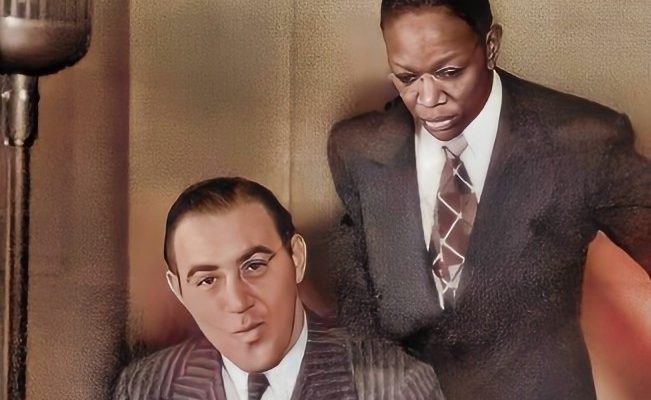
Ziggy Elman’s playing, both on his solo and as the first trumpeter in this performance, reveals that he was playing marvelously well in both of those capacities in 1939. After the departure of Harry James from the Goodman band in early January of 1939, Ziggy’s role in the band became substantially larger, in that he became BG’s featured trumpet soloist, in addition to playing a lot of the lead parts. (Above right: Fletcher Henderson, BG and Ziggy Elman in the summer of 1939. The other man is a radio announcer.)
The final chorus is yet another brilliant use of the instrumental resources of a swing band by Fletcher Henderson. The saxophones riff along, then they are joined by the open brass, the dynamic level going up, then down. Henderson then employs yet another variation – the saxophones and brass bouncing off each other in brief bursts, going up then down in register. Finally, the entire ensemble plays together as the dynamic level of the music ebbs to a quite ending.
This is a wonderful swing era performance of a superb arrangement on a classic tune by a splendid band and great soloists playing at the top of their ability.
“Honeysuckle Rose”
Composed by Thomas “Fats” Waller; Fletcher Henderson arrangement reconstructed by Billy May.
Recorded by Billy May and the Swing Era Orchestra for Capitol on March 8, 1971 in Hollywood.
Billy May, directing: John Audino, first trumpet; John Best, Uan Rasey, trumpets; Clarence F. “Shorty” Sherock, solo trumpet; Dick Nash, Dick Noel and Lew McCreary, trombones; Abe Most, solo clarinet; Arthur “Skeets” Herfurt, first alto saxophone; Chuck Gentry, alto saxophone; Justin Gordon and Don Raffell, tenor saxophones; Ray Sherman, piano; Al Hendrickson, electric guitar; Rolly Bundock, bass; Nick Fatool, drums.
The music:
This performance catches the spirit of the original Goodman recording performance, and then takes on its own quality and swinging excitement. Making musical comparisons is a process fraught with difficulty because of the great temptation to opine that a given performance is better or worse, or more of less inspired, etc. than another. I will avoid such invidious subjective exercises here. Both of these performances are excellent, each in their own way. I will say however that the advances in sound recording in the thirty-plus years between the Goodman recording and this one make it much easier to hear the many felicities in Fletcher Henderson’s great arrangement in this one. For whatever reasons, the 1939 Goodman Columbia recording, which was supervised by John Hammond, who was responsible for luring Benny Goodman away from Victor, is not as good sonically an most of his later prewar Columbia recordings.
 In terms of the music, the tempo Billy May set for this performance is the same as the one BG set in the original. May used a metronome to measure the tempos of the original recordings, and then used that exact tempo because he knew how important this was in capturing the spirit of the original performance. The band performs with the edgy swing Benny Goodman’s performances so often had, thanks in large measure to the excellent playing of both lead alto saxophonist Skeets Herfurt, and lead trumpeter of John Audino. The flowing rhythm on which the fluid ensembles rest emanates from the pulse created by bassist Rolly Bundock and drummer Nick Fatool, who played on the Goodman original. Both of these musicians were masters at “playing for the band,” and by doing so here, they elevated this performance. (Above left: lead alto saxophonist Skeets Herfurt, shown in the late 1950s with baritone saxophonist Chuck Gentry. They were both great musicians and worked together on hundreds of recording sessions in Hollywood from the 1940s through the 1970s.) (Below right is a photo of lead trumpeter John Audino in the mid-1960s.)
 Clarinetist Abe Most was an unabashed Benny Goodman idolator who listened to BG’s original solos on his recording of “Honeysuckle Rose” many times as a young musician, so that Benny’s message of swing would seep-in to his playing. Abe didn’t have to practice these solos very much to deliver the performance here that is a paean to the master.
Likewise, guitarist Al Hendrickson, who was beginning his long career as a talented and versatile guitarist at the same time as Charlie Christian recorded his classic solo on this tune with the Goodman band, was steeped in the recordings of Christian. Those recordings were the Holy Grail to all young guitarists then who wanted to play jazz on the electric guitar. Al’s playing here catches every nuance of Christian’s iconic solo. (Below left: Al Hendrickson in the late 1960s in a Hollywood recording studio.)
 Trumpeter Shorty Sherock made his reputation in the swing era bands of Ben Pollack (with Harry James), Jimmy Dorsey, Bob Crosby and Gene Krupa before moving to Los Angeles in the early 1940s. Sherock was a part of many early Norman Granz Jazz at the Philharmonic jams in the mid-1940s, then tried leading his own band for a brief time after World War II. Shorty was lured back into Jimmy Dorsey’s touring band in late 1949, and remained as Jimmy’s strawboss well into 1952. He then returned permanently to Los Angeles to resume his career there as a studio musician. From 1952 through the 1970s, Shorty was one of the busiest free-lance trumpeters in Hollywood. His excellent playing on this recording demonstrates why.
The recordings presented with this post were digitally remastered by Mike Zirpolo.
Notes and links:
(1) Connie’s Inn was located at 2221 Seventh Avenue at 131st Street in a basement from 1923 until 1934.
(2) Fats Waller first recorded “Honeysuckle Rose” on November 7, 1934 for Victor.
(3) This summary regarding the building at 119 Atkins Avenue, Asbury Park, New Jersey was extracted from the information prepared by Dr. Charles Horner, which is contained at: https://www.aphistoricalsociety.org/history/honeysuckle-rose-house/
(4) Here is a link to the great performance of “Honeysuckle Rose” by Benny Goodman and his band on January 5, 1935. Of particular note are the jazz solos of BG, and trumpeter Bunny Berigan. https://bunnyberiganmrtrumpet.com/2021/11/22/honeysuckle-rose-1935-with-benny-goodman/
Here are links to a couple other great performances by Charlie Christian with Benny Goodman:
https://swingandbeyond.com/2019/12/06/breakfast-feud-1941-charlie-christian-with-benny-goodman/


What a great post about a great piece of music – thanks, Mike!
You are welcome Loren. This is definitely a splendid example of jazz in the swing idiom.
Apropos of nothing, this takes me back many years, to a lady friend I once had in my early 20s. Musically very hep, it was her who first drew my attention to the lyrics, particularly the middle 8;
“Don’t buy sugar
You just have to touch my cup
You’re my sugar
It’s sweet when you stir it up
When I’m taking sips
From your tasty lips…”
Her interpretation of those lyrics I guess have stuck with me! You don’t tend to forget moments like that…