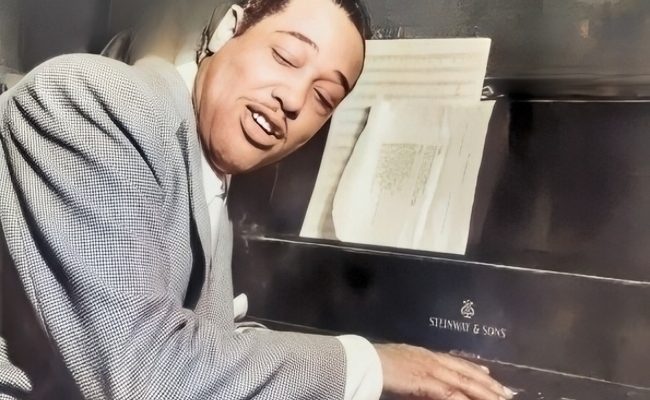
“Hollywood Hangover”
Composed and arranged by Wilbur “Buck” Clayton.
Recorded by Duke Ellington and His Orchestra live at the Regal Theater in Chicago on May 26, 1945.
Duke Ellington, piano, directing: Shelton “Scad” Hemphill, first trumpet; Taft Jordan, William A. “Cat” Anderson, Ray Nance, trumpets; Rex Stewart, cornet; Lawrence Brown, Joseph Nanton, trombones; Claude Jones, valve trombone; Otto Hardwick, first alto saxophone; Johnny Hodges, alto saxophone; Al Sears and Jimmy Hamilton, tenor saxophones (Hamilton doubles on clarinet); Harry Carney, baritone saxophone; Fred Guy, guitar; Alvin “Junior” Raglin, bass; William “Sonny” Greer, drums.
The story – part one – the end of World War II.
VE (victory in Europe) Day, May 8, 1945, had occurred less than three weeks before this exuberant recording was made. The mood in Europe, as one would expect, was one of relief and joy. Spontaneous public celebrations broke out everywhere in countries that had supported the Allied cause. There was dancing in the streets of London, Paris and many other European cities both large and small. For them, the almost six-year long nightmare of World War II was over, at last.

V-E Day in Times Square – the building to the right is Hotel Astor. Americans were happy that the War in Europe was over, but horrible events were yet to play out in the War with Japan.
The mood in America, at least temporarily, was equally ecstatic, especially in New York City, a place given to public expressions of the entire range of human emotions. However, the United States was not completely finished with World War II. Even though by the summer of 1945 it was clear to most observers that the Japanese could not defeat the Americans in the Pacific, and more and more devastating losses were being suffered by the Japanese daily, their war leaders refused to surrender. They sent orders down the chain of command for more desperate resistance by front-line fighters including retreating into caves on numerous Pacific islands and then fighting to the death, and crashing kamikaze flights into American ships. As these extreme tactics played out, the numbers of Japanese and American casualties rose steadily. The months of May, June and July 1945 brought a steady stream of disturbing War news to Americans.
Under cover of U.S. military secrecy, on July 16, 1945, the first successful detonation of an atomic weapon was carried out in the New Mexico desert. In the days following that momentous event, American war leaders pondered weather to use atomic weapons against Japan with the hope of ending the War sooner. It was decided to do that, and on August 6, 1945 an atomic bomb was dropped on Hiroshima, Japan causing apocalyptic loss of life, human injury and destruction. That horrific event nevertheless did not result in a Japanese surrender. A second atomic bomb was dropped on Nagasaki, Japan on August 9, 1945, with equally devastating results. After this, there continued to be debate in the Japanese government over surrender. But finally, with leadership from Emperor Hirohito, surrender by the Japanese was announced on August 15, 1945. The ghastly death and destruction of World War II was at last coming to an end.(1)
The story – part two – Ellington continues leading his band.
 By mid-1945, Duke Ellington had been a bandleader for twenty years. Despite the exhausting regimen of work he and his band had maintained through most of that time, he continued to relish being a bandleader. He loved appearing before the public, and was quite good at it. Tall, debonair, articulate, witty, well-dressed, Ellington was a show himself, even before one heard a note of his music. Duke’s music continued to be produced in substantial quantities during World War II, despite the many obstacles he and other bandleaders had to overcome during those years, including a musicians’ union recording ban, and gasoline rationing that made travel difficult. But perhaps the most devastating obstacle placed in front of bandleaders during the war years was the so-called “cabaret tax.”
During the First World War an excise tax was introduced on entertainment. This sort of ‘sin tax’ was a politically palatable way to squeeze money out of the booming wartime economy to pay for the costs of the War. It was called the “cabaret tax,” and when it was introduced in 1917 it levied a 5% tax on all revenues from places where there was a combination of eating, drinking, dancing, and entertainment by live performers such as a singer and a band. The language of the law was apparently ambiguous, referring to cabarets and roof gardens, which makes it sound as if only upscale places catering to rich people were targeted by the tax. However, the Internal Revenue Service later interpreted that wording to apply to any public place offering this combination of those services and activities, from the high-toned Stork Club in Manhattan to raunchiest juke joint in the rural South.
After World War I, the 5% cabaret tax was reduced to 3% because of political pressure applied by the operators of ballrooms and night clubs. However, the tax was not repealed. At 3%, it did not alter the demand for dancing, or impinge materially on the businesses that operated venues that provided entertainment. World War II brought a new evaluation of the tax as a source of revenue to help offset spiraling war-related costs. Consequently, from 1940 to 1943, it crept back up to 5%.
By 1944, World War II was grinding on with an immense loss of lives and war-related costs, including development of the atomic bomb. In response, the U.S. Congress enacted the Revenue Act of 1944. Taxes on a broad range of goods and services went up: many doubled from 5 to 10%. But the cabaret tax was singled out for a 600% increase, going from 5% to 30%! This brought a public outcry, and the rate was eventually reduced to 20%, a mere 400% increase. Nevertheless, the effects of this massive increase were soon felt in the band business.
At 20%, the cabaret tax started to change the market for big band entertainment. Dancing, always the lifeblood of the band business, rather quickly became unprofitable. Ballrooms scaled back their programs from six or seven nights a week, to three or four, to weekends only, to closing permanently.(2) But venues like theaters and auditoriums that were not subject to the cabaret tax continued to present big bands in concert, and make money doing so.

The ballroom at Idora Park in Youngstown, Ohio in the 1980s. During the swing era, this venue hosted the top bands in the country, and was frequently packed with thousands of dancers. Its slow decline into decrepitude began in the mid-1940s.
Despite all of this, Duke Ellington and His Orchestra remained very busy during World War II. Ellington himself was a most resourceful leader, and he did what was necessary to keep his band before the public, playing a fairly broad spectrum of music. He also had very good management through those years, provided by Cress Courtney, his liaison with the William Morris Agency, his booking agency. On the music side of his band’s operation, Ellington continued to present a top-flight band. As musicians from his classic 1930s band departed, he found suitable replacements. His replacement of trumpeter Cootie Williams, one of the most featured performers before his departure in late 1940 was Ray Nance. Nance was not only an excellent trumpeter, he also sang, played the violin and danced. Soon after, Duke added the stratospheric trumpeter Cat Anderson to his band to provide another musical (and theatrical) approach. When clarinetist Barney Bigard left in 1942, Ellington eventually replaced him with Jimmy Hamilton, a superbly talented musician whose technically advanced clarinet solos, played with an ultra-clean almost classical tone, were very different from his predecessors. Audiences, to a large degree, were pleased by the offerings of these new musicians.(3)

Duke Ellington poses with some of his sidemen – mid 1940s: L-R: Ray Nance, Rex Stewart, Tyree Glenn, Harry Carney, Russell Procope and Sonny Greer.
The music:
The amount of music consumed by Duke Ellington’s band in the mid-1940s was immense. Duke needed music for many kinds of presentations. Like most bands, he needed fresh music for dance dates and/or appearances in showrooms/night clubs. The tunes he played in these venues often reflected a high percentage of current pop tunes. He arranged some of these, but the vast majority of them were arranged by his musical collaborator, Billy Strayhorn. Then he needed a different repertoire for presentation in theaters and concerts. Although he would present some pop tunes in these settings, the bulk of the songs he played there included his classic, evergreen hits, like “Mood Indigo,” “Caravan,” “Sophisticated Lady,” etc. People came out to see and hear Ellington in theaters to hear his music, and perhaps new original composition by Duke, Strayhorn or someone else, in the unique Ellington style. Finally, Duke needed new, often extended works to perform in his series of annual Carnegie Hall concerts, which began in 1943, and continued until 1947. He and Strayhorn worked on these pieces, and they required a lot of work.

Duke Ellington and his band in Carnegie Hall, January 1943.
Despite all of this, Duke only rarely accepted new arrangements or original works from composers or arrangers outside of the Ellington organization. There were a few arrangements in the Ellington mid-forties book by Mary Lou Williams, whose charts made up the bulk of the library of the Andy Kirk band in the 1930s, and whose special arrangements for Benny Goodman, most notably “Roll ‘Em,” had been very well-received. But not many more.
 The composition/arrangement presented with this post, “Hollywood Hangover,” was by trumpeter Wilbur “Buck” Clayton, long associated with Count Basie.(4) Clayton joined the Basie band in 1936 in Kansas City, and remained with Count until he was drafted into the U.S. Army in November of 1943. Among the numerous compositions/arrangements Clayton wrote for the Basie band: “It’s Sand, Man,” “Seventh Avenue Express” and “Taps Miller.” While in the Army, Clayton was a member of the service bands led by arranger Sy Oliver, and Duke Ellington’s son, Mercer. Mercer may well have been Clayton’s contact with the Ellington band, and helped to place “Hollywood Hangover” with Duke. (Above right: Count Basie’s trumpet section in 1939: the drummer is Jo Jones; to his left – Buck Clayton, Ed Lewis, Shad Collins and Sweets Edison.)

“Hollywood Hangover” was never recorded by Basie. My informed speculation about this is that Clayton, in order to place this composition with Ellington, agreed with Duke that he would not sell it to Basie or any other bandleader, in exchange for Duke playing and recording it. Duke did play it quite often, and it did get recorded on various airchecks, and issued on a V-Disc, for use as entertainment for U.S. armed forces during and after World War II. (Above left: Buck Clayton working on an arrangement – mid 1940s.)
This rollicking performance begins with Duke at the piano laying down some churchy chords, followed by the band ascending dynamically and in register. The first two choruses (this is a 12-bar blues) present the exuberant Ellington saxophone quintet swinging away atop strong rhythm. Drummer Sonny Greer’s back beats and taps on his small tom-tom are most conducive to rocking the reeds.
 Trombonist Lawrence Brown follows with two chorus of preaching the blues, backed by roiling reeds. Alto saxophonist Johnny Hodges then plays for two choruses. His solo is notable for how he spaces volleys of notes – he saunters through it with his gleaming tone much in evidence. He plays against a rhythmic and dynamically surging background of brass, but as always, retains his cool, even through the nice climax he builds in his solo. Once again, Greer’s drumming in support of Hodges is excellent in propelling the music, and providing color.

A brassy interlude/modulation brings trumpeter Ray Nance forward. He swings away joyously for two choruses against a background of surging reeds and strong rhythm. Another bright burst of brass provides the opening for clarinetist Jimmy Hamilton to play. His bright, incisive sound, solid swing and good jazz ideas tell us that he was a top-flight musician who definitely added those qualities to a band that included many top-grade jazz soloists. In the second of his two choruses, arranger Clayton provides a fine sonic contrast in the background – romping open trombones, led with zest by Lawrence Brown.
The finale has the entire ensemble blasting and swinging, with screech trumpeter Cat Anderson in his Erskine Hawkins mode, soaring over the fortissimo band. Once again, the drumming of Sonny Greer adds excitement to these climactic choruses. (Above left: Duke reveled in the company of beautiful women – they inspired him. Here he is pictured with a young woman in uniform, Yvonne Lanozze, in 1945.)
The recording presented with this post was digitally remastered by Mike Zirpolo.
Notes and links:
(1) Sadly, the death was not quite at an end at the time of the Japanese surrender. Victims of radiation poisoning, burns and trauma from the bombs detonated at Hiroshima and Nagasaki continued to suffer and die for some time after that.
(2) See: The War on Dancing: https://www.davidvunkannon.com/2016/01/16/the-war-on-dancing/#:~:text=5%25%20dropped%20to%203%25%20after,tax%20had%20stayed%20the%20same.
(3) Some people did not appreciate Jimmy Hamilton’s clarinet style however. In order to mollify them, in 1946 Duke hired the veteran clarinetist/alto saxophonist Russell Procope, whose woody clarinet sound and bluesy style of playing reminded people that Barney Bigard’s New Orleans clarinet heritage was in good hands.
(4) Here is the source for the attribution of this composition/arrangement to Wilbur “Buck” Clayton: https://sova.si.edu/record/nmah.ac.0301/ref40549
Here are links to some other great 1940s Ellington performances:
Here is a link to a post about a Manhattan venue, that as Club Zanzibar, was Duke’s frequent performance home during World War II: https://swingandbeyond.com/2021/03/20/im-just-a-lucky-so-and-so-1945-duke-ellington-with-al-hibbler-johnny-hodges-and-lawrence-brown/
And here is a link to one of Buck Clayton’s special arrangements for Count Basie’s band:


Be the first to comment