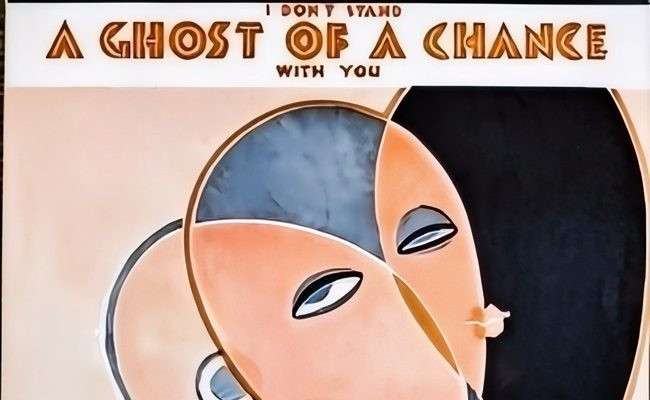
“I Don’t Stand a Ghost of a Chance with You”
Composed by Victor Young; probably arranged by Larry Wagner.
Recorded by Glen Gray and the Casa Loma Orchestra for Capitol in early 1959.
Glen Gray, directing: Conrad Gozzo, first trumpet; Walter “Pete” Candoli, Manny Klein and Clarence F. “Shorty” Sherock, trumpets; Simon H. “Si” Zentner, first trombone; Francis “Joe” Howard, Milt Bernhart and Murray McEachern, trombones; Arthur “Skeets” Herfurt, first alto saxophone; Arcuiso “Gus” Bivona, alto saxophone and B-flat clarinet; Irving “Babe” Russin and Jules Jacob, tenor saxophones; Chuck Gentry, baritone saxophone; Ray Sherman, piano; Jack Marshall, guitar; Meyer “Mike” Rubin, bass; Nick Fatool, drums.
The story – part one – Capitol Records.
“It seemed like the worst of times to start a record label. The United States was at war. The American Federation of Musicians was at odds with the recording industry. Raw materials needed for pressing records were scarce, and the military draft was siphoning off musical talent into the ranks of (the U.S. military.) But the intrepid triumvirate of Capitol founding fathers prevailed. Johnny Mercer, songwriter and sometimes singer, (was) tired of the manner in which record companies treated his material. Glenn Wallichs, founder/owner of the first music ‘superstore,’ Music City at Sunset and Vine in Los Angeles, was eager to expand his custom recording operation. (The third member) was B.G. ‘Buddy’ DeSilva, originally a songwriter but by 1942 a successful Hollywood film producer. Mercer persuaded him to bankroll the operation.” (1)
 The summer of ’42. That is when Capitol Records began releasing their newly made recordings. On April 6, 1942, Johnny Mercer supervised Capitol’s first recording session where singer Martha Tilton recorded “Moon Dreams.” On May 5, Bobby Sherwood and his Orchestra recorded two tracks. On May 21, pianist/arranger Freddie Slack and his orchestra recorded three tracks, one with the orchestra, two with singer Ella Mae Morse, including “Cow-Cow Boogie,” also supervised by Johnny Mercer. On June 4, Capitol opened its first office in a second-floor room south of Sunset Boulevard. On that same day, Glenn Wallichs presented the company’s first free record to Los Angeles disc jockey Peter Potter. On June 5, Paul Whiteman and his Orchestra recorded four songs. On June 12, Whiteman recorded five more, including ‘Travlin’ Light’ with Billie Holiday singing. On June 11, Tex Ritter recorded ‘(I Got Spurs That) Jingle Jangle Jingle’ on his first Capitol recording session. These recordings, among others (made by July 31,1942), comprised Capitol’s 110th produced record.(2) The next day, August 1, 1942, the Musicians’ Union strike against the the U.S. recording industry began. Commercial recording stopped.
 These early Capitol recording sessions took place at Radio Recorders. Founded in 1933 at 932 N. Western Avenue in Los Angeles, Radio Recorders moved their studios in 1949 to 7000 Santa Monica Boulevard.(3) In early 1949, Capitol Records opened its own studio at 5515 Melrose Avenue. The now iconic Capitol Tower was built at 1750 N. Vine Street, and it, including new recording studios, opened in 1956. (Above left: musicians gather for a recording session at the Melrose Avenue studio of Capitol Records – 1954.)
Capitol and Decca were among the first recording companies to come to an agreement with the Musicians’ Union – Decca in September of 1943 and Capitol on October 11, 1943.(4) Their return to active recording then gave them a tremendous advantage over two of their major competitors, Victor and Columbia, who didn’t settle until November of 1944. In a very real sense, Capitol’s and Decca’s gains in market share then were losses for Victor and Columbia. Various producers at Capitol in 1943 were busy recording artists like Stan Kenton, Nat “King” Cole, Jo Stafford and Paul Weston and Peggy Lee. These artists carried Capitol to great success during and after World War II. In 1953, Frank Sinatra signed a Capitol contract, and on that label he soon began a period of enormous success. Through the 1950s he and Nat Cole sold a lot of records for Capitol.
 Despite the fact that Stan Kenton was Capitol’s largest-selling big band from the mid-1940s through much of the 1950s, Kenton’s music was not exactly mainstream in the sense that it appealed to audiences who had been big supporters of the classic big bands of the 1930s and 1940s. Rather, it was an acquired taste, and as Kenton’s music evolved away from swing era audience tastes, many in that audience did not acquire the taste for it. In the mid-1950s, a producer at Capitol, Dave Cavanaugh, who had previously been a saxophonist in swing era bands including Bobby Sherwood’s, noticed a definite uptick in sales for newly recorded high-fidelity performances of big band classics. Benny Goodman’s new recordings of some of his swing era hits on the Capitol label, benefitting from the publicity surrounding the 1956 Hollywood film The Benny Goodman Story, substantially outsold any recordings Benny had made for Capitol while he was contracted to that label in the late 1940s. At RCA Victor, new interest in the music of Glenn Miller, riding the coattails of the 1954 Hollywood film The Glenn Miller Story, had been spurring sales of both the original Miller Bluebird and Victor recordings, and a spate of newly issued aircheck recordings by Miller’s civilian band. In addition, recordings made by Miller’s Army Air Force band, which were also new to Miller fans, began to appear on RCA Victor LP albums. The Miller estate organized a new Miller ghost band under the direction of Ray McKinley, which toured and also recorded for RCA. (Above right: Dave Cavanaugh at a Capitol Records recording session – 1950s.)

The Capitol Records tower at 1750 North Vine Street in Hollywood while under construction in 1955.
The big three record companies, RCA Victor, Columbia and Decca, also sensing this small mid-1950s trend, began reissuing many of the recordings by swing era bands that were stored in their vaults on LP, usually in very good sound. Capitol did not have a similar backlog of swing era material to reissue. They needed new product. Consequently, Cavanaugh began to develop an idea for Capitol to produce a pilot project that would appeal to mainstream audiences who had been fans of the great swing bands of the 1930s and 1940s, but who were now staying at home to raise their families instead of going out to ballrooms to dance. While these folks were at home, they watched television (bandleader Lawrence Welk inaugurated his very successful and long-running television show in 1955), and increasingly were buying new high fidelity record playing equipment on which to listen to the newly developed long-playing 33 1/3 rpm disks that by the mid-1950s had displaced the older 78 rpm records that had been the standard during the swing era. Cavanaugh’s idea was to put together a crack big band of musicians who had begun their careers as sidemen in the classic big bands of the 1930s and 1940s, and to record new performances of the great big band hits of the swing era in high fidelity sound for release on long playing records. In order to help him reconstruct the music that was played on those swing era recordings, Cavanaugh tapped arranger Larry Wagner, who had worked successfully with bandleader Glen Gray during the swing era.
 Glen Gray spent the early 1950s basically in retirement in Plymouth, Massachusetts, one that was richly deserved after spending over 25 years as a touring musician and bandleader. In the mid-1950s, he was contacted by Larry Wagner, about participating in some fashion in a Capitol Records project that would recreate the hits of Gray’s old Casa Loma band in high-fidelity sound, using top-flight Hollywood studio musicians. Gray was not particularly enthusiastic about coming out of retirement to build this project from the ground up. But he did lend his name and image to the project, and may have attended (but apparently did not conduct) the June 1956 recording sessions for it in Hollywood. The resulting Capitol LP, Casa Loma in Hi-Fi, was very successful, as was a follow-up, Casa Loma Caravan. They were so successful in fact that Capitol Records expanded the concept to include the music of many famous swing bands, to be recorded (starting in 1958) in the newly arrived stereophonic sound. Gray participated fully in this project. It was also very successful, and the series of LP albums that were produced exceeded a dozen, and continued to be produced even after Gray’s death in 1963.(5) (Above right: Glen Gray in the late 1950s.)
The recording presented here, a bravura performance by trumpeter Shorty Sherock of Victor Young’s great melody “I Don’t Stand a Ghost of a Chance with You,” was included in the Gray/Capitol 1959 LP entitled Solo Spotlight. That album was a bit different in concept from the Gray big band recreations that had preceded it, as it included a dozen selections, newly arranged, of songs written by Victor Young, who was a great composer of melodies, and who had died unexpectedly in late 1956. (Victor Young was also a friend of Glen Gray’s.) Young then received an Oscar posthumously for the musical score he had written for the 1956 film Around the World in Eighty Days. So his name and music were much in the air in the late 1950s.
The story – part two – Shorty Sherock.
 Shorty Sherock was born Clarence Francis Cherock in Minneapolis, Minnesota on November 17, 1915. He was a child prodigy, playing the cornet from an early age. His family moved to Gary, Indiana when he was a child, and he attended high school there. While in high school, he began his career as a professional musician. He worked with the Charlie Pierce and Dell Coon bands in the Chicago area while he was in his teens. He joined drummer Ben Pollack’s band in mid-1936. Also in that band then were Harry James, Irving Fazola, Dave Matthews and Freddie Slack. He made his first trip to Los Angeles in late 1936 with the Pollack band. He left Pollack in early 1937, and worked in several bands in Los Angeles then for short periods of time, including Jack Pettis, Santo Pecora, Seger Ellis and Jacques Renard. In mid-June 1937, Sherock joined Jimmy Dorsey’s band just as they were concluding a long run as the featured band on Bing Crosby’s NBC Kraft Music Hall radio show. The JD band then played a string of one-night stands with a few longer engagements sprinkled in, heading east. The band finally arrived in Manhattan for a stay at the Ice Terrace Room of Hotel New Yorker on March 1, 1937. (Above left: Shorty Sherock playing the cornet in the middle 1930s.)
 Sherock remained with Jimmy Dorsey’s band into the summer of 1939, when he joined Bob Crosby. He left Crosby to join Gene Krupa in January of 1940, and remained with Krupa until March of 1941. He was with Tommy Dorsey for a few months during the spring of 1941, then joined Raymond Scott for the summer of 1941. He worked in various bands from late 1941 until late 1942, when he joined Horace Heidt. He remained with Hedit until March of 1945.
He then succumbed to that dread disease that affected so many talented sidemen during the swing era, leaderitis, and formed his own big band just as the swing era began winding down. The Sherock band worked regularly until June of 1946, when Shorty disbanded. He tried again briefly in 1947, but then realized that he could not make a big band of his own successful enough to stay in business.(6) This failure had nothing to do with Sherock’s playing or the quality of his band’s music. His timing was just bad, as he was starting his band when the market for the music of swing/dance bands was beginning to shrink rather dramatically. (Above right: Shorty Sherock over Gene Krupa’s right shoulder – 1940 – studying what was needed to be a successful bandleader.)

L-R: Vocalist Elaine Shepard, publicist Win Morrow and Shorty Sherock in 1946 when he was a bandleader.
It appears that Sherock worked as a free-lance musician in New York from mid-1947 until November of 1949, when he joined Jimmy Dorsey again, this time as a featured soloist and deputy bandleader. He would remain with JD until early 1952, when he left the Dorsey band in Los Angeles to become a free-lance studio musician there. By the middle 1950s, he was one of the top free-lances in the Hollywood recording, television and film studios. He continued this work regimen well into the 1970s. He died of cancer on February 16, 1980.
The music:
 “I Don’t Stand a Ghost of a Chance With You” is a song written in 1932. The music was composed by Victor Young, the lyric by Ned Washington and Bing Crosby. One of the first recordings of it was by Bing Crosby on October 14, 1932. This recording, as so often was the case in the 1930s and 1940s, provided the song with a great send-off and had a lot to do with establishing it as a standard. Singers have been especially attracted to it, though a number of fine instrumental versions of it have also been recorded over the years. The one(s) made by tenor saxophone giant Chu Berry with Cab Calloway’s band (June 27, 1940 – two takes are extant), are especially attractive.
 Here we have another masterful interpretation that is a showcase for Shorty Sherock’s virtuoso trumpeting. It begins with an attention-getting introduction that starts with Sherock’s careening high-register entry, and descends directly into the song’s first chorus. Shorty delivers both of the song’s eight-bar main melody statements (AA) in his rich, warm middle register. He continues in this vein through the bridge (B) and the final eight bars (A) of chorus one.
The second chorus begins with a melodic sequence that features the velvet-toned trombone quartet playing, then with the clarinet-led reeds adding a glistening sonority. This is followed by a short ensemble interlude out of which Sherock’s trumpet rockets into its high register with a paraphrase of the main melody, setting the stage for the high-voltage finale, which is a brilliant cadenza topped by a room-shaking high F on the trumpet (E-flat concert).
Bravo, Mr. Sherock!
The recording presented with this post was digitally remastered by Mike Zirpolo.
Notes and links:
(1) Classic Capitol Jazz Sessions (1997), Mosaic Records, liner notes by Dan Morgenstern, 1.
(2) Wikipedia post on Capitol Records.
(3) Capitol early recording studios information comes from Classic Capitol Jazz Sessions (1997), Mosaic Records, 31, and the Wikipedia post on Radio Recorders.
(4) Wikipedia post of the 1942-1944 musicians’ union strike against the recording industry. Decca Records, and its transcription subsidiary World Broadcasting System, settled with the Musicians’ Union in September of 1943, agreeing to make direct payments to a union-controlled relief fund, followed shortly by Capitol Records, on October 11, 1943. Capitol had only begun to issue its first records on July 1, 1942, one month before the strike began.
(5) The Glen Gray/Capitol series of big band recreations was so successful that it was continued on an even grander scale in 1969 under the musical direction of Billy May.
(6) Biographical details on Shorty Sherock’s professional career were extracted from Who’s Who of Jazz …Storyville to Swing Street (1972), by John Chilton, 335.
Here are links to a couple other great performance by Shorty Sherock with Glen Gray and the Casa Loma Orchestra, the first a tribute to fellow trumpeter Billy Butterfield, the second a tribute to fellow trumpeter Charlie Spivak:


Be the first to comment