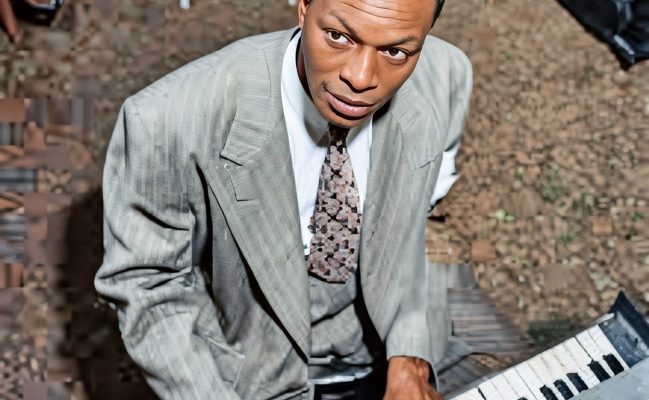
“Back to the Land”
Composed by Lester Young.
Recorded by the Lester Young Trio in late March-Early April 1946 for Mercury Records in Los Angeles, California.
Lester Young, tenor saxophone; Nat “King” Cole, piano; Buddy Rich, drums.
Note: I posted this great performance several years ago, but it was buried somewhat with some other music and story. Recently, I listened to this recording again, and for the umteenth time, my mind was blown by what Lester Young played, and especially what Nat “King” Cole played. Young has long been recognized as a master jazz musician. Cole’s reputation today rests largely on the many vocals he performed on a wide range of recordings for Capitol Records. We must remember however, that Nat “King” Cole was also a superlative jazz pianist. This post puts that front and center. MZ)
The music:
 I will cite the liner notes from Mosaic’s wonderful set of CDs entitled: Classic 1936-1947 Count Basie and Lester Young Studio Sessions (2016, page 32), written by jazz musician and historian Loren Schoenberg, to get at the essence of what Nat Cole’s jazz piano playing was all about on this recording. Mr. Schoenberg, as a pianist and tenor saxophonist, often hears and understands much more than the average listener to classic jazz:“…(Cole) plunges immediately into deep water with ‘Back to the Land,’ a blues for which there is no recorded precedent. Abstraction had long been an element of jazz piano: James P. Johnson, Duke Ellington, Earl Hines, Count Basie and Art Tatum and their disciples took apart various components of both ‘classical’ and popular music conventions to create an inherently American musical reality (to a far greater extent than the exalted Gershwin and Copland ever did – Charles Ives was their predecessor in this regard). On every level, be it rhythmic, harmonic or melodic, Cole is exploring territory that only Tatum had trod before, and never to this extent, with the caveat of judging by recorded performances. Musicians played many things on the job that they would never think of sharing with the public through their recordings. Rich and Young don’t blink an eye at even the most outrageous (and that’s an accurate description) of Cole’s superimpositions, which remain startling today – one can only imagine how they sounded in 1946.”
 Lester Young has always been widely recognized as a master of the blues. Here, Nat “King” Cole definitely proved that he was able to play the blues comfortably, indeed provocatively, with the best. To my ears, Nat Cole’s playing was a part of a distinguished tradition of jazz piano, one starting with Earl Hines, and then running through Art Tatum and Teddy Wilson. Many young pianists who came to jazz maturity in the 1930s were formed in that same crucible. Cole was simply one of the most talented, and creative. His enormous success as a singer, unfortunately, caused him to play piano much less. The unintended and regrettable result was that American music was denied continuing exposure to his great talent and creativity as a jazz pianist.
Cole plays three 12-bar blues choruses here, each quite different from the others. The first is a clever abstraction of “St. Louis Blues.” The second contains a dialog between Cole’s right and left hands that gets pretty far out there (the superimpositions referred to by Mr. Schoenberg). The third takes us back to more basic, preaching blues.(1) I imagine Lester said to Nat after this recording was wrapped, “Lady Cole, that was tasty!”
The absence of a bass here creates opportunities for Cole to supply some very interesting bass sequences at the keyboard using his left hand. The rolling, broken chord patterns he uses are a nod in the direction of pianist Avery Parrish, whose long solo on the blues “After Hours,” which he recorded with Erskine Hawkins’s band in 1940, was very much in the air in the mid-1940s. But as Loren Schoenberg pointed out, Cole went way beyond that with his playing on this recording.
 It must be said that the drummer here, the master of pyrotechnics, Buddy Rich, provides the most subtle, whispering accompaniment for Young and Cole, quite a departure from his usual power and volume.
A bit of context:
I am not sure how this title relates to the music.(1) It is, nevertheless, catchy.
“The Back-To-The-Land movement is a term covering a number of agrarian movements across different historical periods. The common thread is a call for people to take up smallholding, and to grow food from the land on a small-scale basis, whether for themselves or for others. There have been a variety of motives behind such movements, such as social reform, land redistribution, and civilian war efforts. Groups involved have included political reformers, counter-culture hippies, and religious separatists.
There was again a fair degree of interest in moving to rural land after World War II. In 1947, Betty McDonald published what became a popular book, The Egg and I, telling her story of marrying and then moving to a small farm on the Olympic Peninsula in Washington state. This story was the basis of a successful 1947 comedy film starring Claudette Colbert and Fred MacMurray.
The Canadian writer Farley Mowat said that many military veterans returning home after World War II sought a meaningful life far from the ignobility of modern warfare, regarding his own experience as typical of the pattern. In Canada, those who sought a life completely outside of the cities, suburbs, and towns frequently moved into semi-wilderness environs.”(2)
The recording presented with this post was digitally remastered by Mike Zirpolo.
Notes and links:
(1) I will offer a bit of speculation that when Lester Young heard Nat Cole’s third solo chorus, he recognized what Cole was doing in bringing the music back to a more elemental blues, and the title “Back to the Land” occurred to him.
(2) Excerpted from the Wikipedia post on Back to the Land.
Here are links to some other great Nat “King” Cole recordings with him as leader and sideman:
https://swingandbeyond.com/2022/09/02/get-your-kicks-on-route-66-1946-the-nat-king-cole-trio/
https://swingandbeyond.com/2018/12/15/the-christmas-song-and-nat-king-cole/
Here are links to a few of Lester Young’s greatest recordings:
https://swingandbeyond.com/2017/02/17/lady-be-good-1936-lester-young-and-count-basie/
https://swingandbeyond.com/2016/08/28/jumpin-at-the-woodside-1938-count-basie-and-lester-young/


Be the first to comment