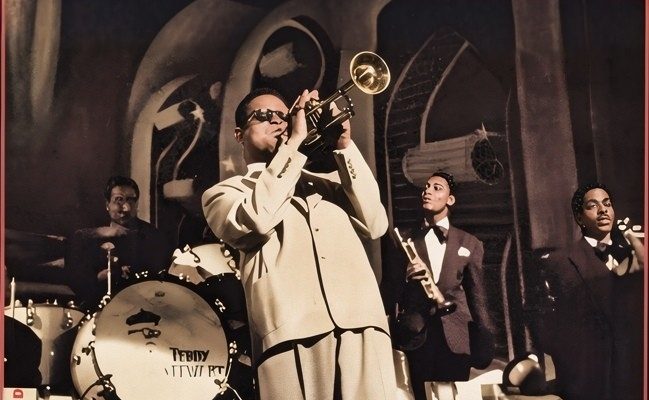
“Dizzier and Dizzier”
(aka “Katy”)
Composed and arranged by Gerald Wilson.
Recorded by Dizzy Gillespie and His Orchestra for RCA Victor on May 6, 1949 in Chicago.
John B. “Dizzy” Gillespie, trumpet, directing: Benny Harris and Elmon Wright and Willie Cook, trumpets; Andy Duryea, Sam Hurt, Jesse Tarrant, trombones; John Brown and Ernie Henry, alto saxophones; Yusef Lateef and Joe Gayles, tenor saxophones; Al Gibson, baritone saxophone; James “Hen Gates” Foreman, piano; Al McKibbon, bass; Teddy Stewart, drums.
The story:
John Birks “Dizzy” Gillespie (1917-1993), the youngest of nine children of Lottie and James Gillespie, was born in Cheraw, South Carolina. His father was a local bandleader, so instruments were made available to the Gillespie children, including John. James died when John was only ten years old.
John Gillespie started to play the piano at age four; and by the time he was 12, he had taught himself how to play the trombone and the trumpet.
From the night in the mid-1930s Gillespie when heard trumpet wizard Roy Eldridge on the radio, he dreamed of becoming a professional musician. He won a music scholarship to the Laurinburg Institute in North Carolina, where he attended for two years, from age sixteen to eighteen. During this time, he studied harmony and theory, but not trumpet. Nevertheless, he continued developing proficiency on that instrument. He moved with his family to Philadelphia in 1935.
 Gillespie’s first job as a professional trumpeter was with Frank Fairfax’s band in 1935. Another young trumpeter was in that band then, Charlie Shavers. Gillespie, Shavers, and a bit later, Harry Edison were young musicians who advanced the technical possibilities of the trumpet in the late 1930s and into the 1940s. Stylistically, Gillespie was a follower of Roy Eldridge in the mid and late 1930s. He replaced Frankie Newton (who had previously replaced Roy Eldridge) (1) in Teddy Hill’s band in May of 1937, then he went on tour of France and England in the summer of 1937 with the Hill band. (A link to a recording Gillespie made with Teddy Hill can be accessed at endnote 2.)
Gillespie earned his nickname “Dizzy” while playing with the Fairfax band. It was bestowed upon him by colleagues because of his clowning, which happened both onstage and off. When it came to music however, Dizzy Gillespie was extremely focused.
 Later in 1937, Gillespie met a young dancer named Lorraine Willis (1920-2004) at a theater in Washington, D.C. (probably the Howard). She worked the Afro-American Washington–Baltimore–Philadelphia–New York City theater circuit which included the the Apollo Theater in Harlem. Ms. Willis was not immediately friendly, but Dizzy pursued her nevertheless. The two eventually married in Boston on May 9, 1940, after Dizzy had become a successful and well-paid member of Cab Calloway’s band. Dizzy and Lorraine had a successful marriage, and she was always a rock of stability and support in his career and life. Lorraine became the de facto personal manager of Dizzy Gillespie from the date of their marriage until Dizzy’s death in 1993.(3) (Above left: Lorraine Willis Gillespie in the 1940s.)
Gillespie stayed with Teddy Hill’s band for a year, then left and freelanced with other bands. In the summer of 1939, with the help of Ms. Willis, Gillespie joined Cab Calloway’s band. He recorded one of his earliest compositions, “Pickin’ the Cabbage,” with Calloway in 1940. After an altercation with Calloway in late 1941, he was fired.
 A number of versions of the story of why Dizzy Gillespie was fired by Cab Calloway have circulated over the many decades since that incident occurred. The essence of it is that Dizzy was first and foremost an excellent musician – he would not have been in the Calloway band if he wasn’t. Calloway had a fine, swinging band as the 1930s segued into the 1940s. Cab himself was a dynamic singer and stage presence, but he had slowly built his band so that by 1940, it could and did compete with the top swing bands of the day. The major instrumental soloists in the band were Chu Berry on tenor saxophone, Cozy Cole on drums, and Dizzy Gillespie on trumpet. The Calloway band was the premier Afro-American band in the nation in terms of box office drawing power, largely because of Cab’s singing and dynamic stage presence. Consequently, the sidemen with Cab were paid salaries that exceeded those paid by all other black bandleaders, and indeed most white bandleaders. (The world of swing was racially segregated, and as in all other areas that separation resulted in substantially lower salaries for black musicians than those earned by their white counterparts.) Whenever a musician was fortunate enough to be hired by Cab Calloway, he could count on steady work and better pay than he could receive just about anywhere else. The musicians in his band endured a lot of hard work and travel with Cab, but very few chose to leave. The money was too good. (Above right: Dizzy in repose – 1940. Photo by Milt Hinton.)
 Dizzy Gillespie, like any other young musician who was lucky and talented enough to get into the Calloway band, basically enjoyed the high-profile work the band did, and of course the pay, which was much greater than he had ever received before. But Dizzy was a creative musician, and he soon grew tired of the repetition that was required of various of Cab’s hits that had to be played exactly the same way nightly to satisfy Cab’s big audiences. His musical frustration was expressed by him often playing solos that the other musicians in the Calloway band (except for Chu Berry) found to be “way out.” Cab himself tolerated Gillespie’s musical adventurism because Dizzy was also an absolutely first-rate section player who could read anything, and always played his parts in the trumpet section with great accuracy. He also tolerated Dizzy’s antics onstage, which often came close to stealing the spotlight away from Cab. But after some time, Cab’s patience with Gillespie began to wear thin. I suspect that Cab took Dizzy aside and told him privately to tone-down the onstage hijinx. But as so often is the case among highly-strung performers who have been appearing before audiences together (and indeed living together) for months on end, nerves snap. Something happened onstage in front of an audience that enraged Cab. (Above left: Dizzy Gillespie at a backstage party with fellow Calloway sidemen Keg Johnson (at rear) and Cozy Cole. Photo by Milt Hinton.)
I will quote Cab Calloway directly, from his reminiscences some 35 years after this incident. By then, the truth had come out, and Cab recognized that he had been unfair to Dizzy by accusing him of something he hadn’t done, and then firing him. Here is what he said: “”I fired Dizzy because of his clowning. Lord, did he clown. He would sit up there in the back row cutting-up and throwing spitballs. One night, during a performance, I was hit by two spitballs. Normally Dizzy limited his kidding to the other guys in the band, but this time, it seemed to me that he had overdone it. After the show, I was steaming. I walked into the musicians’ dressing room and confronted Dizzy. ‘You hit me with those spitballs, man. That don’t go in this band.’ ‘What!’ Dizzy said. ‘You hit me with those spitballs and you’re fired!’ ‘But I didn’t do nothin.’ ‘You’re out man.'” (4) Cab did not mention what happened next. Dizzy took out a knife, and he and Cab tussled. When that was over, Cab had been stabbed in the leg, and had some other minor cuts. It was a bad scene.

Cab Calloway and his band record – summer 1941. L-R: Front: Chu Berry, Andrew Brown, Hilton Jefferson (hidden behind Cab), Cab Calloway, Jerry Blake, Walter “Foots” Thomas; back: Milt Hinton, Cozy Cole, Danny Barker, Jonah Jones, Lammar Wright, Dizzy Gillespie. The two trombonists who are visible are Keg Johnson and Quentin “Butter” Jackson. Pianist Benny Payne and trombonist Tyree Glenn are not visible.
Cab then picked up the narrative: “Fifteen years later, my friend (and former long-time Calloway band bassist) Milt Hinton and I met in New York. We were having a drink and Milt said: ‘There’s something I’ve got to tell you Cab. It wasn’t Dizzy that hit you with those spitballs, it was me. But you were so angry I was afraid you’d fire me instead of Dizzy.'”(5)
During his time in Calloway’s band, Gillespie started writing big band arrangements that he sold to white bandleaders like Jimmy Dorsey and Charlie Barnet, among others. Post Calloway, he then freelanced as a jazz trumpeter with a number of bands including those led by Ella Fitzgerald, Benny Carter, Charlie Barnet, Les Hite, Calvin Jackson, Lucky Millinder, Earl Hines, John Kirby and Billy Eckstine. By late in 1944, “…Gillespie’s name and the word bop acquired great prominence among musicians. In early 1945, after fronting a small group at the Three Deuces in New York, Gillespie toured with his first big band. Toward the end of 1945, he formed a small combo in California. He reorganized a big band in 1946, toured Scandinavia in January and February of 1948, and broke up his big band in early 1950.”(6)
 “Although it has been the subject of much dispute whether Dizzy Gillespie of Charlie Parker was the primary influence in shaping the bop revolution in jazz, the truth seems to be that their ideas and those of several others were interdependent, and that each drew upon the others’ ingenuity. The result was a melodic, harmonic and rhythmic advancement of jazz (and) the incorporation of many subtleties that call for a more developed technique than had hitherto been at the disposition of most jazzmen.” (7) (Above right: Charlie Parker and Dizzy Gillespie – late 1940s.)
On January 6, 1953 at a party Dizzy gave for his wife Lorraine at a Manhattan club called Snookie’s, during the revelry someone stepped on Dizzy’s trumpet causing the bell to be bent upward at a 45 degree angle. Dizzy liked the way this made his trumpet sound, and after that had all of his trumpets made with the bell pointed upward. It became one of many Gillespie trademarks.(7A)
The music:
Dizzy Gillespie’s RCA Victor recording of “Dizzier and Dizzier” begins with an introduction that has him on open trumpet alluding to the main rather morose melody of the piece as he plays simply over sustained ensemble chords. The first chorus has Gillespie playing the unusual, rangy melody, with interesting trumpet asides. Once again, the background he plays against is thickly harmonized sustained chords. Pianist James Foreman shadows Gillespie’s solo.
The transition between choruses has the trombones and reeds blended, with Dizzy’s trumpet leading the ensemble into an open trombone solo possibly played by Sam Hurt. In this sequence, arranger Gerald Wilson employed the harmonized saxophone quintet to contrast with the brassy trombone sonority. After an ensemble eruption, we hear both the trombone and Gillespie’s trumpet, then Dizzy alone as he plays into the cadence and finale.
The composer and arranger of “Dizzier and Dizzier” was Gerald Wilson, who replaced Sy Oliver in Jimmie Lunceford’s band in 1939. In the Lunceford band, Wilson worked mainly as a trumpeter, though he did write some compositions/arrangements for that band including “Hi Spook,” and “Yard Dog Mazurka,”(8) which were recorded. While leading big bands that featured his arrangements off and on from the mid-1940s through the 1960s, he gained a measure of success working as an arranger for a wide array of performers including Nancy Wilson, Julie London, Sarah Vaughan, Ray Charles and Duke Ellington.
***************
“Dizzier and Dizzier”
(aka “Katy”)
Composed and arranged by Gerald Wilson; original arrangement revised by Lew Quadling.
Recorded by Frankie Carle and His Orchestra for Dot in 1968 in Hollywood.
Lew Quadling directing: Frankie Carle, piano. (Probable personnel): Shorty Sherock, Cappy Lewis, Graham Young, Uan Rasey and Conte Candoli, trumpets; Dick Nash, Milt Bernhart, Lloyd Ulyate, tenor trombones; George Roberts, bass trombone; Arthur “Skeets” Herfurt, first alto saxophone, Wilbur Schwartz, alto saxophone; Georgie Auld and Gene Cipriano, tenor saxophones; Chuck Gentry, baritone saxophone; Bob Bain, guitar; Ray Brown, bass; Alvin Stoller, drums. Conte Candoli trumpet soloist; Georgie Auld, tenor saxophone soloist.
The music:
This performance is by an ad hoc band of Hollywood sharpshooter studio musicians who play Lew Quadling’s revised version of Gerald Wilson’s arrangement with authority and panache. The titular leader of the band, swing era veteran pianist Frankie Carle (arranger Lew Quadling was the actual leader of the musicians in the studio), plays his parts with deft accuracy. The featured trumpeter, Conte Candoli, was a Dizzy Gillespie disciple of long-standing. His playing here is a fitting homage to the Master. In place of the trombone solo in the second chorus, arranger Quadling provides a place for tenor saxophonist Georgie Auld to play a soulful solo.
This is a creative reimagining of the original Gillespie-Wilson music that is beautifully performed and recorded.
The recordings presented with this post were digitally remastered by Mike Zirpolo.
Notes and links:
(1) Both trumpeter Roy Eldridge and tenor saxophonist Chu Berry had been in Teddy Hill’s band in 1935 and into 1936. They were enticed to join Fletcher Henderson’s new band in early 1936, which they did.
(2) Here is a link to a recording Dizzy Gillespie made with Teddy Hill’s band on May 17, 1937 – “King Porter Stomp”: https://www.youtube.com/watch?v=EKIqvRgOkj8
(3) Despite their marriage being successful, Dizzy and Lorraine Gillespie had no children. In 1958, Dizzy fathered a daughter with another woman, songwriter Connie Bryson. She grew up to be the jazz singer Jeanie Bryson.
(4) Of Minnie the Moocher and Me (1976), by Cab Calloway and Bryant Rollins, 167.
(5) Ibid.
(6) The New Edition of the Encyclopedia of Jazz (1960), by Leonard Feather, 226.
(7) Ibid.
(7A) The information about how Dizzy Gillespie’s trumpet was first bent comes from the Wikipedia article on him.
(8) Here is a link to the post here at swingandbeyond.com on Gerald Wilson’s “Yard Dog Mazurka,” as performed by Jimmie Lunceford and His orchestra: https://swingandbeyond.com/2019/01/12/yard-dog-mazurka-1941-jimmie-lunceford-intermission-riff-1946-stan-kenton/
(9) Here is a link to another performance of this composition by Dizzy Gillespie and His Orchestra, made seven months before the RCA Victor studio recording:
https://archive.org/details/JV-28303-1948-QmWgr9NYxf5FCon5PW7itF3wbCjXCMJ82ZzJrDkUQiTrdL.mp3
Artist: Dizzy Gillespie And His Orchestra
Title: Dizzier And Dizzier (Katy)
Year: 1948
Date: Royal Roost, NY, Oct 5, 1948
Performers: Dizzy Gillespie, Dave Burns, Elmon Wright, Willie Cook (tp) Jesse Tarrant, William Shepherd (tb) John Brown, Ernie Henry (as) James Moody, Joe Gayles (ts) Cecil Payne (bar) James “Hen Gates” Foreman (p) Nelson Boyd (b) Teddy Stewart (d) Chano Pozo (cga)
(10) Here is a link to a celebration of the music of Dizzy Gillespie’s fellow be-bopper, Charlie Parker, which includes a stirring trumpet solo by Conte Candoli, which is contrasted with Bird’s original recording:
(11) Here is a link to Dizzy Gillespie playing a Billy Strayhorn composition: https://swingandbeyond.com/2017/11/17/u-m-m-g-1960-music-of-billy-strayhorn-dizzy-gillespie-with-clare-fischer/
(12) Here is a link to Dizzy as he sounded with Cab Calloway’s band: https://swingandbeyond.com/2016/07/12/boo-wah-boo-wah-cab-calloway-1940-with-chu-berry-and-dizzy-gillespie/


Be the first to comment