“Loose Lid Special”
Composed and Arranged by Sy Oliver.
Recorded by Tommy Dorsey and His Orchestra for Victor Records July 15, 1941 in New York.
Tommy Dorsey, first and solo trombone, directing: Chuck Peterson, first trumpet; Ziggy Elman, Jimmy Blake, Lawrence “Al”/”Squeak” Stearns, trumpets; George Arus, Dave Jacobs, Lowell Martin, trombones; Freddie Stulce, first alto saxophone; Heinie Beau, alto saxophone; Mannie Gershman and Don Lodice, tenor saxophones; Bruce Snyder, baritone saxophone; Joe Bushkin piano; Clark Yocum guitar; Sid Weiss bass; Buddy Rich drums.
The story:
 By mid-1941, Tommy Dorsey was involving himself more deeply in the business part of the band business in addition to maintaining a great band. He and his band had recently completed a run on a sponsored NBC radio show, the Fame and Fortune program. (The last broadcast was on Thursday April 10,the 26th week of the show’s run.) After that, the Dorsey band hit the road, playing a series of one-night dance dates through the balance of April and into May. Then they opened at the Astor Roof in New York.
“May 20, 1941 (Tue) “Gala Opening Tonight” – Hotel Astor Roof Garden, Times Square, New York. The band opened at the (Astor Roof) with performances Monday through Saturday (Sundays off). They broadcast five half-hour sustaining broadcasts per week over the Mutual network during their engagement.”(1) “Tommy Dorsey’s hard-driving style at the Hotel Astor Roof is apparently what they want, regardless of its cacophony. However, he would do well to moderate the jive, especially at the dinner sessions. Nonetheless, the Roof’s business is well-nigh sensational from a gross standpoint, and that’s what Bob Christenberry (manager of the Astor Roof) best likes to go by.” (2) “DORSEY BREAKS ASTOR RECORD – “New York – Tommy Dorsey’s band has broken all records at the Hotel Astor and is doing the most sensational business of any band in the greater New York area, according to Bob Christenberry, manager of the Astor. While Gene Krupa fared poorly at the Penn, and with hotel business, generally speaking, seriously off, Dorsey’s terrific draw has kept the ropes up every night without a single miss since he opened late in May. Tommy is pretty well satisfied with his lineup now, although he has been seeking a clarinetist to fill the chair he left empty when Johnny Mince pulled out two months ago. Will Bradley’s crew will follow Tommy’s at the Astor in July.” (3) The Dorsey stand at the Astor ended on July 15.

Times Square in Manhattan in 1941. Hotel Astor is in the center/top of this photo. The Paramount Theater is at lower left.
Meanwhile, as always, personnel issues continued to arise in the TD band. Here is a rather bizarre example: “Sid Weiss, bassist with Tommy Dorsey, is getting in short practice session with the band, after recovering from an infected wrist resulting from a bit of horseplay. Player has been out of the band about two months because of a broken wrist bone, suffered when he punched another member of Dorsey’s band on the arm. Break went unnoticed by him and by the time a doctor was called to look at it the arm became infected. It was necessary to employ a drain.”(4) Another personnel shift occurred in the trumpet section: “New York —”Squeak” Stearns, the ex-Raymond Scott trumpeter, joined Tommy Dorsey at Hotel Astor, replacing Shorty Sherock, who left last month to join Scott. Stearns hails from Westerly, R. I.”(5)

Another view of Hotel Astor (at left) with young swing fans lined up to get in to see and hear Tommy Dorsey’s band.
Tommy was also involved in several lawsuits in the summer of 1941. He and his wife Mildred “Toots” Dorsey were parties to a divorce action. Tommy was the plaintiff in a suit against Cincinnati bandleader Barney Rapp for collection of a $2,000.00 loan. He was the defendant in another lawsuit: “Sy (Si) Shribman, manager and backer of various bands, is suing Tommy Dorsey in Massachusetts courts for $100,000 over an old agreement between them. Shribman wants a portion of Dorsey’s earnings under a deal between them made In 1936, wherein, in exchange for a loan of $2,500, he was to get 5% of Dorsey’s one-nighter earnings over a certain gross figure for five years. Suit may be settled before it goes to trial. Meanwhile Dorsey Is avoiding bookings in Massachusetts in fear of running into attachment proceedings, which could tie up any earnings picked up in that state. Shribman is manager-backer of a number of current name bands, including Glenn Miller, Woody Herman, Gene Krupa, Tony Pastor, et al.”(6) Tommy’s reaction to all of this was to forge ahead, make more music and money, and make more business moves.
In July of 1941, TD leased the entire penthouse floor of the Brill Building, 1619 Broadway, to house his various business enterprises and a couple of rehearsal spaces. That venue would soon be the site of many alcohol-fueled parties, brawls and other activities for the Dorsey band.
The music:
 Tuesday July 15, 1941, 1:30 – 6:00 p.m. – Tommy Dorsey leads his band at a recording session at Victor Records studio 1,155 East 24th Street in Manhattan. Five acceptable masters were made, including “Loose Lid Special,” an original Sy Oliver composition/arrangement.
One of the great instrumental blockbusters of the swing era, “Loose Lid Special,” is a perfect example of the direct, colorful, and always swinging arranging of Sy Oliver, and of the ensemble and soloistic virtuosity of the Dorsey band at its zenith. With eight brass, including the brash Ziggy Elman, one of the loudest trumpeters of those years, Chuck Peterson, an excellent all-around trumpeter noted for his high-note work and minimal vibrato, and Tommy Dorsey, “The Old Man” as he was referred to by his band members, even though he was only 34 when this recording was made, on trombone, who could play as loud as anyone, and drummer Buddy Rich, the Dorsey band, when it chose to be, could be one of the loudest in the business. Despite the fact that TD was one of the most strict musical disciplinarians of the swing era when it came to rehearsals and performances, his 1941 band, with a perfectly meshed rhythm section headed by Buddy Rich, ably supported by pianist Joe Bushkin and bassist Sid Weiss, was nevertheless capable of great relaxed swing.
 “Loose Lid Special” comes on with a blasting introduction. Note how Sy Oliver (pictured at left) cleverly creates a musical see-saw effect employing groups of different instruments in short bursts. Big-toned tenor saxophonist Don Lodice, who handled the TD jazz tenor solos in the years 1940-1943, sets forth the “melody” of “Loose Lid Special” such as it is, for 16 bars. The trumpet behind Lodice’s last few bars is played by Chuck Peterson, who also leads the trumpets in this performance. From that point on, Oliver’s sorcery is evident in his kaleidoscopic use of the trumpets, trombones and saxophones both as discrete sections, and blended together. Oliver’s sudden key change and use of the four trumpets in unison is also marvelously inspired. All of this rests on the rocking rhythmic foundation supplied by drummer Rich.
Tenor saxophonist Don Lodice – 1941.
The forceful, burry-toned trombone solo is by is by TD, and it demonstrates that even though his fame had been secured and maintained as the sweet-toned, ballad playing “Sentimental Gentleman of Swing,” he was capable of creating rambunctious music with his slip horn when required. (Hear Oliver’s brilliant use of the surging saxophones behind Dorsey.) Trumpeter Ziggy Elman follows with some inspired blasting, including a dramatic leap into his upper register, which causes Rich, one of the most vocal of drummers, to exclaim “Yes Ziggy!” The band quiets down to allow Peterson to return to play a few bars of Harmon-muted (with stem removed) trumpet (with no vibrato–extremely unusual for jazz in 1941), and wrap up this bracing performance.

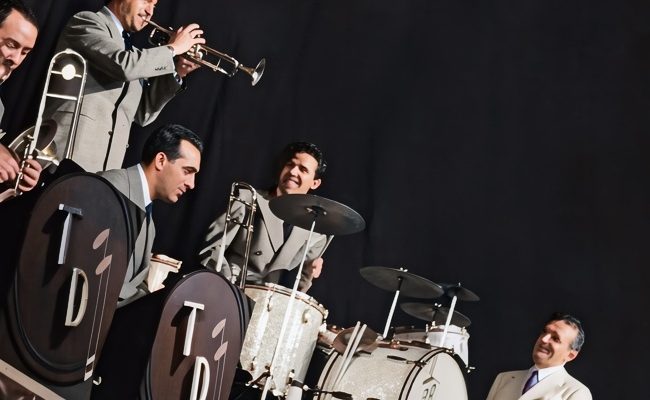
Onstage in 1941 – Ziggy Elman, Buddy Rich and Tommy Dorsey. The two trombonists at left are Dave Jacobs and George Arus.
 If any big band today would perform “Loose Lid Special” as the Tommy Dorsey band did on this classic recording, it would set its audience’s ears a-twitter. This is not only a superb example of swing, it is creative jazz arranging at its best, performed with consummate instrumental virtuosity by the musicians in the Dorsey band. This is timeless music that should be heard, and should be played by bands exploring the music of the swing era. (Trumpeter Chuck Peterson is pictured at right.)
The recording presented in this post was digitally remastered by Mike Zirpolo.
Notes and Links:
(1) Down Beat, June 1, 1941, 3.
(2) Variety, June 11, 1941, 37.
(3) Down Beat, June 15, 1941, 3
(4) Variety, June 18, 1941, 39.
(5) Down Beat, August 1, 1941, 13
(6) Variety, July 30, 1941, 35.
Here are some links to other great performances by Tommy Dorsey and His Orchestra of Sy Oliver’s arrangements.
“Swanee River” https://swingandbeyond.com/?s=Sy+Oliver
“Well, Git It!” https://swingandbeyond.com/2019/06/07/well-git-it-1942-tommy-dorsey-with-ziggy-elman-and-chuck-peterson/
“Quiet, Please” and “Deep River” https://swingandbeyond.com/2017/09/28/buddy-rich-at-100-with-tommy-dorsey-quiet-please-and-deep-river/
“Hallelujah!” (live) https://swingandbeyond.com/2016/12/01/on-the-air-with-the-great-bands-1940-tommy-dorsey-hallelujah/
“Yes Indeed” https://swingandbeyond.com/2020/02/01/yes-indeed-1941-tommy-dorsey-with-sy-oliver-and-jo-stafford/
“Then I’ll Be Happy” https://swingandbeyond.com/2021/07/26/then-ill-be-happy-1946-tommy-dorsey-and-sy-oliver-with-charlie-shavers-and-don-lodice/
“The Minor Goes Muggin” https://swingandbeyond.com/2023/10/27/the-minor-goes-muggin-1945-tommy-dorsey-sy-oliver-with-duke-ellington-sid-cooper-charlie-shavers-and-buddy-rich/
And the most famous of all TD/Oliver collaborations, “Opus One” https://swingandbeyond.com/2024/02/09/opus-one-1944-tommy-dorsey-sy-oliver-with-buddy-defranco-glen-gray-1959-with-gus-bivona-gene-krupa-1945-with-anita-oday-and-don-fagerquist/


These number’s just send me back when my Dad use to listen to WNEW.
They make my Sunday’s a happy day remembering my Dad. Keep those hits coming, I can’t wait. Have a song in your step, and kick it.
Gary, many thanks. More great swing recordings are in the pipeline, so stay tuned.
Am I the only one who hears Chuck Petersen’s seductive coda as a “come on” to a side 2 that never was? That feeling never leaves, despite countless hearings of this Dorsey classic.
“LLS” is one of those perfect examples of, when just about to enter into a global conflict, the kind of soundtrack with exactly the kind of swagger and bravura you need to get you through it.
How did Dominici LoGuidice (Don Lodice) pronounce his last name? I’ve always assumed it was pronounced “Lodis,” but I’ve never heard it spoken.
Michael, he pronounced it Lo’- diss, with the emphasis on the first syllable.
Hello, again–As a young(er) man, I worked with Don Lodice once–maybe twice–in Los Angeles. He was still playing beautifully, and was a kind, friendly man. He pronounced his name, “LOH-dis.”
Hello, Mike–I haven’t checked in with you in some time. I hope you’re well. I’ll still traveling and performing. I’ve been in Europe for a while; I’m presently in northern Germany. I fly home in a week or so. I continue to enjoy your posts, and your insightful comments about each recording. Your research–and the obscure photos you manage to find–continues to amaze me! Thanks for sharing these great “sides” and your sage thoughts. All the best–Dan B.
Dan, it is good to hear from you and to know that you are still out there performing and spreading the message of swing.
Your words mean a lot to me because you are a jazz musician who has steeped himself in the history of the music. Your impressions are valuable. Thank you.
I am constantly searching for images of musicians that are “new” to me. I have a pretty good memory when it comes to this, and as soon as I see one that has been hidden for decades, I try to identify it and include it in a post so that others can see and enjoy it.
Thanks again Dan, and keep swinging!
Mike