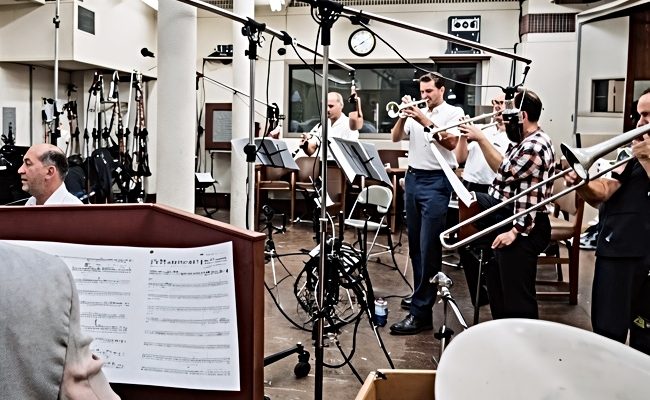
“A String of Pearls”
Composed by Jerry Gray; arranged by Billy Maxted.
Recorded by Billy Maxted and His Manhattan Jazz Band for Liberty probably in Fort Lauderdale, Florida in 1967.
Billy Maxted, piano, directing: Bob Yance and Dave Culp, trumpets; Richy Nelson, trombone; Joe Barafuldi, clarinet; Ron Nespo, bass, John “the Baron” von Ohlen, drums.
The story:
 Billy Maxted (January 21, 1917 Racine, Wisconsin – October 11, 2001 Fort Lauderdale, Florida) was an American jazz pianist and arranger. William George “Billy” Maxted, Jr. was the eldest son of William George Maxted (1884–1972) and Mabel Catherine Myers (1887–1949), who married on September 20, 1910, and raised their family in Racine for several decades. His younger brother was Kenneth Edward Maxted (1919–1980).
Billy Maxted’s early years unfolded in a working-class household amid the economic hardships of the Great Depression, which gripped the nation in the early 1930s and profoundly affected Midwestern communities like Racine, where factory jobs dominated daily life. No prominent musical heritage is noted in records of the Maxted family, distinguishing Billy’s path into music from those born into musical families.
Maxted grew up in an era when jazz and swing were gaining traction as popular music, often disseminated through radio broadcasts that reached even remote Midwestern homes, and provided escapism during tough times. Local music scenes in Wisconsin, including emerging jazz and dance ensembles, offered additional exposure to these sounds in the late 1920s and early 1930s. Wisconsin produced a number of great jazz musicians then including bandleaders Bunny Berigan, Woody Herman and guitar virtuoso Les Paul.
Billy spent his teenage years immersed in the musical environment of the Midwest during the early swing era. How he made his way from Racine, Wisconsin to the Juilliard School of Music in New York during the mid-1930s remains a mystery. But Billy proved to be an excellent student at Juilliard, gaining a solid foundation in piano performance and arranging. Maxted’s formative influences drew heavily from the jazz traditions prevalent in the 1930s, particularly the innovative compositions and performances of pioneers like Jelly Roll Morton and Duke Ellington, which he absorbed via radio programs, recordings, and when he was a student in Manhattan, by attending performances of many big bands.
Maxted started his professional career playing and arranging for cornetist Red Nichols’s band from 1937 through 1940. His first recordings with Nichols were made in early 1939. By mid-1941, he was with Will Bradley’s band, where he remained until he enlisted in the U.S. Navy in 1942. Unlike many musicians who served in World War II, Maxted chose combat duty, and served on aircraft carriers in the Pacific Theater as a fighter pilot. His military service lasted from late 1942 until mid-1945.
After that, he worked briefly with Will Bradley as a pianist, and also contributed at least one original composition/arrangement “Etude Brutus” to Bradley’s book of arrangements. He also provided a few arrangements for Benny Goodman and Claude Thornhill in the immediate postwar period. By 1947, he was the musical director for former Glenn Miller vocalist Ray Eberle’s band. That collaboration continued through 1948.
 Starting in 1949, Maxted took up residence on Long Island, New York. He had married Inez Raybon, and the couple raised four children: daughters Linda (Gagliardo), and Grace, and sons Theodore and William. He also began to work with trumpeters Phil Napoleon, Pee Wee Erwin, Billy Butterfield and Bobby Hackett in New York, very often at Nick’s, a well-known mainstream jazz venue in Greenwich Village. These associations led him to forming his own semi-Dixieland – semi-swing groups, which he billed as his Manhattan Jazz Band, which were also presented regularly at Nick’s through the 1950s.
Maxted also wrote arrangements through the 1950s for pop vocalist Jill Corey, and accompanied her on recordings with his Manhattan Jazz Band. In the mid-1950s, Maxted made several LP albums for Cadence Records where he was presented in various musical contexts including with his Manhattan Jazz Band. (1)
 In the mid-1950s, Billy began what would be a long and profitable association with the Grandview Inn, 1127 Dublin Road, Columbus, Ohio. He was a sideman in a group led by Pee Wee Erwin that played there first in 1956. In 1958, he worked there with Bobby Hackett. After that, he would return there often as the leader of his own bands. Maxted met golf legend Jack Nicklaus at the Grandview Inn, and this association was memorialized by Billy with the 1963 LP entitled The Big Swingers, which included a Maxted original dedicated to Nicklaus, “The Golden Bear.”
In the late 1950s, Maxted also dipped his toes a bit deeper into the water of commercial music. He contributed some of his original compositions (“Serenade to a Genie,” “A Sonata to Genie,” and “A Concerto to Genie”) to master arranger Billy May for inclusion on some of his recordings. His riffy and rhythmic composition “Manhattan Spiritual” was a top-10 hit for English bandleader Reg Owen in 1959.(2) In 1962, he reached the Billboard “Bubbling Under The Top 100” chart with a swing version of “Satin Doll” for his own band. These commercial activities produced enough money to enable Maxted to move his family to Fort Lauderdale, Florida in 1961.
Fort Lauderdale would be Billy’s home for the rest of his life. He continued his career by leading excellent small touring bands through the early and mid-1960s. In 1967, he signed a two-LP contract with Liberty Records, and worked with producer Jack Tracy at Liberty to produce them. They both contain fine music that is performed very well. However for the second of them, they settled on a concept that was perfect for Maxted: him refashioning a dozen well-known hits of the great bands of the swing era to fit the instrumentation and personnel of his then-current band. Not only are his arrangements wonderfully colorful and effective swing vehicles, but their performances are first-rate and show what a fine band Billy led then.

The music:
Billy Maxted’s refashioning of the Glenn Miller/Jerry Gray hit “A String of Pearls” is an excellent example of not only his arranging skill, it is also a showcase for a number of solos by the members of his 1967 band. Maxted gets right into the main melody of “A String of Pearls,” bypassing the famous descending introduction Jerry Gray created for the Miller recording. The blend of instruments Maxted used suggests a much larger ensemble than the seven musicians in his Manhattan Jazz Band. The horns are propelled atop relaxed but swinging rhythms emanating from Ron Nespo’s bass, and especially John von Ohlen’s drums.
 After a brief, bright ensemble transition, we hear a tasty clarinet solo by Joe Barafuldi. (Note the fine piano comping he gets from Maestro Maxted.) The descending brass figure that follows is Maxted’s version of the one heard on the Miller recording. Trombonist Richy Nelson plays a strong and swinging solo, then the set-up for the centerpiece of this performance begins – another Jerry Gray transition that Maxted downsized to fit the instrumentation of his band. The cornet solo that Bobby Hackett played on the Miller recording is justly praised as a small masterpiece of logical and exceedingly musical improvisation. Here, trumpeter Dave Culp plays his respects to Hackett in the first twelve bars of his solo, albeit in rather supercharged fashion, then he takes off on his own improvisation, which is brilliant, swinging and builds to an explosive climax. (Dave Culp is shown above left.)
After this, Maxted takes a brief piano solo, then the band deftly swings through the ensemble passages that lead into a von Ohlen drum break and a key chnage into the finale.
This is a joyous celebration of a swing masterwork by a band of very talented musicians led by an experienced and inspired leader. Bravo!
A link to the Glenn Miller/Jerry Gray recording of “A String of Pearls” can be found at endnote (3).
The recording presented with this post was digitally remastered by Mike Zirpolo.
More story:
After Billy Maxted got off the road in the early 1970s, he continued working with local jazz ensembles in the Fort Lauderdale area for many years, including a long stay at The Beach Club there. He died in Fort Lauderdale on October 11, 2001 at the age of 84 of complications from Alzheimer’s disease, emphysema, and cardiac insufficiency.
Soon after this recording was made, trumpeter Dave Culp was hired by Buddy Rich, and worked in the Rich band for a few years. He then settled in Las Vegas, where he lived and worked.
John von Ohlen was hired by Woody Herman, worked successfully in that band from late 1967 into 1968. Von Ohlen then took a lengthy spiritual sabbatical away from music, going literally around the world with a group led by Sivaya Subramuniyaswami, who von Ohlen called The Master. That tour started in Paris then went on to Mumbai and other cities in India, then into Nepal and Tibet to tour the Himalaya region. When he returned, John joined Stan Kenton’s band, where he remained from 1970 to 1972. Post-Kenton, von Ohlen again took a sabbatical, this time a three-month tour of Europe and India with The Master.
Von Ohlen then returned to his home town of Indianapolis, and worked there successfully through the balance of the 1970s, occasionally accepting a tour with a number of top-grade jazz-inspired vocalists including Mel Torme’, Rosemary Clooney and Tony Bennett. Von Ohlen also appeared on recordings with jazz pianist Keith Jarrett, vocalist Carmen McRae, and saxophonist Benny Carter. In the mid-1970s, he moved his home base to Sunman, Indiana, located in a rural area between Indianapolis and Cincinnati, Ohio. Around 1980, von Ohlen settled in Cincinnati, where he lived and worked until his death in 2018.(4)
I met John at one of impresario Joe Boughton’s jazz fests in the 1980s. I was struck by the immense swing he generated with his drumming. When I asked him about the Billy Maxted band, he said without hesitation: “It was one of the best bands I ever worked in.” John later appeared in several other Boughton-produced music fests. He always swung.
A bit more information about John von Ohlen:

The “Baron,”(5) John von Ohlen, has always been busy, putting together (at the drums) the sounds and rhythms in which he fervently believes. At the age of four, John began the study of piano; this was followed by trombone at age ten, and topped off with drums several years later. At the age of 14, three years before he ever sat behind a kit or held a drumstick in his hand, John von Ohlen became a drummer: “I didn’t know anything about drums or even think about them, but when I saw (drummer) Mel Lewis that night, and the next day when I woke up, in my head, I was a drummer.”
John’s father, who had a pretty good ear, would hear his son play at night when he got home from work. John: “My dad said: ‘For the first few months, I didn’t know what you were doing in there. It just didn’t make it. One night, you were playing and all of a sudden it sounded good. It was really overnight.’ I just kept playing until it clicked. I taught myself. I never took lessons.”
“For a long time I couldn’t use the hi-hat. I didn’t know what to do with it.” (He obviously learned how to use the hi-hat cymbals, and then deployed them in insipred fashion for the remainder of his career.) After military service in the early 1960s, von Ohlen toured with Ralph Marterie’s big band, performed with the Tommy Dorsey Orchestra under Warren Covington, and in 1967 joined Billy Maxted’s Manhattan Jazz Band. Late in 1967, he joined Woody Herman. The year spent providing the rhythmic pulse for Woody was a memorable and maturing experience for the Baron, made infinitely more exciting by the jazz greats who helped to spark the band. John’s experience with Herman led to a two week tour of Japan with Mel Torme’ and the Marty Paich Orchestra, followed by a series of recording sessions with Carmen McRae.
In the summer of 2004 he spent three months away from his drum kit after a sidewalk tumble left him with a broken elbow. But John recovered, and continued his career as a performer, as well as teaching at the University of Cincinnati, giving private lessons and doing workshops.(6)
Notes and links:
(1) The details of Billy Maxted’s early life and career come from this website: https://grokipedia.com/page/billy_maxted
(2) Here is a link to Reg Owen’s recording of Billy Maxted’s tune “Manhattan Spiritual”: https://www.youtube.com/watch?v=VG9SdL0EJrA
(3) Here is a link to the Glenn Miller/Jerry Gray recording of “A String of Pearls”: https://swingandbeyond.com/2016/10/20/a-miller-memory-or-how-would-you-ever-have-anything-signed-by-such-a-great-bandleader/
(4) Details about John von Ohlen’s life and career were extracted from It’s Gotta Swing …The John von Ohlen Story (2017), by Jim Nunn.
(5) The nickname “The Baron” was bestowed upon John von Ohlen by Stan Kenton.
(6) When I was doing research for this post, I came upon this series of quotes from John von Ohlen. Regrettably, I did not copy the source citation for it. I think it is from a lengthy interview von Ohlen gave to Scott Fish in 1984, but I have not been able to verify that. If anyone can locate the exact source for these quotes, please send it to me. I will of course give you full credit for it. I included John’s comment about him being unable to use the high-hat cymbals properly for a long time when he was learning about jazz drumming, because it reveals obliquely how important using those cymbals properly is in generating a swinging beat.
Here is a link to an extensive interview of John von Ohlen:
Here is a list of Billy Maxted LPs:
- 1955: Billy Maxted Plays Hi Fi Keyboard (Cadence)
- 1959: Dixieland Manhattan Style (Cadence)
- 1959: Jazz at Nick’s (Cadence)
- 1959: Bourbon St. Billy and the Blues (Seeco)
- 1959: The Art of Jazz (Seeco)
- 1961: Swingability (K&H)
- 1963: The Big Swingers (K&H)
- 1966: Maxted Makes It! (Liberty)]
- 1967 Satin Doll (Liberty)
Here are a couple of links to other great recordings by Billy Maxted:


Worthy of mention is Maxted’s playing on the Dot stereo Lp “Bob Crosby’s Great Hits.” In his liner notes for that album, Paul Weston indicated that he wanted to particularly mention “the wonderful piano work of Billy Maxted, who certainly plays in the [Bob] Zurke tradition.”