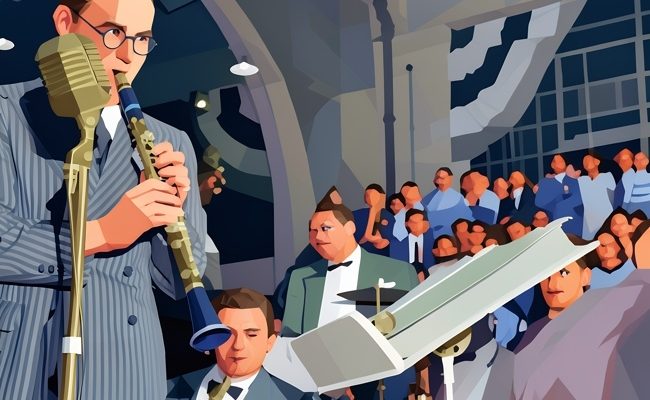
“A Smooth One”
Composed by Benny Goodman; head arrangement.
Recorded by the Benny Goodman and His Sextet for Columbia on March 13, 1941 in New York.
Benny Goodman, clarinet, directing: Cootie Williams, trumpet; Georgie Auld, tenor saxophone; Johnny Guarnieri, piano; Charlie Christian, electric guitar; Arthur Bernstein, bass; Dave Tough, drums.
The story – part 1 – the first half of 1940:
The electric guitar wizard Charlie Christian joined the Benny Goodman organization in the summer of 1939. (The story of that is told in the post here at swingandbeyond.com on the BG Sextet recording of “Breakfast Feud,” which can be accessed via the link at endnote 1.) I use this terminology because in Christian’s early days with Goodman, he did not play with the big band. His appearances were confined to the Goodman small groups, which from the time he joined were largely sextets. The first commercial recordings Christian made with Goodman were made on October 2, 1939. The group consisted of BG on clarinet, Lionel Hampton on vibraphone, Fletcher Henderson on piano, Arthur Bernstein on bass and Nick Fatool on drums. The times when Christian would perform as a member of the full Goodman band were rare. His first commercial recording as a part of that ensemble was “Honeysuckle Rose,” which was recorded on November 22, 1939.  That recording was of a Fletcher Henderson arrangement that had been in the Goodman book for almost five years, and had been played hundreds of times. It appears that Benny simply utilized Charlie Christian as a jazz soloist within this well-worn arrangement, and that Christian, who could and did create inspired improvisations on the chords of this tune throughout his career, did so in that recording. (The story and music of that recording can be accessed using the link at endnote 2.)
The year 1940 was one of transitions for Benny Goodman. The main reason for these transitions was the increasingly disturbing back pain Benny began to deal with through the first half of that year. This problem became so great that he had to break up his band in July, and have surgery on his back. For Goodman fans, this was momentous. Benny Goodman had led that band since mid-1934, and suddenly he and they were no longer on the scene. Consequently, there was a void in the world of swing, which was filled to some extent by clarinetist Artie Shaw, whose career entered a period of great success in the second half of 1940 and into 1941. Quite probably, the appearance of Artie Shaw’s small group, the Gramercy Five, in the late summer of 1940, including the electric guitar played by the talented Al Hendrickson, occurred then to give swing fans Shaw’s version of what BG had been doing with his small groups, including the electric guitar of Charlie Christian.(3)
 The second transition Benny Goodman had to make in 1940 was to operate his band without the revenue that flowed from his long-running Camel Caravan radio show. “Benny’s association with the R.J. Reynolds Tobacco Company expired with the broadcast of the December 30 (1939 show), after 182 programs spread over three and a half years. It was the longest running commercially sponsored series featuring one orchestra continuously.”(4) When Benny started broadcasting for Camel cigarettes in mid-1936, he was an up-and-coming young bandleader. When the series ended, he was an international music star known far and wide as the King of Swing, and a wealthy man. Although money was always a key consideration for BG in his career, through 1940, with the exception of a three-month hiatus from mid-July until mid-October when he had surgery on his back and then recuperated, what drove him most was his desire to present to the public the best band he could, while remaining true to his public identity as the King of Swing.
The band that Benny led through the first half of 1940 was excellent, an amalgam of veteran BG band musicians like trumpeter Ziggy Elman, vibraphonist Lionel Hampton, trombonists Sterling “Red” Ballard and Vernon Brown, tenor saxophonist Jerry Jerome, and newer arrivals like trumpeter Jimmy Maxwell, drummer Nick Fatool, and pianist Johnny Guarnieri. The great lead alto saxophonist Nuncio “Toots” Mondello had played in the early BG band in 1935, and returned for a one-year stint starting in mid-1939. Likewise, bassist Arthur Bernstein had worked with Goodman even before 1935, but he also settled in in mid-1939 for a lengthy stay. Of course, Charlie Christian was a key performer with BG in early 1940, as was the talented vocalist Helen Forrest, who had joined in late 1939, after establishing a solid reputation with Artie Shaw.

June 1940: Benny Goodman and his band pose on Catalina Island during their residency at the beautiful Catalina Casino Ballroom. L-R front: Johnny Guarnieri, Les Robinson, Toots Mondello, Red Ballard, Jerry Jerome; back: Arthur Bernstein, Bus Bassey, Vernon Brown, Irving Goodman, Helen Forrest, BG, Nick Fatool, Jimmy Maxwell, Ted Vesely and Ziggy Elman. Lionel Hampton and Charlie Christian are not in this picture because they were not permitted to stay in the St. Catherine’s Hotel on Catalina Island, where their fellow BG band members were billeted.(4)
 On July 10 1940, Benny Goodman, literally doubled over with pain from what had become a severe and chronic back problem (eventually diagnosed as sciatica), left his band, which was playing at the Casino Ballroom (4) on the island of Catalina off the southern California coast, twenty-two miles from Long Beach. His condition had reached a crisis point. Benny flew from Los Angeles to Minneapolis, and then was driven from there to Rochester, Minnesota, where he had surgery on his back on July 12, at the Mayo Clinic. Various reports had Ziggy Elman leading the band after Benny’s departure, with guest appearances by Artie Shaw and Kay Kyser for probably one night each, until they completed the engagement on July 13. After completing the Catalina gig, the first and most well-remembered Benny Goodman band, which had been in operation since mid-1934, disbanded. (At right: Benny Goodman, smiling gamely despite being in great pain because of a ruptured vertebral disc, pictured outside the Casino Ballroom on Catalina Island, June-July 1940. Notice how thick Benny looks around his middle. That was because he was wearing a heavy brace around his waist then in an attempt to minimize his chronic and intense back pain which radiated down one of his legs.)
 Six of the men in Goodman’s band immediately began to work for Artie Shaw, who at that very time was organizing a new band in Los Angeles after not having one since the prior November. A number of key BG performers including trumpeters Ziggy Elman and Jimmy Maxwell, guitarist Charlie Christian, bassist Arthur Bernstein, vocalist Helen Forrest and arranger Eddie Sauter were retained, with Benny paying them their base salaries. He wanted them to be available when he reorganized, which he hoped would be as soon as possible. He instructed Sauter to begin composing originals, which he would feature when his new band began performing.(5)
The story – part 2 – BG reorganizes:
“Benny Goodman remained at the Mayo Clinic until August 3, then he flew to Banff, Canada for a few weeks of rest.”(6) It was reported that he had his clarinet sent there so he could practice, which undoubtedly relieved the tedium of inactivity. Presumably, Benny returned to New York around September 1. He continued his recovery there until around October 1, when he began organizing a new band. The people he had kept on salary all returned, except for Lionel Hampton, who had decided to begin the process of organizing his own band, and Ziggy Elman, who decided to join Tommy Dorsey’s band in late August. Benny then began casting about for a trumpet soloist to fill the void left by Elman’s departure.
 Shortly before Benny left his band in July, he overheard a record that Jimmy Maxwell had been playing, and listening to with Benny’s trumpet-playing brother Irving, who at that time was a member of Benny’s band. Maxwell later recalled: “(Duke Ellington’s) ‘Concerto for Cootie’ was one of the records we played all the time. One day, …Benny asked us, ‘Who is that trumpet player?’ Irving said, ‘You’ve got to be kidding Benny. That’s Cootie Williams.’ Benny just nodded and said, ‘Yeah, that’s a pretty good solo he plays there.’ The following October Benny had Irving call the creator of that ‘pretty good solo,’ and offer him a job.”(6) Cootie signed a one-year contract with BG, which started on November 6, 1940. His trumpet would provide one of the defining sounds of the late 1940 – early 1941 Benny Goodman Sextet, which then included seven musicians. (Benny hired tenor saxophone soloist Georgie Auld as the seventh musician.)
The new Benny Goodman big band debuted on October 18, but the personnel was not set. Benny broke the band in slowly, and did not have a settled personnel until mid-November. The new Goodman band made their first commercial recordings on November 13, 1940.(7) The new Sextet, with Count Basie sitting-in on piano, had made some recordings on November 7. BG began taking the band on gigs at this time, and he continued making commercial recordings with both the big band and the Sextet in late November and through December. He also stepped-up his performances of “classical” music then, appearing at Carnegie Hall on December 12 and 13, playing the music of Mozart and Debussy.
Benny found it difficult to get a pianist whose playing would fit the music of his new ensembles. Many pianists worked with BG on an ad hoc basis through the final weeks of 1940 and into 1941. They included, in addition to Count Basie, Ken Kersey, Bernie Leighton, Milt Raskin and Teddy Wilson. Johnny Guarnieri, who had played very well in both BG’s big band and small groups is early 1940, was someone whose playing Benny appreciated. But Guarnieri was still a member of Artie Shaw’s band until mid-March, when he rejoined Benny, if only sporadically, until early June of 1941, when BG hired Mel Powell. Powell’s presence through the balance of 1941 and well into 1942, as both a pianist and arranger, would prove to be a boon to Benny’s music through that period.

Early 1941. The new Benny Goodman Sextet plays for an audience of dancers who were enjoying the music up-close. The musicians shown from L-R are: Georgie Auld, Charlie Christian, Bernie Leighton, BG and Cootie Williams.
The music:
The new Goodman band and small group continued to evolve through January of 1941. BG landed a radio show, sponsored by Old Gold cigarettes, called What’s New? which began its 13-week run on February 10. This show was broadcast only in the greater New York area on radio station WJZ. In order to solidify the rhythm section of the large and small groups, Benny hired the masterful Dave Tough on drums, whose salutary presence is immediately noticeable on Goodman recordings made through February and March. (Tough was in and out of the BG groups through April, and then out completely after the May 1 What’s New? broadcast.)
On March 13, 1941 all of the members of Benny Goodman and His Sextet were present in one of Columbia’s recording studios in Manhattan, except Benny. While everyone waited for BG, the Columbia sound engineers had the musicians play informally in order to achieve an optimum balance for when the actual recordings were made. Fortuitously, the recording equipment was turned on during this jam session, and the resulting recordings offer an insight into how the music of this great swing group was made. After Benny arrived, the group made several tries at what eventually resulted in two issued masters, “Good Enough to Keep,” later called “Airmail Special,” and “Moppin’ It Up,” later called “A Smooth One.”

Benny Goodman and His Sextet record on March 13, 1941. L-R: Arthur Bernstein, Cootie Williams; at his left elbow Charlie Christian; Dave Tough, Georgie Auld, BG and Johnny Guarnieri.
After a minimalist introduction that consists of Charlie Christian playing a chord repeatedly over Dave Tough’s brushed snare drum that evokes some strange Morse Code that announces that swing is about to happen, the ensemble comes in with two eight-bar passes at the main melody in the first chorus. It is played by Georgie Auld on tenor saxophone, Cootie Williams on plunger-muted trumpet, and Charlie on electric guitar, in unison. Benny flutters about fancifully on his clarinet, and pianist Johnny Guarnieri adds his own witty asides. The eight-bar bridge is taken by Cootie Williams, with BG’s quiet clarinet in the background. The final eight bars of chorus one are a reprise of the main melody as before.
 Chorus two encompasses the sixteen-bar improvised tenor saxophone solo by Georgie Auld which is played against a background of guitar and muted-trumpet riffs. Mr. Goodman solos on the bridge with a tasty piano accompaniment courtesy of Johnny Guarnieri. That last eight bars of this chorus bring Auld back for a bit more warm tenor, with those quiet riffs again setting off the robust sonority of his saxophone.
Chorus three is handled by the ensemble as in the first chorus, except Cootie adds some tart trumpet punctuations at the beginnings of each riffy phrase for the first sixteen bars. Christian then adds a funky solo on the bridge at the end of which the musicians say the word “Ma” or “Mop.”(7A) The final eight bars again repeat what was hears in the first sixteen bars of this chorus, but with a bit of Benny’s clarinet at the very end. (At right: the label of the original Columbia 78 of “A Smo-o-o-oth One,” including the attribution: Trombone-George Auld.)
“A Smooth One”
Composed by Benny Goodman; arranged by Eddie Sauter.
Recorded in performance by Benny Goodman and His Orchestra at the Meadowbrook Ballroom, Cedar Grove, New Jersey on September 11, 1941.
Benny Goodman, clarinet, directing: Billy Butterfield, first trumpet, with assists from Cootie Williams; Jimmy Maxwell and Al Davis, trumpets; Robert “Lou” McGarity and Robert D. “Cutty” Cutshall, trombones; Skip Martin, first alto saxophone; Clint Neagley, alto saxophone; Vido Musso and george Berg, tenor saxophones; Chuck Gentry, baritone saxophone; Melvin Epstein (Mel Powell), piano; Tom Morganelli, guitar; Morty Stulmaker, bass; Sid Catlett, drums.
More story:
May 5, 1941 was the date of Benny Goodman’s final What’s New? broadcast. Later in May and into June, he became involved in the Dance Carnival promoted by a man called Monte Prosser, which was staged in the old Madison Square Garden on Eighth Avenue and 50th Street, beginning on May 28. Bandleaders Charlie Barnet and Larry Clinton were also involved. This grandiose venture appears to have limped along for about ten days before folding. Barnet later reported that he and his band were not fully paid for their appearances at this venue.

May 31, 1941 – Madison Square Garden – the world’s largest nightclub, housing Monte Proser’s “Dance Carnival” under a star-studded super circus tent-size blue silk net sky. Benny, who appears to be enjoying the “crowning,” is flanked by Charlie Barnet, “queen” Joyce Matthews and Larry Clinton.
In early June, in preparation for an upcoming tour, Benny hired the eighteen year-old piano virtuoso Mel Powell, quite possibly on a trial basis, as Powell was at that time just beginning his musical career. Very soon, Benny realized that Powell was completely capable of performing brilliantly in any context, and then learned that Powell could also arrange. Powell remained with BG essentially until he began his military service in late 1942, and added greatly to the Goodman canon of classic tunes and arrangements.
The Goodman band began a summer tour by making their first stop at the ballroom at Cedar Point amusement park in Sandusky, Ohio for a week-long engagement that started on June 14. After that, they bounced around in the Midwest doing a couple weeks of one-nighters, then opened a choice engagement over the July Fourth holiday at the Steel Pier in Atlantic City, New Jersey. It appears that that gig lasted until at least July 12. Benny appeared as a soloist with the Philadelphia Orchestra at Robin Hood Dell on July 10, and then with the New York Philharmonic at Lewisohn Stadium on July 14. The Goodman band then headed for Chicago, where they opened a lengthy engagement at Hotel Sherman on July 25. That engagement would last until August 28.
 Sensing perhaps that Charlie Christian’s tuberculosis was worsening, Benny sought out another performer who could add excitement to the Goodman performances. The person he chose was the great drummer Sid Catlett. Sid was a large man, powerfully built. Though he was capable of playing with restraint and taste, he also could and did do things that could be characterized as showboating, including humorous vocal interjections into performances and his stick-tossing routine. Audiences generally were entertained by Sid’s antics, but Benny was not. It appears that something happened at a Goodman concert at Soldier’s Field in Chicago that started Sid’s downhill slide with BG. John Hammond recalled: “When I heard that Sidney had nearly caused a riot with his solo during Benny’s concert at Soldier’s Field, …I thought, Oh Jesus, Sidney’s cooked.” Bassist John Simmons, who was also a member of the Goodman band on that gig, elaborated: “…Sid took a solo on ‘Don’t Be That Way.’ Well, he started playing and then he threw a stick in the air – and dropped it. On purpose, of course. He got up and walked around in front of his drums and picked up the stick and started playing again. Then he threw the stick in the air, and dropped it again – and so forth. They were rolling in the aisles. But when he finally stopped horsing around and got down to business, that place nearly blew up. I was watching Benny’s face. It wasn’t a cheerful sight.”(8)

By mid-June, the Goodman aggregation was on tour. Tragically, Charlie Christian was forced to leave Goodman, probably at Cedar Point, and return to Manhattan because of tuberculosis. The story of his hospitalization and treatment is strange and sad. He died on March 3, 1942, not yet 26 years old. His withdrawal from the Goodman organization marked yet another turning point for Benny. Who could possibly fill the void left by Charlie Christian’s departure? (At right: Charlie Christian performs with Benny Goodman and His Sextet at the Ohio University Junior Prom, February 21, 1941.)
The Goodman band opened at the Meadowbrook Ballroom, on the Newark-Pompton Turnpike, in Cedar Grove, New Jersey on September 11, and remained at that venue until October 8, 1941. It is from the band’s opening night there that the full-band performance of “A Smooth One” presented here is taken.(9)
The music:
This arrangement is attributed to Eddie Sauter, though through most of this performance it sounds remarkably un-Sauterlike. My informed speculation is the Benny, seeing that his small group recording of “A Smooth One” was selling briskly, and facing the rapidly changing situation in his band and small groups, specifically that Charlie Christian was gone, permanently as it turned out, and Sid Catlett was very much present, indeed a presence in his big band through the summer of 1941, instructed Sauter to expand the tune to fit the band, specifically allowing room for Catlett to be heard.

From the downbeat Catlett is unmistakably present. The bright four bar introduction leads into the antiphonal sixteen bar main melody exposition/repeat where the saxophone quintet leads with Skip Martin on first alto balanced by Chuck Gentry’s robust baritone, answered by the brass, with Cootie Williams providing a zesty lead. The brass carries the secondary eight bar bridge melody, and the saxophones return as before to complete the first chorus.
 BG plays with inspiration through the entirety of the second chorus, his bright clarinet sound buoyed by the smooth saxophones and brass interjections. After this there is an ensemble burst that catapults Cootie Williams into a swaggering sixteen bar open trumpet improvisation that is strongly abetted by Catlett’s drumming. The reeds sail through the bridge then Vido Musso romps through an eight bar solo.
The final chorus is a shout, with the trumpets, saxophones and trombones playing in round-robin fashion leading to a volcanic explosion of Catlett’s tom-toms. The inevitable shout of “Ma” leads to the hot, riffing finale.
The recordings presented with this post were digitally remastered by Mike Zirpolo.
Notes and links:
(1) Here is a link to a recording of “Breakfast Feud” that fans of Charlie Christian will savor: https://swingandbeyond.com/2019/12/06/breakfast-feud-1941-charlie-christian-with-benny-goodman/
(2) Here is the link to the Benny Goodman big band recording of “Honeysuckle Rose” featuring a great solo by Charlie Christian: https://swingandbeyond.com/2026/04/03/honeysuckle-rose-1939-benny-goodman-fletcher-henderson-with-charlie-christian-and-ziggy-elman-1971-billy-may-with-abe-most-al-hendrickson-and-shorty-sherock/
(3) Artie Shaw’s first Gramercy Five was not simply a knock-off of the Benny Goodman Sextet. In order to clearly differentiate the two groups, Artie included an electric harpsichord in his group, played with skill by Johnny Guarnieri.
(4) There is confusion about where Benny Goodman broadcast from during the Catalina Casino Ballroom engagement, which ran from June 5 to July 13, 1940. It appears that the band was billeted at the lovely St. Catherine’s Hotel (Santa Catalina is Spanish for St. Catherine) on Catalina Island during the Casino Ballroom engagement. It has been reported that the few sustaining BG radio broadcast airchecks that have survived emanated from that Hotel. I wonder why those broadcasts would have originated at the Hotel instead of the Casino Ballroom. Goodman specialists, what do you think?
(5) The originals Sauter composed during this time and shortly after included: “Benny Rides Again,” “Superman” (as a feature for trumpeter Cootie Williams), “Something New” (Negra Soy), and “Clarinet A La King.”
(6) Swing, Swing, Swing …The Life and Times of Benny Goodman, by Ross Firestone (1993), 287.
(7) One of the recordings Benny made on November 13, 1940 was of Eddie Sauter’s original composition “Benny Rides Again.” Here is a link to the music and story of that: https://swingandbeyond.com/2019/10/05/benny-rides-again-1940-benny-goodman-and-eddie-sauter/
(7A) The swing era historian Christopher Popa suggested to me that the word the musicians shout is actually “Mop,” not “Ma.” This would make sense inasmuch as the original title for this piece was “Moppin’ it Up.” What do you think?
(8) The recollections of John Hammond and John Simmons regarding Sid Catlett and Benny Goodman first appeared in a profile of Sid by Whitney Balliett in the New Yorker. Later, Balliett gathered many of his other profiles of jazz musicians along with this one and had them published as a compendium called American Musicians …56 Portraits in Jazz (1986). It is from that compendium (page 186) that I extracted the quotes cited in this post.
(9) The details of Benny Goodman’s activities through the period 1940-1941 that appear in this post were derived from Benny Goodman …The Record of a Legend, by D. Russell Connor (1984).


I hear “Mop”, by parallel to “Bop”, vogueish in the Forties in songs like “Mop Mop” and “Rag Mop” and nicknames like “Klook-mop”.