“Danza Lucumi”
Composed by Ernesto Lecuona y Casado; arranged by William Grant Still.
Recorded by Artie Shaw and His Orchestra for Victor on October 8, 1940 in Hollywood.
Artie Shaw, clarinet, directing: Charles William “Billy” Butterfield, George “Jumbo” Wendt, Jimmy (Jack) Cathcart, trumpets; Truman Eliot “Jack” Jenney and Vernon “Red” Brown, trombones; Les Robinson and Neely Plumb, alto saxophones; Clarence “Bus” Bassey and Jerry Jerome, tenor saxophones; John A. “Johnny” Guarnieri, piano; Alton Reynolds “Al” Hendrickson, guitar; Jud De Naut, bass; Nicholas “Nick” Fatool, drums; Truman Boardman, Ted Klages, Bill Brower, Bob Morrow, Alex Beller, Eugene Lamas, violins; Allen Harshman and Keith Collins, violas; Fred Goerner, cello.
(The music presented with this post strongly evokes Hollywood to me, the Hollywood of 1940, or at least my idealized version of that place and time.)
The story- part one – elegance.
 Elegance. That word summarizes concisely how the 1930s and 1940s felt, at least in some ways. Men wore suits and hats much more than they do now. Women wore dresses. (At right: Hollywood film start Cary Grant in the 1930s. He epitomized elegance then and for the next four decades.) There was a much more pronounced sense of formality in the mass media, especially in music. Music was made for the most part by highly trained and/or experienced professional musicians. The bands they played in were usually identified with the name of the person who was the leader of the band. When bands appeared in public to perform, they were often clad in suits or tuxedos. The songs bands performed were often sophisticated, with words and music composed by master craftsmen (and a few craftswomen).
American popular culture was evolving during the swing era. It was being shaped increasingly by successive waves of new mass media. In the first two decades of the Twentieth Century, recorded sound and primitive moving pictures entered the pop culture mainstream. Then commercial radio appeared and soon thrived in the decade of the 1920s. As the Twenties ended, sound arrived in motion pictures. The decade of the 1930s in many ways saw a consolidation and massive expansion of all of these media, and others. Each medium became an industry unto itself.
These industries were greatly enriched by the new music being composed by American musicians who were writing in most instances for the mass media of the time. A parallel but much smaller consumer of new music then was the Broadway theatrical world. Broadway also consumed vast amounts of new music, and often the music that started out as a part of a Broadway production was then performed on network radio, on commercial recordings and/or as a part of Hollywood feature films. From the 1930s well into the 1960s, the mass media in the U.S.A. was awash in music, the majority of which had been composed fairly recently. Indeed, the creation and promotion of new popular music became an industry unto itself starting in the nineteen-tens, and then experienced explosive growth through the 1920s and 1930s.
As a result of the landmark U.S. Copyright law of 1909, the creators of new music, new feature films, and new Broadway productions obtained what lawyers call “property rights” (that is ownership) in their works. As these new copyrighted works were packaged and sold via the mass media, great amounts of money were generated. Consequently American composers like Irving Berlin, Jerome Kern, George Gershwin and Cole Porter, among many others, became wealthy men, whereas composers like Steven Foster and Scott Joplin, who created their music largely before 1909, died in poverty.
 In addition to the mass media development of American pop culture in the early decades of the Twentieth Century, other cultural trends added to the elegance of America through those years. No trend added more however than Art Deco. Art Deco, short for the French Arts Décoratifs ( Decorative Arts), is a style of visual arts, architecture, and product design that first appeared in Paris in the 1910s, just before World War I, then became a vogue internationally during the 1920s to early 1930s. Art Deco found expression in styling and design of the exterior and interior of anything from large structures to small objects, including clothing, fashion, and jewelry. Art Deco has influenced buildings from skyscrapers to cinemas, bridges, ocean liners, trains, cars, trucks, buses, furniture, and everyday objects, including radios and vacuum cleaners.(1)
The city of Los Angeles was experiencing enormous growth in the 1920s and 1930s. Art Deco inspired architecture flourished in Los Angeles then. (Above left: An entrance to the Art Deco Hollywood Bowl, an outdoor concert venue in Los Angeles which opened officially on July 11, 1922. See the comment of Nick Rossi below for more information about this sculpture.)

Hollywood has always been as much a state of mind as it has been a place.
Another architectural expression of Art Deco, via its descendent Art Moderne, is the Los Angeles Coliseum. It was erected in the 1920s, and then expanded in 1932 for the summer Olympic Games that were held in Los Angeles then. Moderne architecture (also called Art Moderne or Streamline Moderne) is a 1930s style that evolved from Art Deco. It favored smooth surfaces, horizontal lines, and curved corners over vertical geometry. Influenced by airplane and automobile aerodynamics, it remains famous for its minimal decoration, flat roofs, and steel “speedlines.”(2)
The story – part two – Shaw in Hollywood.
 Through the spring of 1940, Artie Shaw, firmly ensconced in the Hollywood film capital since early in the year, and his managers were actively pursuing opportunities that would feature him and a band on a sponsored network radio show, and in his second feature film. During this time, Shaw was living in his home on Summit Ridge Drive in Hollywood with his wife, M-G-M starlet Lana Turner. (Above right: Artie and Lana Turner – spring 1940, playing the Hollywood game.) Shaw had no standing band. In whatever work he chose to do, he was supported by ad hoc musical aggregations, usually Hollywood studio musicians. As summer began, it was announced that Shaw would appear in another feature film, this one entitled Second Chorus, to be produced by Paramount, and star Fred Astaire and Paulette Goddard. He was also selected to appear on the highly successful sponsored weekly George Burns and Gracie Allen NBC network radio show. Consequently, had no choice but to form his own standing band, which he began to do in late June. The first Burns and Allen show with Artie Shaw aired on July 1.

NBC studios in Hollywood in the early1940s. It is from this venue that Artie Shaw and His Orchestra broadcast in 1940-41 on the popular Burns and Allen radio show. (2A)
Artie was aided greatly in this process by the coincidental disbanding of Benny Goodman’s band, which had been playing in southern California. Goodman’s chronic sciatica had by the summer of 1940 become so painful that he was advised to have surgery to alleviate some of the discomfort. He left his band in early July, and shortly after the following Goodman sidemen transferred to Shaw: lead alto saxophonist Les Robinson (Shaw’s lead alto player from 1937 through 1939, who had been Artie’s contact in the Goodman band); tenor saxophonists Jerry Jerome and Bus Bassey; trombonist Vernon Brown; pianist Johnny Guarnieri; and drummer Nick Fatool. Around this strong nucleus of players, Shaw built his new band. His first trumpeter was Billy Butterfield, who was also a fine jazz soloist. His eventual first trombonist, Jack Jenney, was also an excellent jazz soloist (especially on ballads), who had very recently decided to give up his own band, which had been commercially unsuccessful.

The instrumentation of the new Shaw band was that of a standard swing ensemble (three trumpets; two [later three] trombones; four saxophones; and four rhythm), plus six violins, two violas, and one cello. The string section was gathered for Shaw by violinist Alex Beller, who acted as concertmaster for the strings. This band started out very good, and just got better as time passed. Shaw’s own playing at this juncture, despite his relative inactivity for the previous seven-plus months, was superb. (At left: Shaw and Lana Turner in his house on Summit Ridge Drive in Los Angeles – spring 1940.)
Despite the almost immediate cohesiveness of the musicians Shaw had hired, and the continuous demands of ballroom and theater operators across the nation for personal appearances, Shaw vetoed all proposals to take this group on the road. The band remained in Hollywood. At first, they rehearsed, played the Burns and Allen radio shows weekly, and through late July and early August worked on the film Second Chorus. Shaw meanwhile continued to reside in his house on Summit Ridge Drive with movie starlet Lana Turner, whom he had met while filming Dancing Co-ed at M-G-M the previous summer. They had married earlier in 1940.
 It was stipulated in Shaw’s contract to work on Second Chorus that whatever was required of him and his band during production of the film, it would not in any way interfere with his weekly commitment to the Burns and Allen radio show. The work of Shaw and his musicians on that film started on July 26, 1940 and ended on approximately August 16, 1940. Artie was very well compensated for his and his band’s appearance in Second Chorus. (Above right: Shaw and actress Paulette Goddard have fun in the film Second Chorus.)
Shaw’s commitment to the Burns and Allen radio show required his presence in Hollywood only on Mondays, the day the show was rehearsed and then broadcast.  On most or all of the other six days of the week through the second half of August, Shaw and his musicians rehearsed what was essentially a new repertoire of music for his big band, and began working on several tunes which would feature a small group that Artie dubbed the Gramercy Five, after one of the romantic sounding telephone exchange names that were then used in New Your City. This process of developing the new band’s book of music continued from mid-August until September 3, when the first Gramercy Five recordings were made for Victor. Four titles were recorded. On the evening of September 7, Shaw took his full orchestra into Victor’s Hollywood studio to make their first recordings. At that session, four titles were recorded. (Above left: Victor’s Hollywood studio in the 1940s.)
In order to keep this new band working through each week, Shaw’s management team secured a location gig for them, at the Palace Hotel in San Francisco, where they were ensconced from September 12, 1940 until late November. Sidemen described being in San Francisco then as idyllic. While they were at that location, they flew to Los Angeles every Monday to rehearse and broadcast the NBC Burns and Allen radio show. This schedule made it difficult for Shaw and his orchestra to make recordings in Hollywood for Victor. Only one recording session was scheduled during this time, on October 7 into October 8. The Palace Hotel gig was originally scheduled to last six weeks, but it was extended into late November. By then, Artie was getting restless, a condition that afflicted him his entire life.

Artie Shaw and His Orchestra at the Palace Hotel in San Francisco in the autumn of 1940. The girl at the microphone is vocalist Anita Boyer. The musicians across the back row are: bassist Jud DeNaut, drummer Nick Fatool, trombonists Jack Jenney and Vernon Brown, trumpeters Jack Cathcart, George Wendt and Billy Butterfield.
The music:
Billy Butterfield sometimes shared the first trumpet book for this orchestra with George “Jumbo” Wendt, a Los Angeles-based musician. Although both were powerful players, it is rather easy to differentiate between their playing: Wendt had a faster vibrato and a more piercing sound. Although Wendt can be heard playing lead parts on “Marinella,” “Danza Lucumi,” and the first half of of “Dancing In the Dark” (including the solo), Butterfield’s fat, ringing lead trumpet tone most often defined the sound of Shaw’s 1940-41 brass section, including on the brilliant finale of “Dancing in the Dark.” (A link to Artie Shaw’s recording of that song can be found at endnote 3)
 “Danza Lucumí” is an Afro-Cuban instrumental piece composed in 1928 by the renowned Cuban pianist and composer Ernesto Lecuona. This piece was originally a part of Lecuona’s 1928 piano suite Danzas Afro-Cubanas, which fused European harmonies with Afro-Cuban rhythms. It is unclear how this piece came to Artie Shaw’s attention. I will speculate that he and William Grant Still discussed how they could collaborate on a follow-up to the massively successful “Frenesi,” and Still did the actual detective work that resulted in finding this composition. Another possibility is that “Danza Lucumi” was brought to Shaw’s attention by the Cuban bandleader Desi Arnaz, whom he met in 1940 in Hollywood. Arnaz was a close friend of Lecuona. “Danza Lucumi,” with an English lyric by Albert Gamse, was recorded by Benny Goodman and Glenn Miller in 1941 under its English title, “From One Love to Another.”(4)

The Shaw-Still collaboration on “Danza Lucumi” is made up of many apparently disparate parts. I will suggest that Artie used this arrangement (along with the one on “Star Dust,” which was recorded on the same date) as a welcoming gifts for the velvet-toned trombone virtuoso Jack Jenney, who had joined his orchestra shortly before this recording was made. (Above left: Jack Jenney and his wife, singer/composer Bonnie Lake, pictured in Golden Gate Park in San Francisco in the autumn of 1940. Many of the musicians in the Shaw orchestra had their wives with them while they worked at the Palace Hotel from mid-September to late November 1940. Tenor saxophonist Jerry Jerome told me that this time “was like a two and a half month vacation.”)
The bright, brief introduction spots all four saxophonists playing their clarinets, along with Shaw, to establish the rhythmic base for this performance, along with Nick Fatool’s ringing snare drum patterns. The strings add warmth, evoking the sunny, blue skies, pre-freeways and smog Los Angeles of 1940.

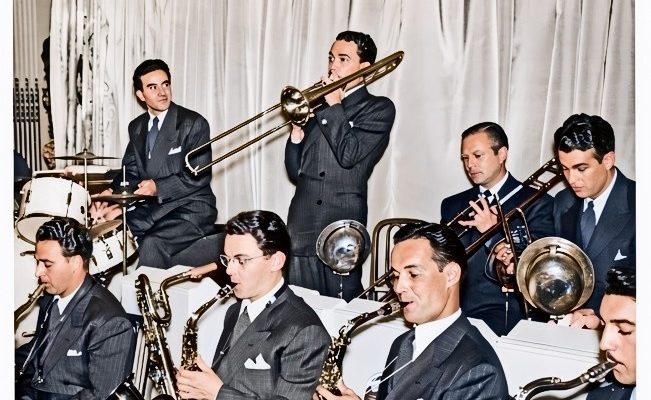
Jack Jenney plays a solo as drummer Nick Fatool looks on approvingly. To Jenney’s left are Vernon Brown and Jack Cathcart. In front are the saxophone section, L-R: Jerry Jerome, Neely Plumb, Les Robinson, and Bus Bassey.
Jack Jenney sings the melody on his open trombone, his silken sound caressed by the strings. His playing is elegant. He could justly be regarded as the Cary Grant of the trombone. The next sequence features the smooth sound of the saxophone quartet, led in impeccable fashion by Les Robinson. The straight-muted trumpet we hear was played by George Wendt. The next tract has the strings out front, with Jerry Jerome warming their sonority with his tenor saxophone, a felicitous arranging touch. Jenney and the saxophones play melodically to finish the chorus.
What follows is percussively rhythmic with various instruments being heard before the straight-muted brass (Wendt in the lead) take over, with undulating saxophones beneath them.

The brass section of Artie Shaw’s orchestra at the Palace Hotel in San Francisco – autumn 1940: L-R: Jack Jenney, Vernon Brown, Jack Cathcart, George Wendt and Billy Butterfield.
Shaw’s clarinet solo is delivered with rhythms that to my ears recall his remarkable ability to play Klezmer style music.(5) But somehow, what he plays here fits perfectly. His final couple of bars have him soaring off dramatically into his high register.
The ensemble plays as a unit, now with Billy Butterfield playing the first trumpet part, a melodic beacon to guide the orchestra. The strings and saxophones offer a brief contrast, then the orchestra returns as a unit to take the music to its conclusion.
The recording presented with this post was digitally remastered by Mike Zirpolo.
Notes and links:
(1) Wikipedia article on Art Deco.
(2) Wikipedia article on Art Moderne.
(2A) Here is a link to a brief story about the NBC studios in Los Angeles in the 1940s: https://www.youtube.com/watch?v=QJiTfnfhySA
And another fascinating collection of information and images about those studios: https://martinturnbull.com/photo-blog/2017/05/31/a-collection-of-photos-of-the-nbc-radio-and-television-studios-on-the-northeast-corner-of-sunset-blvd-and-vine-street-hollywood-los-angeles/
(3) Here is a link to Artie Shaw’s great recording of “Dancing in the Dark”: https://swingandbeyond.com/2022/11/19/dancing-in-the-dark-1941-artie-shaw-lennie-hayton/
(4) Benny Goodman’s recording of “From One Love to Another” was recorded on August 1, 1941, with a vocal by Tommy Taylor. Glenn Miller’s recording of this song was made on August 11, 1941, with a vocal by Ray Eberle and a cornet solo by Bobby Hackett. It should be noted that this song was not ASCAP licensed, and could therefore be broadcast on radio during the 1941 ASCAP-radio dispute, which did not end until later in 1941.
(5) For a deep-dive into Artie Shaw’s relationship with Klezmer, follow this link: https://swingandbeyond.com/2018/10/13/the-chant-1939-artie-shaw-and-klezmer-music/
Here are links to other great performances by Artie Shaw’s 1940-1941 orchestras:
https://swingandbeyond.com/2025/12/14/frenesi-1940-artie-shaw-william-grant-still/
https://swingandbeyond.com/2022/03/31/temptation-1940-artie-shaw-with-les-robinson-and-nick-fatool/
https://swingandbeyond.com/2017/10/21/star-dust-1940-artie-shaw/
https://swingandbeyond.com/2021/06/16/blues-from-lenox-avenue-1940-artie-shaw-william-grant-still/
https://swingandbeyond.com/2016/03/25/88/
https://swingandbeyond.com/2023/05/12/april-in-paris-1940-artie-shaw-and-1955-count-basie/


As always, an excellent article. But see any ’30’s or ’40’s movie shot outdoors to reveal that we’ve had terrible smog during that period and beyond. Exhaust from motor vehicles was rich with visible particulate matter and every long shot was “cloudy”. Today–huge improvement.
Thanks Randolf for your kind words. I’m very happy to learn that the L.A. smog problem is being solved. That is very good news.
Thank you, Mike, for a crystal-clear remastering job of Artie Shaw’s stylish “Danza Lucumi,” with your interesting historical context of, to me, what is a much-lamented Hollywood (and America) of the 1940s. And I applaud your informed speculation how Artie Shaw may have learned of “Danza Lucumi.”
Christopher, thanks for your comment. The recordings made in Victor’s Los Angeles studio before World War II were some of the best-sounding of the swing era. Victor’s Harry Meyerson was responsible for that. We recognize and thank him for that here at swingandbeyond.com My work in remastering Harry’s brilliant source recording here was much easier than it often is.
Mike, this is a post which touches on a few “erogenous” zones, namely the peak of western culture, contemporary architecture, and the golden age of Hollywood.
I’ve often thought that Artie Shaw was a frustrated writer for screen scores, so much of his work has “Noir” all over it.
It’s a warm night here in England, and I’ve just been outside, listening to some of Artie’s work from this period; “I ask the Stars”, “Dusk (Evensong)”, and “Suite no.8” have femmes fatales draped all over them, not to mention a smoking .32, and some mug in the frame(!)
There are others. His work from here to the Navy epitomises that sound. I for one, will never get tired of listening to it. It goes on forever.
Seriously though, Artie could have written some brilliant scores for the screen, although, as we all know, not for long…
Mark, your comments are excellent and for the most part I agree with you. However, I find it odd that when he had the opportunity to write a film score during this period – namely “Second Chorus” – that the results were somewhat lackluster. As Mike says, Shaw was well compensated for his work on the relatively low budget film and is credited with the music (perhaps the first jazz musician to receive an on screen credit for a film score) and yet the actual music he appears to have written for the underscore is both minimal and slightly underwhelming compared to much of his 1940-1941 work. Shaw was attached to the project months before shooting began so I do wonder why the results are somewhat disappointing – again, at least compared to what else he recorded during this period.
Hi Nick, thanks for replying, and I really must check out the score of Second Chorus again, as it’s been many years since I last saw it. In fact, apart from C4C, I didn’t realise he’d scored the rest of the film- leastways, it didn’t make much impression!
Mark, I appreciate your comments. You mention music from Shaw’s 1941-1942 orchestra. That was certainly a special group. The atmospheric titles you mentioned are great evocations of swing noir. But that ensemble could also romp. Check out their recording of “Just Kiddin’ Around.”
As always Mike, an absolutely excellent piece of work here on Shaw. In a fine example of synchronicity, I just recently completely work on a “Second Chorus” project, as part of an upcoming restored Blu-ray release so I have been up to my eyeballs in all matters Shaw 1940-1941. As you suggest, his music from this period is so evocative of both the time and place – and just plain excellent. As a side note, that image of the Hollywood Bowl you used in this piece includes one of my favorite pieces of public art in Los Angeles: George Maitland Stanley’s Muse of Music, completed in 1939 for the venue as part of a government-sponsored WPA project. It exemplifies the late Deco period, particularly as it manifested here in the USA, part of what often is termed Streamline Moderne. But by any name, it’s among my favorites in design aesthetics and big part of that elegance you mention that was 1930s Hollywood. Thanks again, this made my evening.
Thanks for your comments Nick. I’m glad this brought a bit of joy to you.