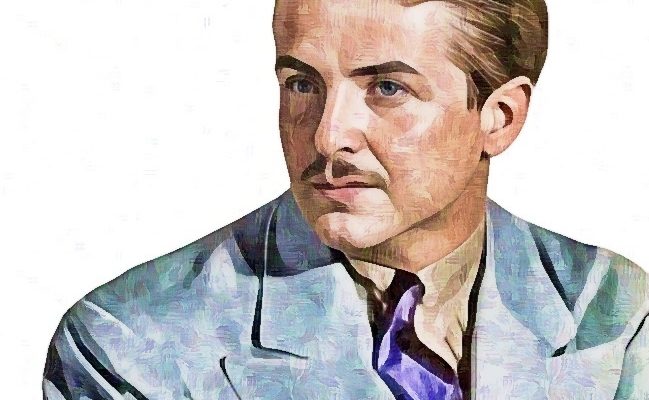
“Trees”
Composed by Oscar Rasbach, arranged by Abe (later Glenn) Osser.
Recorded by Bunny Berigan and His Orchestra for Victor on December 23, 1937 in New York.
Bunny Berigan, first and solo trumpet; directing: Steve Lipkins and Irving Goodman, trumpets; Sonny Lee, first trombone; Al George, trombone; Mike Doty, first alto saxophone; Joe Dixon, alto saxophone; Georgie Auld and Clyde Rounds, tenor saxophones; Joe Lippman, piano; Tom Morganelli, guitar; Hank Wayland, bass; George Wettling, drums.
The story:
 On December 23, 1937, Bunny Berigan led his bandsmen into Victor’s Twenty-fourth Street studios in Manhattan. The last time they had been there was on October 7, before they went on a tour of the major theaters and ballrooms of the eastern U.S. Despite fine trumpeting by Bunny, that session, as directed by Victor’s self-styled hit-maker Eli Oberstein, produced only four forgettable pop tunes with vocals. This session, which began at 1:00 p.m., ran until 5:30, produced five instrumentals, something that was virtually unheard of in the swing era. All of the performances recorded that afternoon are good, and a couple of them, including “Trees,” are more than that.
Bunny and his band’s late 1937 tour culminated in a triumphant stand at the premier swing era showcase for big bands, the Paramount Theater on Times Square in Manhattan. That engagement ran from November 24 to December 7.(1) Before that tour, Bunny had slowly become submerged in debt as a result of the lengthy build-up process he and his band had undergone through much of 1937. By the time this recording was made, Berigan had cleared all of his debts and had a substantial amount of cash on-hand to continue the operation of his band. Late December of 1937 was an early peak of financial success for the Berigan band.
Musically, the band was quite good then, and they benefitted from many fine arrangements by their chief arranger, Joe Lippman, who was also the band’s pianist. But like all good bandleaders, Bunny sprinkled in some arrangements by outside writers in order to add a bit of variety to the music his band played. The arrangement on “Trees” that is played here by the Berigan band was one such, from the gifted Abe Osser. It was clearly designed as a showcase for the expressive and virtuosic Berigan. By the time this recording was made, Bunny, by performing with his band from five to seven hours a day for almost all of 1937, was playing brilliantly, even by his own vaunted standard.

The Berigan band, with Bunny out front, on the stage of the Paramount Theater in Manhattan December 1937. L-R front: Clyde Rounds, Mike Doty, Joe Dixon, Georgie Auld, Irving Goodman, Steve Lipkins, Al George and Sonny Lee; back: Tom Morganelli, George Wettling and Hank Wayland. Pianist/arranger Joe Lippman is not in this picture.
The music – part one – the studio recording:
It would seem that the vintage tune “Trees” (written in 1922 by Oscar Rasbach as a melody for the poem previously written by Joyce Kilmer while he was serving in France during World War I, shortly before he was killed in action), was a rather odd choice as a vehicle for the dramatic and expressive Berigan trumpet. Nevertheless, with this recording, Bunny utterly transformed it into one of the essential performances not only of his career, but of the entire swing era.
Abe Osser’s arrangement is open and airy, and is taken at a perfect dance tempo. It provides an ideal showcase for Bunny’s unique talents as both a first trumpeter and as a jazz soloist. Joe Dixon on clarinet leads the reeds, which play the background figures while Berigan leads the cup-muted brass, which carry the melody through the first twenty-four bars. Bunny’s very personal sound, phrasing, and expressive vibrato utterly permeate and define the sound of the brass choir: no one else could ever play this music in precisely this way.

When Dixon switches to alto saxophone, the four-man sax team steps out for sixteen bars of its own superb melodic playing under the supple lead of Mike Doty’s first alto, with the still muted brass punctuating behind them. At about bar 10 of this chorus, the brass are suddenly open, and warm; they then finish the chorus with eight glistening bars of melody. The saxophones modulate into Berigan’s iconic open trumpet solo.
The late jazz trumpeter and writer Richard M. Sudhalter, who knew what playing the trumpet was all about, explained what happened next: “He chooses the trumpet’s lowest register to begin a solo that after many hearings seems less an improvisation than a commentary on both Kilmer’s poem and (Rasbach’s) melody. Especially poignant is a drop to his F sharp (concert E) in bar six, followed by a low F (concert E flat), a note not actually on the horn, but which Bunny ‘lips’ into being. A magnificent upward sweep to his high B flat and he sings out a legato passage in his horn’s highest register, culminating a clarion high F—all with no diminution of power or tonal breadth. He lets Lipkins carry things for four bars, then returns to play his own strong, sure lead, bearing the performance into immortality.”(2)

I have played this recording for many trumpeters, and have discerned a consensus in their reactions to it. That consensus can be summarized in the statement I heard more than once: “Man, there’s a lot going on when he plays.” It has taken me a long time to begin to understand what that means. Berigan did not just play notes on his trumpet, he shaped them, he sculpted them. He used a wide assortment of musical devices including: glissandi, slurs, scoops, rips, growls, half-valve effects, and lip vibrato. He also ventured bravely into the lowest and highest registers of the trumpet. These techniques most often resulted in deeply expressive playing by him. The downside of using them was that each of them held pitfalls that could result in missed or cracked notes. Berigan did the cost/benefit analysis, and usually opted to keep using theses expressive techniques in his solos. As singer and pocket comb (covered with tissue paper) virtuoso Red McKenzie, who worked with Bunny often in the mid-1930s said: “If that man wasn’t such a gambler, everybody would say he was the greatest that ever blew. But he’s got such nerve, and likes his horn so much that he’ll go ahead and try stuff that nobody else would ever think of trying.” Indeed!
 Usually, the best judges of any human endeavor are those who do the same thing professionally. Fellow trumpeters made no secret of their opinions about Bunny’s trumpeting. Louis Armstrong’s admiration for Berigan’s playing is well-known. Harry James, one of the greatest trumpet virtuosos who ever lived, was also deeply affected by Bunny’s playing. When James first arrived in New York in 1936, he couldn’t wait to go the the Famous Door, a small jazz club on West 52nd Street, to hear Bunny. After he heard Berigan play, he confided to a companion: “this is the greatest living trumpet player.” A little later, after James had become the star of Benny Goodman’s 1937-1938 band, he raced up to the Savoy Ballroom in Harlem after the Goodman band had finished work for the night to catch the battle of music between Berigan’s band and that of Erskine Hawkins, another fine trumpeter who specialized in high-note playing. Berigan’s guitarist then, Dick Wharton recalled: “(Harry stood) only a few feet in front of the bandstand to hear Bunny. He stood there set after set.”(3)
 Trumpet virtuoso Mannie Klein, perhaps the most recorded trumpeter in history, met Berigan in the radio and recording studios of Manhattan in the early 1930s, and performed with him many times. Indeed, Klein substituted for the workaholic Berigan often because during his free-lance days as a studio musician Bunny’s services were in such high demand he literally could not get to all the gigs he had agreed to play. His opinion: “You didn’t know sometimes if he was going to show up for a session. But when he did show up–well, nobody played with the balls and the beat he did.” (4)
The trumpeter Uan Rasey, like Mannie Klein a stalwart Hollywood studio player whose career spanned a half-century, was not only a virtuoso performer – he was a teacher who thought deeply about trumpet technique, and then passed on his insights to many students. Here are his thoughts about Bunny: “(Bunny) played some solos that were so good… His solos came across well. His solo on (Tommy Dorsey’s recording of) “Marie” is a classic. Very few people have everything tied together like he did. It takes a lot of work to do that.” (5)
Berigan’s performance here on “Trees” is obviously a tour de force in the technical sense, but more than that, it is a magnificent, passionately made musical statement. The emotional and musical content of Berigan’s playing here is so powerful that the technical wizardry is all but completely subsumed by it. All in a day’s work, I guess—if you are Bunny Berigan.
Part two – the live recording:
Recorded in performance live at the Paradise Restaurant, New York City, May 3, 1938.
Bunny Berigan, Steve Lipkins, Irving Goodman, trumpets; Nat Lobovsky and Ray Conniff, trombones; Mike Doty ( as/cl/bcl), Joe Dixon (as/cl), Georgie Auld (ts/cl), Clyde Rounds (ts/bs/cl), reeds; Joe Lippman, piano; Tom Morganelli, guitar; Hank Wayland, bass; Johnny Blowers, drums. Gail Reese, vocals.
More story:
During the first year of his band’s existence, Bunny built a very strong ensemble whose personnel remained stable from the summer of 1937 well into 1938. Notable new performers included Thomas Ball “Sonny” Lee, a veteran trombonist who was a first-rate lead player and jazz soloist; Robert “Mike” Doty, an experienced and very strong lead alto saxophonist; much respected bassist Frederick “Hank” Wayland; and the young and exciting jazz clarinetist/alto saxophonist Joe Dixon. Tenor saxophonist Georgie Auld came into Bunny’s employ as an eighteen year-old prodigy and left in late 1938 as a fine jazz soloist. Joining the Berigan band just days before they opened at the Paradise on Sunday March 20, 1938, was drummer Johnny Blowers (pronounced like flowers), who replaced the fabulous Dave Tough, who had replaced George Wettling. Berigan had a thing for drummers: he liked great ones. (Buddy Rich would follow Blowers into the Berigan band. Later, Jack Sperling drummed for Bunny.) Blowers, though less well-known than Bunny’s other great drummers (largely because he spent the vast majority of his long career in the studios), was nevertheless a splendid, colorful drummer.
Berigan broadcast very frequently over the Mutual radio network while he was at the Paradise. He and his band were a great hit there. Their engagement was extended several times with it eventually running seven weeks (March 20 to May 6, 1938).

Bunny Berigan and his band on the stage of the Paradise Restaurant in Manhattan in late March 1938. L-R front: pianist Joe Lippman, vocalist Gail Reese, Tom Morganelli, Georgie Auld, BB, Joe Dixon is hidden behind Bunny, Mike Doty, Clyde Rounds; back: Johnny Blowers, Hank Wayland, Irving Goodman, Steve Lipkins, Al George and Sonny Lee.
This performance occurred toward the end of that engagement. The musicians in Bunny’s band generally liked working for him. The level of performance of the band was very high, and everyone involved had great pride in that. Although Bunny was not a disciplinarian in the manner of Tommy Dorsey, Glenn Miller or Benny Goodman, he was very focused on every aspect of the band’s musical performance. According to the arrangers who worked for him then, including Joe Lippman and, starting in the spring of 1938, Andy Phillips, Bunny knew exactly what he wanted from his sidemen, and usually got it. He respected them as musicians and it was understood that they were in his band because they were talented professionals. His method to shape the music was to demonstrate on his trumpet how he wanted the nuances to be handled. They took it from there.
Of course, what made working in the Berigan band a unique experience for the musicians was their ongoing proximity to Bunny’s playing. Everyone who ever worked with him, even casually, knew that he was an extraordinary musician. His playing in the technical sense was on a very high plane. There was very little he was unable to do with his trumpet. In addition, he was a crack reader of music, could transpose keys at sight, and had a great sense of how to choose the best tempos. But it was in the area of his solos that he was most impressive to his fellow musicians. No one was more favorably impressed by Berigan’s trumpet artistry than his fellow trumpeter and band member Irving Goodman, one of Benny Goodman’s younger brothers. “Steve (Lipkins) and I would sit there in the back row, night after night, set after set and watch and listen to Bunny and be totally amazed at what he could and would do. I think most jazz musicians could appreciate Bunny’s improvisations and many of the things he did, but I think you have to be another trumpet player to really, totally, understand and appreciate what Bunny was able to do on the trumpet. Oh, he had his off nights and on occasion he was less than inspired, but even then his playing was far above many of us. Steve was a fine lead player; I was a less than average soloist. But night after night Steve and I would look at each other often with a nod or a raised eyebrow, etc. in acknowledgment of what we’d just heard Bunny do. Playing the trumpet is damn hard work and Bunny would often make it seem so easy! But Steve and I knew how hard it was. Bunny, being able to drink as he did and still play, was even more amazing to us. Sonny Lee in our band had played with many of the greats including Bix. He told Steve and me on a number of occasions how great Bunny really was. I know Muggsy (Spanier) told Ralph Muzzillo, another very fine lead trumpet player, how much he admired Bunny’s playing. We all did!” (6)

Nevertheless, then as always, the musicians in Bunny’s band were being pulled in many directions, usually by wives, children, a desire to get off the road, and of course, money. Whenever any of them left the Berigan band, it was usually with some regret. Trombonist Sonny Lee, who left while they were at the Paradise Restaurant, later explained how that worked-out for him: “…Jimmy Dorsey, who was playing around the corner at Hotel New Yorker, made me an offer of $300.00 a week. This was considerably more than Bunny was paying, and too good to turn down. Still, I was reluctant to leave Bunny because of the band’s musical kicks.” (7) (Sonny Lee did then join Dorsey, and remained with Jimmy until 1946.)
The music:
This performance of “Trees” is excellent, and although Bunny plays the same solo as on the Victor record (his fans demanded this) (8), there are nevertheless some variations. The tempo here is a bit slower. Berigan’s lead in the cup-muted segment is quintessential, and it permeates the music. The saxophone soli are perhaps a bit more relaxed than on the Victor recording, with lead man Mike Doty really singing out his part. Bunny’s lead trumpet sound on the open brass tract is incandescent.
A word about that. We must remember that in this band, Bunny played a lot of the lead trumpet parts, and then immediately after played solos. Fans were basically unaware of what Bunny was doing when he played the lead parts, though they undoubtedly felt what he was doing. But when he played solos, their expectation was always that he play great and perfectly, like on the records. When solos like this one were involved, that was very difficult to do. But Bunny being who he was, plunged ahead. Angels sometimes rush in where fools fear to tread.
The recordings presented with this post were digitally remastered by Mike Zirpolo.
Notes and links:
(1) The Berigan theater tour continued after the Paramount Theater engagement ended on December 7. They appeared at the Metropolitan Theater in Boston from December 9-15, and grossed $24,000.00 ($360,000.00 in 2016 dollars.) After that, they did one-night dance jobs until the December 23 Victor recording date.
(2) Liner notes—The Complete Bunny Berigan, Vol. 2 (1986); RCA/BMG Bluebird 5657-1-RB, by Richard M. Sudhalter.
(3) White materials, November 4, 1938.
(4) Lost Chords…White Musicians and Their Contribution to Jazz 1915-1945, by Richard M. Sudhalter, Oxford University Press (1999), page 496.
(5) Goz and Other Greats …An Anthology of Interviews with family, friends and colleagues of Conrad Gozzo (2025), 429.
(6) White materials: June 18, 1937.
(7) White materials, April 14, 1938.
(8) As the years passed, Berigan fans expected Bunny to play the tunes he had recorded that were miniature concertos for his trumpet style exactly as he had recorded them. These included, in addition to “Trees,” “Caravan,” “Night Song,” and of course “I Can’t Get Started.” To say that this was an ongoing challenge for him would be an understatement.
Here are links to some other great recordings by Bunny Berigan:
https://swingandbeyond.com/2019/07/10/the-pied-piper-1938-bunny-berigan-and-ruth-gaylor/
https://swingandbeyond.com/2017/01/27/swingin-at-the-brill-building/
And the most famous Berigan recording:
https://swingandbeyond.com/2016/10/05/i-cant-get-started-1937-bunny-berigan/


Be the first to comment