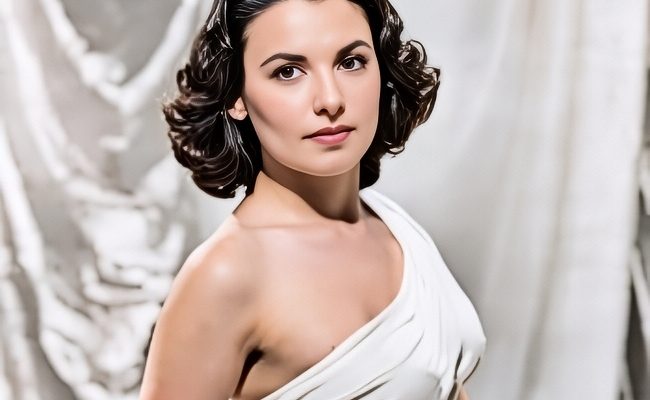
“You’re My Thrill”
Composed by Jay Gourney (music) and Sidney Clare (lyric); arranged by Bud Estes.
Recorded by Charlie Barnet and His Orchestra for Bluebird on January 7, 1941 in New York.
Charlie Barnet, soprano saxophone, directing: George “Spots” Esposito, first trumpet; Bob Burnet, Bernie Privin and Lyman Vunk, trumpets; Claude “Spud” Murphy, Don Ruppersberg and Bill Robertson, trombones; Conn Humphries and Leo White, alto saxophones; Kurt Bloom, tenor saxophone; Jimmy Lamare, tenor and baritone saxophones; Bill Miller, piano; Anthony “Bus” Etri, guitar; Phil Stephens, bass; Cliff Leeman, drums; Lena Horne, vocal.
The story:
 Lena Mary Calhoun Horne was born in Bedford-Stuyvesant, Brooklyn, New York to Edwin and Edna Horne on June 30, 1917. Her family belonged to the well-educated upper stratum of black New Yorkers at the time. She lived the first five years of her life in a brownstone at 519 Macon Street, Brooklyn. (At right: A determined Lena Horne at age three.)
Lena’s father, Edwin Fletcher “Teddy” Horne Jr., a one-time owner of a hotel and restaurant, was a gambler. Teddy Horne left the family when Lena was three years old and moved to the African American community in the Hill District of Pittsburgh, Pennsylvania. Her mother, Edna Louise Scottron, was an actress with a black theater troupe, who traveled extensively. Lena was raised mainly by her paternal grandparents, Cora Calhoun and Edwin Horne.
When Lena was five she was sent to live in Georgia. For several years thereafter she traveled with her mother. From 1927 to 1929 she lived with her uncle, Frank S. Horne, who was the dean of students at Fort Valley Junior Industrial Institute, now a part of Fort Valley State University in Fort Valley, Georgia. Lena then moved to Atlanta with her mother for a short time. They returned to New York when Lena was twelve years old (1929), after which she attended St. Peter Claver School in Brooklyn. She then attended Girls High School, an all-girls public high school in Brooklyn, but dropped out at age 16 in 1933. By then she was quickly becoming a great beauty.

In the fall of 1933, she joined the chorus line of the Harlem Cotton Club, which then featured black performers but a whites-only audience. In the spring of 1934, she had a featured role in the Cotton Club Parade starring singer/entertainer Adelaide Hall, who took Lena under her wing. Horne made her first appearance in a film as a dancer in the musical short Cab Calloway’s Jitterbug Party (1935). Shortly after that, she joined Noble Sissle’s band (billed as Helena Horne), and made her first recordings with that unit on March 11, 1936. (At left: Lena Horne in 1936.)
Soon thereafter, she moved to her father’s home in Pittsburgh, staying in that city’s music-rich Hill District for four years. Among the young musicians who helped Lena learn more about music then were native Pittsburghers Billy Strayhorn and Billy Eckstine.
Ms. Horne married Louis Jordan Jones in January 1937 in Pittsburgh. On December 21, 1937, their daughter Gail was born. They also had a son, Edwin Jones, who died of kidney disease. She and Jones separated in 1940, and divorced in 1944.(1)
From January of 1937 until late 1940, Lena did not work as a performer. Nevertheless, she was a show business veteran when she joined Charlie Barnet’s band in December of 1940.

Above is a copy of Lena Horne’s contract with Charlie Barnet, dated December 24, 1940.
Lena’s association with the Barnet band was her first step in the direction of reviving her career as a performer. That plan was working well when an incident occurred at the Paramount Theater in Manhattan which resulted in her leaving the Barnet band. Here is what happened as recalled by Barnet: ” “Dinah Shore was also on the bill at the Paramount and it was during this engagement that she objected to Lena’s presence – not because of her race, but because she was such a powerful and dominating competitor. Let’s put it this way, Lena was murdering her.” The Paramount management, in response to Ms. Shore’s objections, basically ordered Barnet to drop Lena from his presentation. That put Charlie in a difficult position. He and his band were well aware of how powerful a stage presence Ms. Horne was, and how popular she was with their audiences. But he couldn’t walk out of the Paramount engagement. He went to Ms. Horne and said: “Lena, … your contract with me is yours if you want it. I can’t protect you. They are not going to let you go on any more. Don’t worry about the contract you have with me. If I can’t protect you, I don’t deserve to have you.” (2) (At right: Lena Horne while she was working with Charlie Barnet’s band.)
Ms. Horne did not remain with the Barnet band, but word of what had happened to her swiftly began circulating along the Broadway grapevine, and she emerged from this incident very strongly. In the spring of 1941, she began to work at Cafe’ Society in Greenwich Village, and to appear on NBC’s popular radio show series The Chamber Music Society of Lower Basin Street. One of that show’s resident maestros, Henry Levine, recorded with Horne in June 1941 for Victor Records. At about this same time, Lena was involved in a personal relationship with Artie Shaw, and recorded with him also. (One of the recordings she made with Shaw can be accessed at endnote 3.)
After her relationship with Shaw ended, she began a liaison with heavyweight boxing champion Joe Louis. That relationship lasted through the second half of 1941. Lena left her work at NBC after six months and headed for Hollywood. There she worked in a Cotton Club-style revue on the Sunset Strip, but soon was signed by M-G-M to appear in films.

Lena Horne photographed on September 15, 1941 at Greenwood Lake, New York with Joe Louis by Carl Van Vechten.
The music:
 The song “You’re My Thrill” had a somewhat humble beginning as a part of the 1933 pre-Code Fox film Jimmy and Sally. It was written by Jay Gourney (Abraham Jacob Gornetzsky – (music) and Sidney Clare (lyric). It did not enjoy widespread success in the years immediately after it was composed. Notable recordings of it early-on included by Mike Doty and His Orchestra, a nom du disque for the Joe Haymes band (Bluebird – November 9, 1933); Isham Jones (Victor – January 1934); and in England, Lew Stone (Decca – April 24, 1934). The recording of it presented here by Charlie Barnet, good though it is, and Charlie keeping this song in his band’s presentation through the 1940s, did not move it into the jazz/pop mainstream. What appears to have done that were a spate of recordings of it in the late 1940s by vocalists, including Billie Holiday, who kept it in her regular repertoire through the 1950s. Jazz musicians embraced it then, and it gradually became something of a semi-standard in the jazz community.
 The arrangement that Charlie Barnet’s band recorded in January of 1941, written by Bud Estes, is a vehicle for the singing of Lena Horne. After a brief, building introduction, Ms. Horne sings the vocal chorus. The sound of the supple saxophones and cup-muted brass complement her contralto voice through the first sixteen bars in most pleasing way. The bridge is interesting in that Lena hums in places, adding even more warmth to an already torchy performance by her. Her last eight bars in this chorus hint at the dramatic power she had onstage, and would build a very successful career with. (Above left: Lena Horne in Hollywood in the mid-1940s.)
The second chorus starts with an eight-bar tutti where the various sections of the band blend and swing gently. This is followed immediately and dramatically by Mr. Barnet entering in a different key, playing the melody softly on his soprano saxophone, an instrument that he used very effectively throughout the 1940s. He is backed by rhythm and the other four saxophones in the band. This sequence is an effective contrast to the full-band sounds heard before and after it. Drummer Cliff Leeman cues the band to come in with a snare drum roll at the end of Barnet’s solo, an unusual touch. (Above right: Charlie Barnet plays his soprano saxophone with his band in the Blue Room of Hotel Lincoln in Manhattan in 1940.)
The finale spots a return to the microphone for Lena Horne, who reminds the listener that ...You’re My Thrill.
***************
Recorded by Mel Powell for Vanguard on August 24, 1954 in New York.
Mel Powell, piano; Ruby Braff, cornet; Bobby Donaldson, drums.
The story:
After the swing era, pianist/arranger Mel Powell, who made his initial jazz reputation with Benny Goodman, and then Glenn Miller’s Army Air Force orchestra, eased out of jazz and into composing and teaching long-form “classical music.” He had a successful career in these endeavors from the 1950s through the 1980s.  He was the founding dean of the music department at the California Institute for the Arts. Before doing that, Powell taught first at Mannes College of Music at the New School in Manhattan, then at Queens College in New York City, then at Yale University, and finally at Cal Arts. In 1990 Powell received the Pulitzer Prize in Music for his composition Duplicates: A Concerto for Two Pianos and Orchestra. (At right: Professor Mel Powell in his post swing era career, probably around 1970.)
Although Powell worked sporadically in jazz with Benny Goodman, who appreciated his musical talent and liked him as a person, in the late 1940s and early 1950s, he basically worked outside of jazz. The year 1954 was an exception however. Probably because producer John Hammond had secured a recording contract for Powell with Vanguard Records, he returned to considerable work in the jazz field during that year. Powell led groups on four separate Vanguard recording sessions in 1954, and also continued his association with Benny Goodman, appearing as BG’s pianist on five recording sessions and a few live recordings then.(4)
The music:
 Powell begins this performance with an unaccompanied, rhapsodic paraphrase of the main melody of “You’re My Thrill,” that soon evolves into an Art Tatum-like improvisation that reveals that he had virtuosic piano technique, and a fertile musical imagination. As Powell picks-up the tune’s bridge, he goes into a thoughtful tempo, with drummer Bobby Donaldson falling in behind him with his gently brushed snare. Powell’s improvisation in this sequence becomes more abstract, then suddenly he gets back to the melody, with a tip of the hat to his jazz piano idols, Earl Hines and Teddy Wilson. The descending passage he employs as a cue to cornetist Ruby Braff is lovely. (At left: Mel Powell in the mid-1950s.) (For a link to Powell’s paean to Earl Hines, go to the link at endnote 4A.)

Reuben “Ruby” Braff (1927-2003) (5), was a jazz musician who built his reputation on solid cornet technique, a velvety sound and often inspired jazz ideas. All of that is on display in his full-chorus solo here. His approach is to celebrate the melody by paraphrasing it, and by using syncopated phrasing that is the essence of swing. The accompaniment he gets from Mr. Powell is particularly Wilsonian, and tasty. Braff’s solo is at once contrasting with and complementary to what Powell had played. (At right: Ruby Braff in the 1950s.)
As Powell returns for a bit more solo playing, he cleverly reverses the descending passage he played before Braff’s solo, and now ascends into a brief musical reverie that once again summons the spirit of Teddy Wilson. Braff then comes back for a bit more melodic paraphrase before Powell descends into a final out-of-tempo allusion to the main melody.
***************
Recorded by Bobby Hackett for Project 3 in December of 1968 in New York.
Bobby Hackett, cornet; Don Forestieri, piano; Tito Russo, bass; Joe Brancato, drums.
The music:
 Bobby Hackett was very fond of this song, and played it often over the years. His first recording of it was with Billie Holiday (Decca – October 19, 1949). He recorded it as a leader for Capitol (November 10, 1954), and as a part of one of Jackie Gleason’s classic 1950s easy-listening albums (Capitol – 1958). What we hear in this performance is the melody of “You’re My Thrill,” played masterfully, indeed exalted, shorn of almost all ornamentation. Hackett’s phrasing, which was always the essence of swing, and the glorious sound of his cornet, celebrate this great melody. The accompaniment Bobby receives, including a sensuous bossa nova rhythm from drummer Joe Brancato, heightens the langourous, romantic mood. The piano solo by Don Forestieri is perfectly complementary to Hackett’s playing.
The recordings presented with this post were digitally remastered by Mike Zirpolo.
Notes and links:
(1) The information about Lena Horne’s early life and career were extracted from the Wikipedia post on her.
(2) Charlie Barnet …An Illustrated Biography and Discography, by Dan Mather (2002) 61.
(3) Here is a link to Lena Horne’s recording of “Don’t Take Your Love from Me,” with Artie Shaw. https://swingandbeyond.com/2018/01/20/dont-take-your-love-from-me-artie-shaw-and-lena-horne-1941/
(4) In addition to his great musical talent, Mel Powell had two other remarkable assets: a resonant voice that sounded like what people imagine that God’s voice sounded like when he spoke to Moses, and a truly magnificent head of hair.
(4A) Here is a link to Mel Powell’s musical tribute to jazz piano pioneer Earl Hines: https://swingandbeyond.com/2020/10/10/the-earl-1941-benny-goodman-and-mel-powell-earl-fatha-hines-1941/
(5) Here is a link to the obituary for Ruby Braff written by John Fordham and published in the Manchester Guardian on February 12, 2003. It contains an excellent summary of Braff’s career: https://www.theguardian.com/news/2003/feb/12/guardianobituaries.jazz
Here is a link to another great performance by Bobby Hackett: https://swingandbeyond.com/2025/08/01/yellow-days-1968-bobby-hackett/
And here is a link to Mr. Hackett brightening a great recording by Tony Bennett: https://swingandbeyond.com/2021/11/09/ill-be-around-1963-tony-bennett-with-bobby-hackett/


I highly recommend Illinois Jacquet’s 1964 recording of “You’re My Thrill” on the Verve album “Desert Winds.” That album has been reissued on an Argo cd.