“Wrappin’ It Up”
(“The Lindy Glide”)
Composed and arranged by Fletcher Henderson.
Recorded by Fletcher Henderson and His Orchestra for Decca on September 12, 1934 in New York.
Fletcher Henderson directing: Russell “Pop” Smith, first trumpet; Irving “Mouse” Randolph and Henry “Red” Allen, trumpets; Claude Jones and Frederic Homer “Keg” Johnson, trombones; Hilton Jefferson, first alto saxophone; Russell Procope, alto saxophone; William C. “Buster” Bailey and Benjamin F. “Ben” Webster, tenor saxophones; Horace Henderson, piano; Lawrence Lucie, guitar; Elmer James, bass; and Walter Johnson, drums.
The story:
History is full of apparent coincidences. But very often, when one digs into the context surrounding those coincidences, facts emerge that clarify the situation. The coincidence then seems less coincidental. One of the most striking apparent coincidences of the swing era was the devolving of pioneering bandleader and arranger Fletcher Henderson’s great band in 1934 at the very same time as the fledgling Benny Goodman band began evolving into what eventually became one of the most important bands in the history of American music. (The story of Fletcher Henderson’s rise to prominence is told in the post here at swingandbeyond.com on his great recording of “Happy as the Day is Long,” which can be accessed at endnote 1. More about the Henderson story can be found in the post on Fletcher’s recording of “Down South Camp Meeting,” which can be accessed at endnote 2.)

Relevant to this post are the facts that form a through-line from Fletcher Henderson’s seminal recording of “Wrappin’ It Up” in September of 1934, to Benny Goodman’s recording of it in June of 1935 for Thesaurus Transcriptions, to Benny’s recording of it for Victor Records in May of 1938. Fletcher’s recording is the template. The written arrangement he wrote, which his band used when they made their recording, was the one Fletcher sold to Benny, probably sometime in early 1935. The performance of that arrangement by the Goodman band that was recorded by BG as a part of the marathon recording session that took place on June 6, 1935 offers an early glimpse into how Mr. Goodman, even at age 26, had his own ideas about how this arrangement should be played. The BG commercial recording of “Wrappin’ It Up” is a document of how this arrangement evolved in the three years it was played regularly by the Goodman band. All three recordings also present vivid snapshots in time of the bands that made the recordings, including both the ensemble performances, and the improvised solos. This allows the listener to appreciate the evolution in swing as a musical idiom that took place from 1934 to 1938.

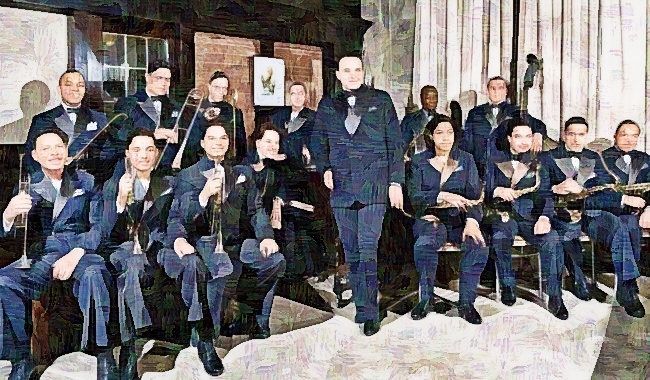
The Fletcher Henderson band in 1933, with Fletcher standing in the middle. This is essentially the same band that made the Henderson recording of “Wrappin’ It Up” in September of 1934. One major change was that Ben Webster would replace Coleman Hawkins, who is shown at extreme right in this photo. Henry “Red” Allen is at the extreme left, and Hilton Jefferson is to Fletcher’s immediate left in the front row.
The music:
The first thing one notices about this performance of “Wrappin It Up” is its tempo, which can accurately be described as brisk. The brass take the lead in the four bar introduction, answered in antiphonal fashion by the reeds. This pattern reverses through the first sixteen bars of the first chorus. Then the band finishes the chorus largely as a tutti. The saxophones are led in spirited and disciplined fashion by Hilton Jefferson, the brass by Russell Smith. The pattern for this composition is a 32 bar song in ABAC form.
 The second chorus is taken up by an alto saxophone solo, a brilliant one, by Hilton Jefferson. To my ears, what he plays and how he plays it is at the cutting edge of what improvising alto players were doing in 1934. His sound is bright and clear, but not edgy. His phrasing and articulation are clean and smooth. His ideas are interesting and devoid of cliche’. His elegantly flowing playing has escaped almost completely from the vertical, bouncing-ball rhythmic approach of saxophone pioneer Rudy Wiedoeft that was so pervasive in the late 1920s and early 1930s in most saxophone players. Jefferson’s playing was much admired by his colleagues. His career during the early 1930s included stints, usually as a lead alto saxophonist, with bands led by Claude Hopkins, Chick Webb, and of course, Fletcher Henderson. He joined Cab Calloway’s band in 1940, and remained there through the 1940s. (Above left: Hilton Jefferson in the mid-1930s.)
 The third chorus is opened by trumpeter Henry “Red” Allen. His playing, though always interesting from the standpoint of jazz, could be somewhat eccentric in that he would often phrase with linearity, then suddenly veer off into a flurry of offbeat notes, as he does in the second part of his solo here. He also frequently employed “blue notes” that drew the sound of what he was playing away from the tonic. (3)
The appearance of a clarinet trio, one of Henderson’s patented musical devices, answered in different registers by the brass, leads to a brief, gleaming clarinet solo by Buster Bailey.
“The final chorus presents Henderson’s own orchestrated variation of the theme – another arranger’s chorus, this one by the composer himself. The melody contains more rhythmic than melodic interest, and its darting, syncopated line is conceived for instruments, not voices. In fact, many of the phrases of the melody bear a striking resemblance to figures that Louis Armstrong played in his solos with Henderson a decade earlier. These figures, along with the blues inflections laced throughout the melody, are almost entirely composed, and even during the solos, the underscoring interacts with the soloists, and often rises up to take the lead, only to recede into the background and allow the soloist to continue. The soloists obviously thrived on the foundation Henderson provided for them.”(4)
A final observation: Henderson’s rhythm section, Horace Henderson, piano; Lawrence Lucie, guitar; Elmer James, bass; and Walter Johnson, drums, operates at peak efficiency in this performance, meaning they swing smoothly as a unit.
“Wrappin’ It Up”
Composed and arranged by Fletcher Henderson.
Recorded by Benny Goodman and His Orchestra for the Thesaurus Transcription Service on June 6, 1935 in New York.
Benny Goodman, clarinet, directing: George “Pee Wee” Erwin, first trumpet; Nate Kazebier and Jerry Neary, trumpets; Jack Lacey and Sterling “Red” Ballard, trombones; Nuncio “Toots” Mondello, first alto saxophone; Hymie Shertzer, alto saxophone; Arthur Rollini and Dick Clark, tenor saxophones; Frank Froeba, piano; Allan Reuss, guitar; Harry Goodman, bass; Gene Krupa, drums.
(Note: In recent years, there has been some confusion about the personnel for this historic Benny Goodman recording session. The personnel above comes from the 1969 edition of “BG on the Record …A Bio-Discography of Benny Goodman,” by D. Russell Connor, page 142. Mr. Connor published two supplemental volumes to this initial groundbreaking work, the first in 1984, and the second in 1996. He did not make any revisions to the personnel as listed above in either of those volumes. I must conclude therefore that his initial personnel listing was accurate. The significant changes in personnel in the Goodman band that did occur when they began a cross-country tour in mid-July 1935 were as follows: Bunny Berigan replaced Pee Wee Erwin on first and solo trumpet; Ralph Muzzillo replaced Jerry Neary on trumpet; Hymie Shertzer replaced Toots Mondello on first alto saxophone; Billy DePew replaced Hymie on the other alto saxophone chair; and Jess Stacy replaced Frankie Froeba on piano.)

Benny Goodman and his band on the NBC Let’s Dance show – December 1934. Back row, L-R: Jerry Neary, Sammy Shapiro (later Spear), Pee Wee Erwin, Gene Krupa; middle: Frank Froeba, Harry Goodman, George Van Eps, Jack Lacey, Red Ballard; front: Dick Clark, Hymie Shertzer, Toots Mondello and Arthur Rollini. Benny is in front with Barry McKinley and Helen Ward.
The story:
The story of how Benny Goodman’s career as a fledgling bandleader got a major boost when his band was selected to appear on the NBC Let’s Dance radio show at the end of 1934 is told in the post here at swingandbeyond.com on “I Got Rhythm,” which can be accessed at endnote 5. This development was a major stroke of good luck for Benny. It allowed him literally to keep his band together because of the money it paid, and at the same time, to develop a repertoire for the band via new arrangements that were constantly needed for each weekly broadcast. The Let’s Dance show provided Goodman with a budget for eight new arrangements a week, at $37.50 per arrangement. (Multiply by 15 to get the value in today’s dollars.) No one arranger could write eight new arrangements in one week, so Benny spread the work around, buying charts from a number of young, swing-oriented arrangers who were in various stages of their musical development insofar as swing was concerned. These included: Lyle “Spud” Murphy, Joe Lippman, Deane Kincaide, Gordon Jenkins, Fud Livingston, Edgar Sampson, Oscar Levant, and Benny Carter. The Goodman band played many different arrangements from these many different arrangers during its first few shows, and played them well. This was largely because Benny, even at this early date, was rigorous in rehearsal, taking as long as he thought necessary to prepare the music to be performed cleanly. (At right: Benny Godman in the mid-1930s.)
Into this situation John Hammond began to have input which Benny, in need of as much help as was possible, accepted, sometimes reluctantly. Hammond was definitely on the scene as the Benny Goodman band began working on the Let’s Dance radio show. He basically watched and listened to what the Goodman band was doing, and after a few weeks delivered his opinion to Benny: despite their clean performances the band was not swinging, even though Benny himself was. Although this was not what Benny wanted to hear, my informed speculation is that he agreed with Hammond, and they discussed ways and means of solving that problem. That led to Fletcher Henderson, whose various bands and music had long been Hammond favorites.
 The story of Benny Goodman’s relationship with jazz critic, record producer, talent scout, crusader for racial justice and impresario John Hammond is a long and interesting one, complicated greatly by the fact that Goodman married Hammond’s sister Alice in 1942. For now, we will just say that Hammond was an early, influential, and wealthy (he was a part of the Vanderbilt family), supporter of Benny Goodman’s music and career, and that he helped Benny in a number of important ways. (Above left: John Hammond in the mid-1930s.)
The most important way that Hammond helped Goodman at the end of 1934, when Benny was trying various ways to try to make his band swing more convincingly, was that Hammond approached Fletcher Henderson, who had led one of the pioneering swing bands (long before that term was used), and had written many arrangements for his band that actually did swing, and asked him to sell Goodman arrangements that were already written, and also to begin writing new arrangements, including those on pop tunes, that Benny could use on the Let’s Dance radio show. Henderson, at that moment without a band, agreed to this. By early 1935 his arrangements began to be gradually incorporated into the Goodman band’s offerings on the Let’s Dance radio show each week. On the January 5, 1935 show, BG played Fletcher Henderson’s arrangements of Fats Waller’s “Honeysuckle Rose” (6) as an instrumental, and “Between the Devil and the Deep Blue Sea,” a song written by Harold Arlen and Ted Koehler, as a feature for vocalist Helen Ward. Many more Henderson arrangements then came into the Goodman band book.
 The BG’s association with the Let’s Dance radio show ended on May 25, 1935. Soon thereafter his band opened at the Roosevelt Hotel in Manhattan, long-time home of sweet band king Guy Lombardo. To say that the music the Goodman band had been refining over the previous six months on the Let’s Dance show didn’t fit with the patrons of that room would be an understatement. Within a few days of opening at that venue, they were fired. Benny and his business-savvy brother Harry, who played bass in the Goodman band, cast about with their management team at Music Corporation of America (MCA) for work the keep the band together. To capitalize on the buzz the Goodman band had created among young radio listeners, a cross-country tour, which had been in the pipeline for several weeks, was finalized at this time. But that tour would not start until mid-July. In the meantime, at least a little work for the band had been secured in New York. That work consisted of a recording session for Thesaurus transcriptions for June 6, and a couple of Victor recording sessions, on June 25 and July 1. (Above right: Benny Goodman no doubt following his manager’s orders to smile and take off his glasses – at Hotel Roosevelt in Manhattan late May 1935. It made no difference – the Goodman band was soon fired.)
The marathon recording session – a snapshot of the early Goodman band:
The fact that Benny Goodman and His Orchestra recorded fifty tunes in one day for the Thesaurus radio transcription service on June 6, 1935 is one of the most unusual occurrences of the swing era, or indeed of any other era of recorded music. The norm, if there was such a thing at transcription recording sessions then, was that the bands that made recordings at those sessions very often recorded between ten and twenty songs at a session. The basic modus operandi was that the band came into the recording studio, the sound engineers got a balance on the band and soloists for the recordings, and the band started playing through which ever tunes their leader and the producer of the session had agreed to record. There was usually just one take per tune. That is pretty much what happened during this marathon recording session. The result was that much of the book of arrangements that the Goodman band used at that particular time was recorded for posterity.
 This recording session also provides a snap-shot of what the band sounded like at that juncture. Making general statements is often a risky business, nevertheless some judicious generalizations can be made about the playing of the Goodman band as of June 6, 1935. First, the band played very well together. This no doubt was the result of them playing together for the previous six-plus months, both on the Let’s Dance radio shows, and of course at Benny’s frequent and intense rehearsals. The musicians were comfortable playing together, and were very familiar with the arrangements they recorded that day. Benny’s playing was at its usual high level. However, although he very often played with professional excellence, he rarely played with inspiration. This was certainly understandable, given the sheer volume of music played and recorded that day. The same can be said for the other soloists: Pee Wee Erwin on trumpet; Arthur Rollini on tenor saxophone; Toots Mondello on alto saxophone; Jack Lacey on trombone. Pianist Frank Froeba was a good pianist and excellent reader, but his playing never did swing. But he was dependable.
The band did not swing consistently, and it lacked an overall recognizable style or musical identity, despite BG’s consistently excellent clarinet solos. Diagnosing why the band was not swinging consistently then is something I think Benny Goodman thought about a lot. The drumming of Gene Krupa, soon to emerge as one of the band’s brightest stars, was at this point often plodding and noisy. But Gene, handsome and enthusiastic, was an audience favorite no matter what he did. The playing of alto saxophonist Toots Mondello, a truly great musician, was still evolving toward swing. Trumpeter Pee Wee Erwin was likewise in the process of becoming one of the best swingers in the business. Both of these musicians played their lead parts in a technically exemplary fashion, though not always with solid swing. But then they may have been a bit cautious and tense in the unusual circumstances of this recording session.
 What is also revealing is an analysis of which arrangers were contributing most to the sound of the early Goodman band. Of the fifty tunes recorded that day, nineteen were arranged by Lyle “Spud” Murphy. Seventeen were arranged by Fletcher Henderson. The balance of the charts recorded that day (another fourteen) were one-offs by many different arrangers, as cited above. Quite a few of Spud Murphy’s arrangements were excellent, for example: “Ballad in Blue,” “The Darktown Strutters’ Ball,” “Jingle Bells,” “Restless.” Nevertheless, the judgment of the public was more favorable to Fletcher Henderson. It is remarkable how many of the classic Henderson arrangements that would become an enduring part of the Goodman canon were already in BG’s book in mid-1935. Among those recorded that day were: “Changes,” “Can’t We Be Friends?,” “Between the Devil and the Deep Blue Sea,” “Sometimes I’m Happy,” “Wrappin’ It Up,” “King Porter Stomp,” “I Know that You Know,” and “Down South Camp Meeting.”
The music:
Those familiar with Fletcher Henderson’s recording of “Wrappin’ It Up” will notice immediately that Benny takes this performance of it at a slower tempo. Which tempo works better? Also, the smooth swing of the Henderson rhythm section contrasts with what we hear in this opening sequence, where Gene Krupa does the right things, but in a noticeably deliberate fashion. On the other hand, every nuance of the music Henderson wrote is played with precision by the Goodman bandsmen.
Toots Mondello’s alto saxophone solo is excellent jazz for mid-1935, and would sound good even if it were played today. The soft open brass pads he plays against are a delightful feature of this arrangement. Krupa’s heavy high-hat rhythm is something of a distraction. Benny’s first clarinet burst is exuberant, and spiced with a few rasps. The intensifying ensemble that follows is once again played perfectly, and it leads to more passionate playing by BG. The out-chorus is handled very well by the band, though the trumpets struggle a bit with the final ascending passage.
I am reasonably certain that if Benny listened to this recording, he would have regarded it as a work-in-progress. The progress part came slowly, but surely. It would be another three years before BG recorded “Wrappin’ It Up” for Victor.
“Wrappin’ It Up”
Composed and arranged by Fletcher Henderson.
Recorded by Benny Goodman and His Orchestra for Victor on May 28, 1938 in New York.
Benny Goodman, clarinet, directing: Harry James, first and solo trumpet; Ziggy Elman and Chris Griffin, trumpets; Sterling “Red” Ballard and Vernon Brown, trombones; Ernani “Noni” Bernardi, first alto saxophone; Dave Matthews, alto saxophone; Arthur Rollini and Lawrence “Bud” Freemen, tenor saxophones; Jess Stacy, piano; Ben Heller, guitar; Harry Goodman, bass; Dave Tough, drums.
The music:
In the three years between the Thesaurus recording of “Wrappin’ It Up” and the Victor, Benny Goodman and his band worked as hard as humanly possible. In fact the pace of their work continued to increase to an almost ridiculous level through 1937 and 1938. There were many days when this band was playing for six or more hours a day, often for weeks on end, in front of audiences. The kind of ensemble cohesion and instrumental mastery that results from this amount of playing is truly remarkable.

Benny Goodman and his band in the spring of 1938. L-R front: Jess Stacy, Ben Heller, Bud Freeman, Noni Bernardi, Dave Matthews, Arthur Rollini, BG and Martha Tilton; back: Harry Goodman, Dave Tough, Chris Griffin, Ziggy Elman, Harry James, Vernon Brown and Red Ballard.
All of that is on display in this recording. In addition, there had been a number of key personnel changes in the Goodman band since mid-1935. Notable among them were the arrival of the young and fiery trumpet virtuoso Harry James at the beginning of 1937. Pianist Jess Stacy had arrived shortly after the Thesaurus recording date, and acquitted himself very well as the band’s pianist over the next three years. Of particular note is that Jess’s ensemble playing was seldom heavy or plodding. Saxophonist Dave Matthews came into the Goodman band in the spring of 1938. He was well-regarded as a tenor saxophone soloist, but because the great Bud Freeman handled that job in this band, Matthews played alto. Finally, Dave Tough joined the Goodman band in March of 1938. His playing was in many ways the antithesis of Gene Krupa’s. But the bottom line on Tough is that whatever he did at the drums, it swung, and it deeply affected and inspired how the musicians around him played.
 As one will hear immediately, this Goodman ensemble plays the music as precisely as it’s predecessor had. The difference is that this ensemble also simultaneously plays relaxedly. That magic blend results in swing. Dave Tough’s drumming is unobtrusive. Nevertheless he is deftly propelling the band. Hear the aureoles of cymbal sounds he applies around the brass bursts. The reeds, led smoothly by Noni Bernardi, swing along. The brass, led by Harry James, swagger. (Above right: BG solos – mid 1938, backed by, front, L-R: Ben Heller, Bud Freeman, Noni Bernardi; rear: Chris Griffin, Ziggy Elman and Harry James.)
 The undulating alto saxophone solo by Dave Matthews is quite good, and everything happening behind him is swinging. Harry James’s first solo burst is bathed in warm saxophone section rhythms and Tough’s high-hat cymbals. When James returns after the intensifying ensemble passage, he is preaching. The ever-alert Mr. Tough is enhancing the music during all of this with a variety of cymbal sounds. (At left: Dave and Dave, Tough and Matthews – summer 1938.)

The out-chorus consists of beautifully played and swinging ensemble passages spiced by short solos by BG and Bud Freeman. The brilliant finale, where the saxophones go down while the brass goes up, is handled with no strain.
The recordings presented with this post were digitally remastered by Mike Zirpolo.
Notes and links:
(1) Here is a link to a post that summarizes Fletcher Henderson’s rise to prominence as a bandleader:
https://swingandbeyond.com/2017/07/01/happy-as-the-day-is-long-1934-fletcher-henderson/
(2) Here is another link that delves into the Jim Crow world Fletcher Henderson inhabited in the late 1920s and early 1930s:
(3) “Blue notes” are a microtonal variant, usually flatted from the pure intonation of the note. They are associated almost exclusively with the third, fifth and seventh degrees of the scale. See: The Swing Era …the Development of Jazz, 1930-1945 (1989), by Gunther Schuller, 862. Perhaps the most vivid demonstration of Red Allen’s approach to improvisation can be found in the Fletcher Henderson recording of “Queer Notions,” (ARC/Vocalion – August 18, 1933.)
(4) The Uncrowned King of Swing …Fletcher Henderson and Big Band Jazz (2005), by Jeffrey Magee, 187-188.
(5) Here is a link to Benny Goodman and his band playing another Fletcher Henderson arrangement, this time on the Let’s Dance radio show:
(6) Here is a link to the story and music of Benny Goodman’s performance of Fletcher Henderson’s arrangement of “Honeysuckle Rose,” on the January 5, 1935 Let’s Dance radio show. It includes the electric presence of trumpeter Bunny Berigan:
https://bunnyberiganmrtrumpet.com/2021/11/22/honeysuckle-rose-1935-with-benny-goodman/
(7) Here is a post that celebrates the Henderson/Goodman collaboration on “Honeysuckle Rose” further:


Be the first to comment