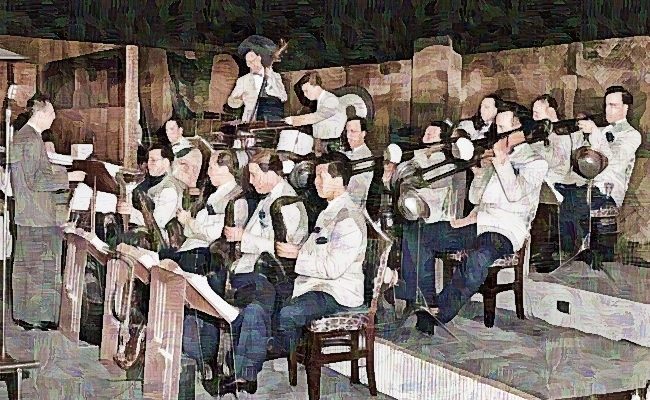
“Blue Flame”
Composed by Joe Bishop; arranged by Joe Bishop and James “Jiggs” Noble.
Recorded by Woody Herman and His Orchestra for Decca on February 13, 1941 in New York.
Woody Herman, clarinet, directing: Johnny Owens, first trumpet; Horace “Steady” Nelson and Carroll “Cappy” Lewis, trumpets; Neal “Biggie” Reid, Bud Smith and Vic Hamann, trombones; Eddie Scalzi and Herb Tompkins, alto saxophones; Maynard “Saxie” Mansfield and Mickey Folus, tenor saxophones; Tommy Linehan, piano; Hy White, guitar; Walt Yoder, bass; Frank Carlson, drums.
The story:
(The story of Woody Herman’s early years as a bandleader (1936-1940) is told in the post here at swingandbeyond.com on “Blue Prelude.” That story and music can be accessed by clicking on the link at endnote 1.)
Woody Herman’s great assets as a young bandleader were his solid musicianship, his limitless patience with his sidemen (and in dealing with the vicissitudes of leading a band on the road), and his boundless enthusiasm. In addition, the first Herman band was a co-operative venture, meaning that several of the sidemen in the band, along with Woody, actually owned the business enterprise that operated the band. That modus operandi had been necessary after the musicians involved decided to remain together as a band after the retirement of their prior leader, Isham Jones, which happened in 1936. Woody proved to be an effective politician both in his role as front man for the band on jobs, and as president of the corporation that ran the band’s business.
 Lastly, Woody was a show-business veteran, having been a vaudeville performer on the road since he was a boy. That experience taught him to recognize what audiences wanted, and give it to them. His time as a sideman with Isham Jones taught him that in addition to entertaining audiences, music could be used to uplift them emotionally, spiritually and aesthetically. Woody used all of these tools with varying degrees of success over the next five decades of leading what were usually very good bands. (At right: Woody Herman as a vaudeville performer at age eight. The unique Herman physiognomy was already in place.)
The music:
A concise summary of what was going on in the Woody Herman band and the world of swing in early 1941 when “Blue Flame” was composed appears in Gene Lees’s biography of Woody, Leader of the Band …The Life of Woody Herman (1995), 78-79: “On February 5, 1940 the Herman band recorded its theme song ‘Blue Prelude,’ with a vocal by Woody. It would not long remain the band’s theme, for ASCAP, the American Society of Composers, Authors and Publishers, after a strained effort to negotiate a higher pay rate from the broadcasting industry, instituted what amounted to a strike. It refused to allow any ASCAP songs (songs composed by ASCAP members) to be played on radio, which in effect meant (the vast majority of) the American (popular) song repertoire, except songs whose copyrights had expired, (were so banned). The broadcasting industry (had previously) set up its own licensing agency, Broadcast Music Incorporated (BMI), a move that in the opinion of many industry observers, (greatly) contributed to the decline of American popular music.”(2)
 “One of the ban’s immediate effects was that many bands changed their theme songs, since they wanted and needed identifying exposure on radio. ‘Blue Prelude’ was registered with ASCAP since (its composers) Joe Bishop and Gordon Jenkins were both ASCAP members. To replace it, Bishop quickly wrote a new one, based on a tune already in the Herman band’s book, ‘Casbah Blues,’ calling it ‘Blue Flame.’ Curiously, the blue label Decca record on which the Herman band’s initial recording of ‘Blue Flame’ was issued identify it as the work of James (Jiggs) Noble, another of the band’s arrangers, but Woody attested that the piece was Bishop’s…. A possible explanation is that Bishop, as an ASCAP member, could not at the time claim the work as his own, and Noble, who was not an ASCAP member, was perhaps assigned a temporary credit for it so that it could be played on radio as a non-ASCAP composition. In any case, ‘Blue Flame’ became Woody’s theme song, (it became popular), and it would remain Woody’s theme song for the next several decades, earning royalties for Bishop for the rest of his life.”
Woody Herman first recorded “Blue Flame” on a World transcription in January of 1941.
This performance begins quietly, with the three trombones going oo-ah in their low register setting up, along with the softly played rhythm, what will be an ongoing ostinato. The first chorus (this is a twelve-bar blues) has the saxophones setting forth the melody in three four-bar tracts. Woody, on clarinet, adds some bluesy notes that are a contrast to the other sounds we hear, as are the funky and spare piano notes played by Tommy Linehan. The trumpets add an unusual touch at the end of this chorus – straight-muted notes played with a throat growl that creates an eerie buzzing sound.
 The second chorus is a showcase for the buzzing (3) straight-muted and soulful trombone played by Neal Reid. Once again, there are three four-bar tracts, each has Reid’s trombone sound supported by and contrasted with the low-register reeds playing melodically, almost moaning, along with the spicily harmonized oo-ah brass. Reid takes a second chorus, this time backed by the quiet harmonized reeds, drummer Frankie Carlson’s China cymbal splashes and some colorful clarinet notes by Woody. (At right: Woody Herman and Neal Reid.)
The buzzing trumpets announce the coming of another chorus, this one featuring the melodic saxophones, the oo-ah brass and soft and spare solos by pianist Linehan and guitarist Hy White.
The finale comes via a richly harmonized ensemble, the buzzing muted trumpets and Woody’s cascading clarinet notes.
This is a creative use of the fifteen instruments of a fine swing band by arrangers Joe Bishop and Jiggs Noble that unfolds in a logical, well-paced fashion. The solos add instrumental color, and Neal Reid demonstrates that he could play the blues quite convincingly.
“Blue Flame”
Composed by Joe Bishop; arranged by Henry Mancini.
Recorded by Henry Mancini and His Orchestra for RCA Victor in Hollywood on February 22, 1960.
Henry Mancini, directing: Conrad Gozzo, first trumpet; Pete Candoli, Frank Beach and Graham Young, trumpets; Dick Nash, first trombone; John Halliburton, Jimmy Priddy, tenor trombones; Karl DeKarske, bass trombone; Vince DeRosa, first French horn; Dick Perissi, Sinclair Lott, John Graas, Herman Lebow and George Price, French horns; Ronny Lang, Ted Nash, Gene Cipriano, and Harry Klee, flutes and saxophones; Wilbur Schwartz, saxophone; John Williams, piano; Bob Bain, guitar; Rolly Bundock, bass; Jack Sperling, drums; Victor Feldman and Larry Bunker, vibraphones.
The music:
This performance is quintessential early Mancini. It begins with drummer Jack Sperling setting the tempo in whispering fashion by brushing a cymbal and his snare. The first chorus is an exposition for the unique Mancini sound of four bass flutes, played here by Ronny Lang, Gene Cipriano, Ted Nash and Harry Klee. Their sound is garnished with a few choice vibraphone notes, played by Victor Feldman. They play the melodic tracts of the three four-bar segments, contrasted with robust trombone oo-ahs.

Ronny Lang, Ted Nash, Gene Cipriano and Harry Klee play their bass flutes on a Mancini recording session.
Trombonist Dick Nash is cast in the role originated by Neal Reid. His approach is more rhythmic and fanciful than his predecessor. He plays against a velvety curtain of sound – the quiet French horns, and piano and guitar (John Williams and Bob Bain.)

Henry Mancini with a few of his stalwart sidemen: L-R: Ronny Lang, Dick Nash and Pete Candoli.
The shout (climactic) chorus has the the brass, led in fiery fashion by Conrad Gozzo, erupting atop a heavy beat created by the piano, vibes and drums, with the reed players, now playing their saxophones, answering the brass. The trombones return with their oo-ah ostinato to add yet another color to the sonic mix.
The final chorus has contemplative piano plinks, a return of the bass flutes, and finally, the harmonized French horns.
“Blue Flame”
Composed by Joe Bishop; arranged by Joe Bishop and James “Jiggs” Noble.
Recorded by Glen Gray and the Casa Loma Orchestra for Capitol in Hollywood in late 1962.
Glen Gray, directing: Conrad Gozzo, first trumpet; Clarence F. “Shorty” Sherock, Joe Graves and Uan Rasey, trumpets; Francis “Joe” Howard, Ed Kusby, Lew McCreary and Milt Bernhart, trombones; Abe Most, B-flat clarinet; Arthur “Skeets” Herfurt, first alto saxophone; Irving “Babe” Russin and Plas Johnson, tenor saxophones, Chuck Gentry, baritone saxophone; Ray Sherman, piano; Jack Marshall, guitar; Meyer “Mike” Rubin, bass; Nick Fatool, drums.
The music:
This beautifully recorded performance spots trombonist Milt Bernhart in the starring role. His phrasing is elegant, his command of the trombone virtuosic. Abe Most on clarinet pays his respects to Woody, and Jack Marshall on guitar handles his solo expertly.
This performance captures the spirit and mood of the original, but on a grander scale.
The recordings presented with this post were digitally remastered by Mike Zirpolo.
Notes and links:
(1) Here is a link to the story of Woody Herman’s early years as a bandleader, along with some interesting music:
(2) BMI was founded in October 1939 by the National Association of Broadcasters as an open-door alternative to ASCAP. Key milestones include opening its New York offices in February 1940, expanding support for country and rhythm and blues genres in the 1950s, and growing into a major global music rights organization. The term “open door” is significant. ASCAP members from the 1910s through the 1930s, tended to be New York- based composers whose work was centered in the Broadway theater, and a bit later, in Hollywood films and dance bands. One did not simply join ASCAP. They had to qualify for membership. BMI, to counterbalance this exclusivity, welcomed composers from far and wide, and those working in many different musical idioms.
A good and concise summary of the founding of Broadcast Music, Inc. (BMI) in 1939, and the reasons for the 1941 ASCAP-radio dispute, can be found here: https://en.wikipedia.org/wiki/Broadcast_Music,_Inc.
3) The buzzing sound we hear in trombonist Neal Reid’s playing was probably achieved by him using a “buzz-wow” straight mute.
Here are links to other great performances by Woody Herman and his various bands:
https://swingandbeyond.com/2019/04/26/happiness-was-a-guy-called-joe/
https://swingandbeyond.com/2018/01/13/red-top-1945-woody-herman/
https://swingandbeyond.com/2016/12/10/let-it-snow-1945-woody-herman/
https://swingandbeyond.com/2024/02/16/ebony-concerto-1946-woody-herman-igor-stravinsky/


Be the first to comment