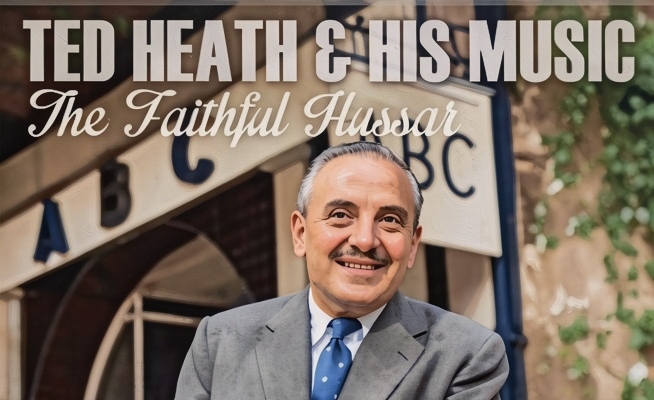
“The Faithful Hussar”
Composed by Heinrich Frantzen; arranged by Johnny Keating.
Recorded by Ted Heath and His Music for Decca on May 13, 1956 in London, England.
Ted Heath, directing: Bobby Pratt, first trumpet; Bert Ezard, Duncan Campbell and Eddie Blair, trumpets; Don Lusher, first trombone; Wally Smith, Jimmy Coombes and Ric Kennedy, trombones; Leslie Gilbert, first alto saxophone; Ronnie Chamberlain, alto and soprano saxophones; Henry Mackenzie and Red Price, tenor saxophones; Ken Kiddier, baritone saxophone; Frank Horrox, piano; Ike Isaacs, guitar; Johnny Hawksworth, bass; Ronnie Verrell, drums.
The story:
Time and place. These two factors are important in everyone’s life. No one can choose when he/she will be born, or where. It just happens. What a person does with the unique circumstances of their life is governed by choices. The psychological process of making choices is a very deep subject that I will not get into here. Suffice it to say that process can be extremely complicated and anxiety-producing. It can be affected by many things, some real and some imagined. Or it can be very simple, direct and painless. In my life, I have confronted many choices. The ones I have made without complication and anxiety have usually been ones that have brought great rewards to me. Being drawn to music at an early age is something I never thought about, much less chose. A family legend has it that when I was being wheeled-about in a stroller as a toddler on a brisk, sunny November afternoon, I began humming the melody of “On the Sunny Side of the Street,” to the astonishment of my parents. You can decide how true that may be.
My relationship with music is something that has brought immense joy to me throughout my life. It is the gift that keeps on giving. I have not reflected greatly on how and why music has been so important in my life until recently. While I was preparing this post, I had to go back to certain events of my childhood that were, seemingly, rather insignificant at the time they were happening. But now, especially when regarded in the light of the role music has played in my life, those events seem much more significant and important.

An aerial view of downtown Canton, Ohio. From the buildings I see, I think this photo was taken around 1950.
I was born and raised in the middle of the Twentieth Century. I was formed in many ways in the crucible of popular culture as it existed in the 1950s and 1960s in a small city in Ohio. That city, Canton, was different then than it is now. Some of the changes I have observed to my home town, where I have spent almost my entire life, have been for the better. Some have not. Nevertheless, I have been most fortunate to have often found myself in situations throughout my life here where I have been involved with people who have made my life richer.
 One of the things that existed here when I was a child (and still does, though in a vastly different form) was an AM radio station, WHBC. Presumably because my parents liked the programming on that station in the mid-1950s, it was often playing on the main radio in our house. On weekday mornings, my mother liked to listen to Don McNiell’s Breakfast Club, which was broadcast live from the College Inn of Hotel Sherman in Chicago (among other venues). It was a variety show, and I came to enjoy it greatly. After that program was over each day, the radio may or may not have been turned off. If it remained on, I would hear songs by 1950s pop music performers like Frank Sinatra, Nat “King” Cole, Jo Stafford, Peggy Lee, Ella Fitzgerald, Ray Conniff and Perry Como, among many others. The music they performed was melodic. The lyrics I heard were poetic, at least to my juvenile sensibilities. I was enchanted. Indeed, it seemed that the songs that I heard then on the radio came from some magical, inexhaustible source, something I knew nothing about, but was grateful for.
At 3 P.M., the radio was usually turned on again so that when my father came home from work at around 3:30, he could hear the afternoon drive-time show on WHBC, hosted by Jim Roberts. The sign-on theme for that show was Ted Heath’s recording of “The Faithful Hussar.” Mr. Roberts did not announce that title very often, if ever. He simply used that music to begin each of his shows. I liked that recording, and heard the first chorus of it hundreds of times not knowing what I was listening to. It took me a long time to discover the title and artists performing that tune. (Above right: a print ad for WHBC radio – your good neighbor – in Canton, Ohio from September of 1946. Later the station became affiliated with the ABC radio network. )

The WHBC radio broadcast facility in downtown Canton, Ohio. This image is from a mid-1950s post card.
The music:
It appears that antecedents to what we now know as “The Faithful Hussar” can be found as far in the past as the Eighteenth Century in Austria and pre-Germany. The version of the melody that was popular in the 1950s was composed by Cologne Carnival composer and former military bandleader Heinrich Frantzen (1880-1953) as a marching song. Cologne-based music publisher Gustav Gerdes (now part of Hans Gerig Publishers) published the song in 1924. The march was allegedly composed on the occasion of establishing the Cologne Carnival Society K.G. Treuer Husar Blau-Gelb in 1925. Originally, the lyrics taken from the folk song, were added only to the refrain-like part of the piece. Which version of the text served as the model to Frantzen is not known. Frantzen’s melody does not match any of those published in the 19th century.  It is unclear whether Frantzen did utilize an existing song, or whether the march he composed originated with him. A note in a sheet music issue of original publisher states: “This is the only popular and protected version of the ‘Faithful Hussar’ with the additional composition by Heinrich Frantzen.” Joseph “Jupp” Frantzen, the composer’s son, added additional lyrics subsequent to the initial publication of the song.(1)
The English bandleader Ted Heath likely became aware of “The Faithful Hussar” in the wake of the release of the West German comedy film The Faithful Hussar (German: Der treue Husar) in 1954. In addition to Ted Heath’s recording of it, one by the English singer Very Lynn, and another by Louis Armstrong received a lot of airplay in the United Kingdom in the mid-1950s. The song was later included at the end of the 1957 Stanley Kubrick American film Paths of Glory.
 Ted Heath’s recording performance of “The Faithful Hussar” is cast in a simple and direct arrangement that was probably written by Johnny Keating. A brief introduction serves to establish the 2/4 ostinato carried by the baritone saxophone, played masterfully by Ken Kiddier. This marching ostinato continues into the first chorus, and indeed in various iterations through the entire performance.
The first chorus begins with the trombone quartet, horns open, playing the melody for sixteen bars. The second pass at the melody is repeated by the open trombones, but in this sequence we hear in the background the four trumpets, Harmon-muted, with the trumpeters getting a subtle oo-ah effect by cupping their left hand flexed at the wrist over the mute, then extending it. (Note that English Decca was still issuing 78rpm singles in 1956. The transition to long-playing 331/3 rpm 12-inch disks was nevertheless also happening there, albeit more slowly than in the U.S.)

Ted Heath, who began his long and successful career as a trombonist, listens to the blend of the trombone quartet in his band.
A powerful upward ensemble modulation moves the melody from the brass to the saxophones, led in singing fashion by Les Gilbert. The bass, played by Johnny Hawksworth, and drummer Ronnie Verrell’s bass drum keep the rhythmic ostinato going in the background. The brass join in, softly at first, with their sound augmenting the underlying rhythm. A contrasting and swinging melodic paraphrase, which provides the climax for this performance, follows, played by open brass against drummer Ronnie Verrell’s rocking back-beats. Notice how the ostinato continues through this sequence with the five saxophones, baritone prominent, providing a solid foundation both harmonically and rhythmically for the other instruments.

Ted Heath conducts his saxophone in a 1956 performance. L-R: Ken Kiddier, Ronnie Chamberlain, Les Gilbert, Red Price and Henry Mackenzie.
The music then returns to a quieter place, as it continues to be propelled by the baritone saxophone into a reprise of the open trombones/Harmon-muted trumpets melody. The finale consists of the ensemble quieting down, then ascending both dynamically and in register into an ensemble blast.
“The Faithful Hussar”
Composed by Heinrich Frantzen; arranged by Billy Maxted.
Recorded by Billy Maxted and His Manhattan Jazz Band in March 1962 for K and H Records in New York.
Billy Maxted, piano, directing: Ben Ventura and John Dengler, trumpets; Lee Gifford, trombone; Dan Tracey, clarinet; Hugh Martin, bass; Don MacLean, drums.
The music:
 Whereas Ted Heath’s recording of “The Faithful Hussar” is a virtuoso big band performance that celebrates the melody of that song using a medium dance tempo, Billy Maxted’s recording of it is a series of musical contrasts crafted by a master arranger, and that arranger definitely had a sense of humor. The tempo of this performance is in the insinuating range Louis Armstrong referred to as “half-fast.”
Maxted starts his performance with his well-balanced horn ensemble of two trumpets, a trombone and a B-flat clarinet stating the melody for sixteen bars in short bursts, interspersed with bass notes emanating from Hugh Martin’s bass and Billy’s left hand at the piano. The next sequence presents Dan Tracey paraphrasing the melody on his clarinet in its juicy, low chalumeau register against a sparse background of piano, bass and drums. (Dan Tracey is shown above right.)
 Then the entire ensemble comes in forcefully, swinging the melody atop drummer Don MacLean’s rocking two-beat rhythm. Trombonist Lee Gifford adds some raucous trombone counterlines to add further spice to an already tasty musical mix. (At left: Don MacLean, Lee Gifford and Ben Ventura.)
The band then returns to the call-and-response of the first chorus. Maxted’s tinkling piano cues the rest of the band to come in with a shouting finale of Billy’s creation.
This band definitely punched way above its weight in terms of ensemble power and musical creativity thanks to their inspired leader.
The recordings presented with this post were digitally remastered by Mike Zirpolo.
Notes and links:
(1) The information about the song “The Faithful Hussar” comes from the Wikipedia post on it. The word “Hussar” is defined as follows: Originally one of a body of Hungarian light cavalry formed during the 15th century. A member of a class of similar troops, usually with striking or flamboyant uniforms, in European armies.
Here are some other recordings by Ted Heath and his fine band:
https://swingandbeyond.com/2023/08/13/ive-got-the-world-on-a-string-1957-ted-heath/
https://swingandbeyond.com/2022/04/09/tenderly-1957-ted-heath-with-leslie-gilbert-on-alto-saxophone/
https://swingandbeyond.com/2021/05/05/ill-never-be-the-same-1957-ted-heath-with-bert-ezard/
Here is some Heath music contrasted with that of other bands:
https://swingandbeyond.com/2018/10/20/harlem-nocturne-1940-ray-noble-and-1969-ted-heath/
And here are some links to other excellent performances by Billy Maxted:


Be the first to comment