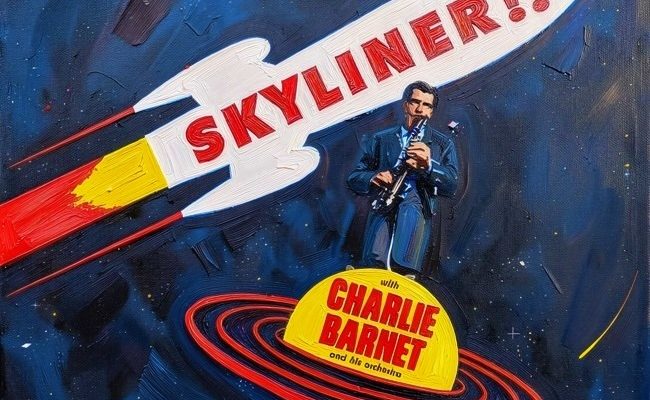
“Skyliner”
Composed by Charlie Barnet; arranged by Billy Moore.
Recorded by Charlie Barnet and His Orchestra for Decca on August 3, 1944 in Los Angeles.
Charlie Barnet, soprano and tenor saxophones; directing: Jack Mootz, first trumpet; Lyman Vunk, Johnny Martel and Peanuts Holland, trumpets; Dave Hallett, Charles W. Coolidge, Burt Johnson and Gerald Foster, trombones; Hal Herzon, Joe Meissner, Kurt Bloom, Eddie Pripps, and Bob Poland, saxophones; Michael “Dodo” Marmarosa, piano; Barney Kessel, guitar; Howard Rumsey, bass; Harold Hahn, drums.
The story:
 The chaotic 40s. That is how Charlie Barnet described the decade of his greatest success as a bandleader. Running a big band, even under the most favorable of circumstances, was a daunting challenge. For the most part, during the 1940s Barnet was not operating his band under most favorable circumstances. In the early 1940s he confronted myriad management challenges and a situation where the supply of big bands exceeded the demand. Then after Pearl Harbor he began losing sidemen to the military draft. Then as war conditions in the United States ramped-up, he found it difficult to transport his band to gigs because of gasoline and rubber rationing. Through it all, he remained remarkably focused on making good music, and managed to present very good bands to swing fans. Many people who knew him were surprised at how serious Charlie was about bandleading. His personality and family circumstances suggested other behavior.
It would be easy to think that Barnet was a dilettante. Very few bandleaders could call their mother on the phone and say: “Mom, I need $10,000.00 immediately,” …and get it. Barnet could do that, and I suspect did that more than once. He was an only child, and a spoiled one. He wore his privilege comfortably, like the cashmere sport coats he favored. But unlike most spoiled children, Barnet had an obsession: he loved music and got tremendous joy out of leading a big band. And in pursuit of that obsession, he worked as hard as any other successful bandleader, over a period of 15 years, to form, lead and tour with some of the best bands of the swing era. Of course, that does not mean that he did not party. He did, often on an epic scale. (At right, the Mad Mab, Charlie Barnet in the middle 1940s.)
 Women pursued Barnet because he was a tall, handsome guy, and a bandleader. Here is a story about one such woman: “…(T)here was a girl – let’s call her Sally – who gave me a lot of trouble. She was a blonde and fairly attractive, and she put me in a jackpot several times. She would haunt the stage door of wherever I was playing, and when she was rebuffed, she would wield her purse (like a mace). She also had the nasty habit of going to the police station and swearing out a warrant for my arrest. She wasn’t playing with a full deck; although I never was actually arrested, I did have several visits from the police. She used to write letters from the mental institution she was confined in from time to time, and I had a full dossier on her. …Once, when I got back off the road and I entered an elevator at the Park Central Hotel (in Manhattan) where I was staying, who was running the car but Sally! She managed to get a key to my room, and one night I came in and found her waiting there for me. The hotel got rid of her in a hurry. Another musician who had problems with her was Tony Pastor.”(1)
It is unclear why Charlie Barnet never served in the military during World War II. We do know that he was given physical examinations in New York by the U.S. Army on February 5 and 13, 1944. On those dates, his band was led by tenor saxophonist Georgie Auld.(2) After that, it appears that his draft status remained unresolved. He took a vacation for a couple of weeks in late February and early March. (Above left: a newspaper ad for the Barnet band’s appearance at the Golden Gate Theater in San Francisco – March 29 to April 4, 1944. It is apparent that vaudeville was still alive then, but not for much longer.)
During the late winter of 1944, Barnet moved his base of operations from New York to Los Angeles. He took along many sidemen from his band, and filled-in the other personnel when he got to L.A. He then began work on the RKO film Music in Manhattan. By the end of March, his newly constituted band began a series of dates which culminated with an engagement at the Casa Manana in the Culver City section of Los Angeles, which ran from May 19 to June 25. The Barnet band then played a couple of weeks at Slapsie Maxie’s in Hollywood in July, during which time they made two V-Disc recording sessions, one on July 13 and the other on July 21. They played a week-end gig at Casino Gardens in Ocean Park July 21-23. After that, they worked on a movie short called Melody Parade, which was filmed at Universal Studios.(2)

Originally Frank Sebastian’s Cotton Club, this venue was known as the Casa Manana from 1938 into the mid 1940s.(3)
The music:
This Barnet band then entered the Decca recording studios in Los Angeles on August 3 to make some records, including of the relatively new original Barnet composition “Skyliner.” (Note: The name “Dale Bennett” that appears on the Decca commercial record of “Skyliner” was an alias used by Charlie Barnet on some of the music he composed.) It appears that “Skyliner” had entered the Barnet repertoire in late May or early June, if not earlier. It was one of the titles Charlie played at the Casa Manana, and recorded at his June 13 V-Disc session. For a man who drank a lot of Dewar’s scotch whiskey, Charlie Barnet maintained a remarkable memory well into his later years. He recalled to Stanley Dance in the early 1980s: “I had an old foot-pump portable organ that I carried around and would set up in the dressing room and compose on. We were at the Royal Theater in Baltimore when I used this old wheeze-box to write “Skyliner.”(4) The time the Barnet band played at the Royal Theater in Baltimore when this probably occurred was October 22 to 28, 1943.(5)

The Barnet band probably in early 1945, not long after they recorded “Skyliner.” L-R front: CB, Bob Poland, Kurt Bloom, Ray DeGeer, Gene Kinsey, Eddie Pripps; middle: John Chance, Harold Hahn, Ed Fromm, Dave Hallett, Porky Cohen, Gifford Barnett; back: Peanuts Holland, Lyman Vunk, Jack Mootz and Ernie Figueroa. Pianist Marty Napoleon is not visible.(*)
 The Barnet Decca recording of “Skyliner” opens with pianist Dodo Marmarosa playing a swinging eight-bar sequence that sounds improvised. This is the introduction. The first chorus begins with the brass octet playing the first main melody (melody one – A) with the support of the rhythm section. This is followed by an ascending two-bar brass pyramid played through a break in the rhythm which leads to the exposition of the second main melody (melody two – B), played by the reeds with Barnet out front on his soprano saxophone. During this sequence, the brass return to play melody one as a counterline to melody two, which is played by the saxophones. To make the music more rhythmically interesting, arranger Billy Moore has the brass playing twice as fast as the reeds. After another two-bar break/brass pyramid, the preceding sequence is repeated. (Piano whiz Dodo Marmarosa at right in 1944.)
Another ascending two-bar brass break (but not a pyramid) leads to a sequence where the saxophones (without Barnet) play an abstraction of melody two, shadowed by the open trombones, then a brief melodic solo probably played by lead trumpeter Jack Mootz, who uses a cup mute to soften his sound. Another tract of the half-fast saxophones in dialogue with the fast brass follows.
 We then hear a four-bar interlude during which the brass at first, then with the reeds, bring on the four open trombones, who play a paraphrase of melody one. Barnet then improvises an eight-bar solo on his tenor saxophone. The preceding is then repeated, trombones then a tenor saxophone solo.
A burst of brass opens the way for another tasty piano solo (eight bars) by Dodo Marmarosa, backed by singing, softly played saxophones. This is also repeated, except Marmarosa’s allotted only four solo bars in the repeat.
The band returns with a reprise of the saxophones, with CB once again leading them on soprano, playing half-fast, while the brass play twice as fast. A cadence starts the finale – the brass, now slower and emphatic, joined by the five saxophones, and a big trombone chord as the capper.
The form of “Skyliner” is quite different from the norm. In order to sort that out, I consulted my musical guru Dennis Roden. Here is the result of his analysis: Intro: 8 bars. A and B are 16 bars each, oddity is A 3x. AAABA extra 4 measures added before trombone soli and sax solo. A Trombone soli, saxophone solo. A repeated, with added sax orchestration. B Trumpets with piano solo. A repeated with melody. Thanks Dennis!
“Skyliner”
Composed by Charlie Barnet; arranged by Billy Moore. Moore’s arrangement was reconstructed by Sammy Nestico.
Recorded by Billy May and the Swing Era and His Orchestra for Capitol on September 9, 1970 in Hollywood.
Billy May, directing: John Audino, first trumpet; John Best, Shorty Sherock, Uan Rasey, trumpets; Dick Nash, first trombone; Lloyd Ulyate, Francis “Joe” Howard and Lew McCreary, trombones; Arthur “Skeets” Herfurt, Les Robinson, alto saxophones; Plas Johnson and Abe Most, tenor saxophones, (Johnson doubles on soprano saxophone); Chuck Gentry, baritone saxophone; Ray Sherman, piano; Jack Marshall, guitar; Rolly Bundock, bass; Nick Fatool, drums.
A bit more story and music:
Billy May began his big-time career in the world of swing as a member of Charlie Barnet’s band in 1939, and remained friends with Barnet until Charlie’s death in 1991 at age 77. If anyone knew Barnet’s music, it was Billy May. As the conductor of this recording, he facilitated super-tight section work and a relaxed, swinging overall ensemble performance. The soloists are: Ray Sherman on piano, John Audino on trumpet and Plas Johnson on tenor saxophone. I’m sure that Charlie Barnet smiled when he heard this recording.
The recordings presented with this post were digitally remastered by Mike Zirpolo.
Notes and links:
(1) Those Swinging Years …The Autobiography of Charlie Barnet with Stanley Dance (1984), 99. Hereafter Dance.
(2) Charlie Barnet … An Illustrated Biography and Discography (2002), by Dan Mather, 82. Hereafter Mather.
(3) Frank Sebastian’s Cotton Club was a large night club located at the intersection of Washington Blvd. and National in the Culver City section of Los Angeles. Sebastian ran the club from 1926 until 1938. This venue was not far from the M-G-M film studio, and was a playground for Hollywood film actors, directors and writers. With its upstairs “secret” gambling room, it was the prototype for nightclubs in Hollywood films from the 1930s into the 1950s. The Cotton Club closed in 1938, but soon reopened under new ownership as the Casa Manana, with a new manager, Joe Zucca. The Casa Manana became Zucca Opera House in the late 1940s, however as the nightclub business declined during the postwar years, the venue mysteriously burned to the ground in 1950.
(4) Dance, 93.
(5) Mather, 80.
(*) Artie Shaw, when he began reorganizing a band for a tour in September of 1944, raided the Barnet band and took these sidemen: pianist Dodo Marmarosa, guitarist Barney Kessel and trombonist Charles Coolidge.
Here are links to more of Charlie Barnet’s music:
https://swingandbeyond.com/2020/06/10/afternoon-of-a-moax-1940-charlie-barnet/
https://swingandbeyond.com/2016/08/11/harlem-speaks-1941-charlie-barnet/
https://swingandbeyond.com/2025/05/31/lois-1941-charlie-barnet-with-bernie-privin-and-the-quintones/


Be the first to comment