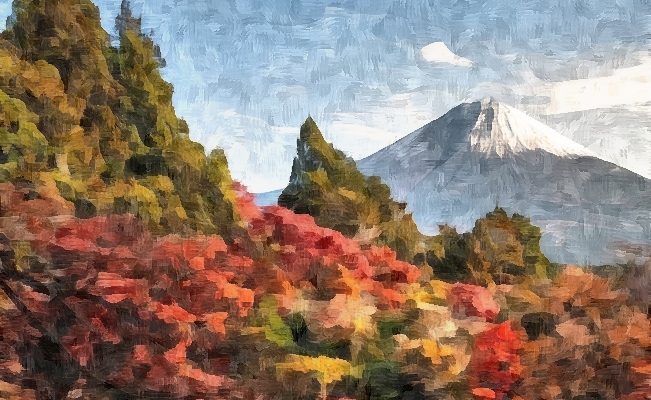
“Ad Lib on Nippon”
Composed by Duke Ellington with input by Jimmy Hamilton; arranged by Duke Ellington and Billy Strayhorn.
Recorded by Duke Ellington and His Orchestra for RCA Victor (Studio B) on December 20, 1966 in New York.
Duke Ellington, piano, directing: Herbie Jones, Melvin “Cootie” Williams, William “Cat” Anderson and Mercer Ellington, trumpets; Lawrence Brown, George “Buster” Cooper and Chuck Connors, trombones; Russell Procope and Johnny Hodges, alto saxophones; Paul Gonsalves and Jimmy Hamilton, tenor saxophones; (Hamilton doubles on B-flat clarinet); Harry Carney, baritone saxophone; John Lamb, bass; Rufus Jones, drums.
The story – part one – my impressions of Japan:
Recently, I had the good fortune to visit Japan. I had many wonderful experiences while I was there, and met many delightful people. I visited Tokyo, Kyoto, Kobe, Hiroshima, Nagoya and Matsumoto. I could go on and on about the beauty of the country, the culture and cuisine of Japan, and the overall joy I had interacting with Japanese people over a period of two weeks. Their courtesy and warmth is remarkable.
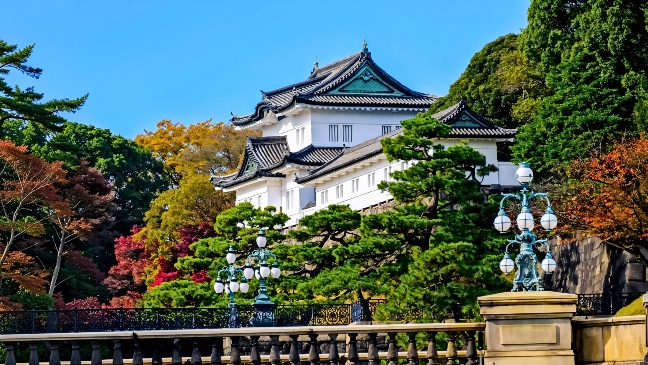
The Imperial Palace in Tokyo.
But what struck me most profoundly was the presence of American jazz in Japan, especially in restaurants. I had experiences in Japan that I have never had in the United States: of having breakfast with Stan Getz, and Miles Davis and Paul Desmond; I had lunch with Benny Goodman, Bobby Hackett and Teddy Wilson; and I had dinner with Bill Evans, Tommy Flanagan, Vince Guaraldi, and Thelonious Monk, among others. 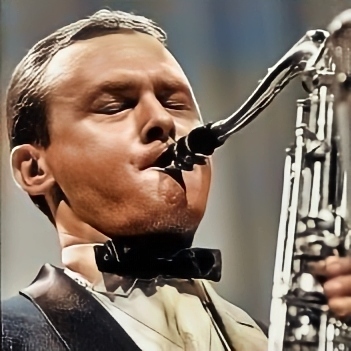 This is not to say that I didn’t hear other music in restaurants. I did, and it was often the piano music of Mozart, Beethoven, Chopin, Scriabin and Debussy, among others. It was made very clear to me that the Japanese understand the concept of music to dine by in a way that is vastly different from what I normally encounter in the United States. (At right: a Japanese favorite – Stan Getz.)
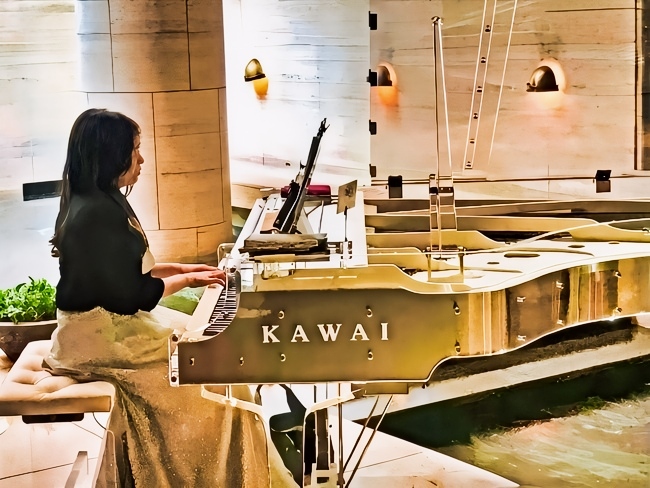
In one hotel where we stayed, there were several restaurants on various levels surrounding and open to a large multi-level lobby. In one of those restaurants, there was a small place that simply served tea and various baked items in the afternoon. As I was sitting in this restaurant sipping tea and eating a scone, I began to hear what sounded like celestial piano music. Adjacent to this restaurant, on a small stage that jutted into a decorative pool of water that was moving gently over rocks, a beautiful young woman began to play “Tenderly.” I was awestruck. She played gently, softly, …tenderly. She then segued into “September in the Rain.” As she was playing that, I unfortunately had to leave to meet someone. But the impression that was left on me will not be forgotten any time soon. (Below: “Tenderly.”)
Part two – Duke and Nippon.
On June 19, 1964, Duke Ellington and His Orchestra began a three-week tour of Japan. The tour’s promoters were Yomiuri Newspapers and the Kambara Music Co. The band played at venues in several cities in Japan before being presented in Tokyo. Those cities were: Osaka, Kobe, Hiroshima, Kyoto and Nagoya. The band was then presented in various locations in Tokyo from June 26 to July 11. Despite the Ellington concerts being wildly applauded by audiences, the revenue generated by those concerts covered only about 45% of the cost of the tour. (Each concert had many complimentary attendees, usually students.) Consequently, the promoters incurred a loss of around $40,000.00, which they chalked up as the cost of presenting great jazz artists in-person to Japanese audiences.(1)
 The Columbia Broadcasting System sent a film crew along with the Ellington entourage to Japan. The filming they did was used to produce a thirty-minute segment entitled Duke Ellington Swings Through Japan for the CBS documentary series “The Twentieth Century,” hosted by Walter Cronkite. (2) The music in that documentary consists mostly of Ellington standards, except for “Depk” and “Amad,” which later became, along with “Ad Lib on Nippon,” parts of the RCA Victor LP recording entitled The Far East Suite.
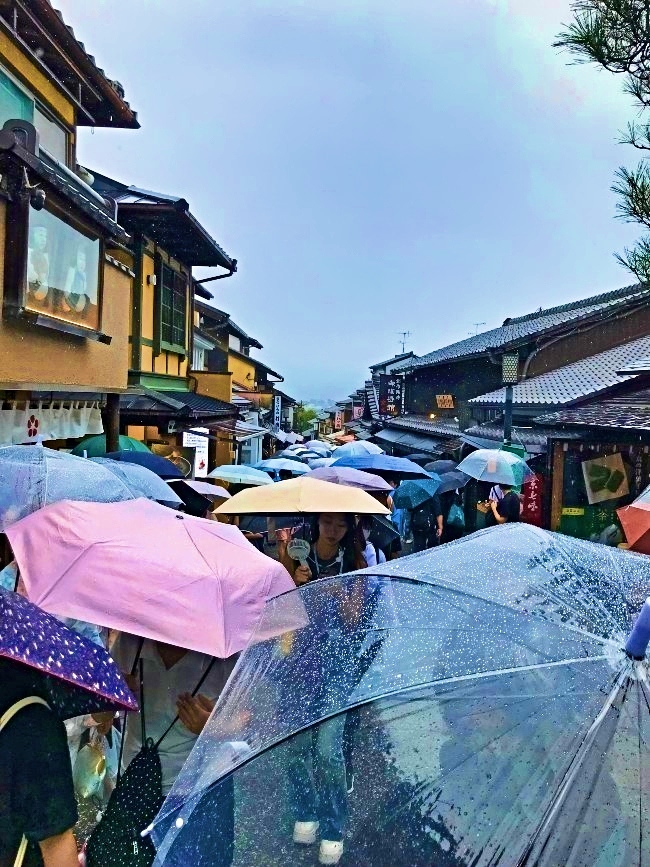
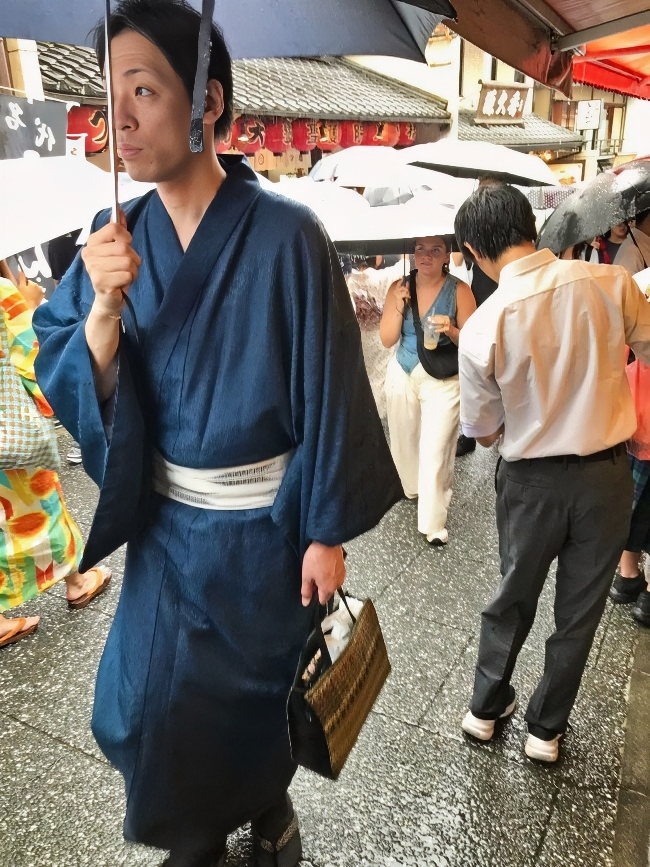
The album’s title is something of a misnomer. As critics Richard Cook and Brian Morton wrote: “It really should have been The Near East (or Middle East Suite.) Strictly speaking, only one track – ‘Ad Lib on Nippon,’ inspired by a 1964 (Ellington band) tour of Japan – is concerned with a country in the ‘Far East.’ The rest of the music on the album was inspired by a goodwill tour undertaken by Ellington and his orchestra in 1963…” which was sponsored and promoted by the U.S. State Department (what a quaint idea!). That tour included stops in Damascus, Amman, Istanbul, Ankara, Cairo, Alexandria, Athens, Thessalonica, Nicosia, Baghdad, Tehran, Kabul, New Delhi, Madras and Ceylon. (Above right: The Umbrellas of Kyoto.)

The Diet (Parliament Building) of Japan in Tokyo.
Why, one wonders, did Duke Ellington use the word “Nippon” in the title to this piece, as opposed to “Japan”? My informed speculation is that he wanted the title to be unusual, something that would catch the eye and engage the imagination, and would convey his admiration of Japan and its people. He also undoubtedly asked various Japanese people about the word Nippon, to get a sense of the nuances of that word before he used it.
 Here is an explanation from the Japanese point of view: “It often takes foreigners in Japan a while to distinguish between the two ways of pronouncing the name of the country itself, Nihon and Nippon. First of all, they are two different ways of reading the same kanji. So how do you know which to say when you see those kanji? (Kanji (漢字) literally means Han characters or Chinese characters in Japanese. Kanji is one of the three scripts used in the Japanese writing system, alongside hiragana and katakana.
Nihon is the standard reading, and much more commonly used. It doesn’t really have any overt nuance. Nippon, however, has that hard ‘p’ sound in the middle, which makes it sound a lot stronger, and harder, than the somewhat breathy Nihon. As a result, Nippon is used when you want to add emotion or strength to the name. So, for example, at sporting events people will chant Nippon. It’s used when people want to show their love or feeling for Japan.”(3)
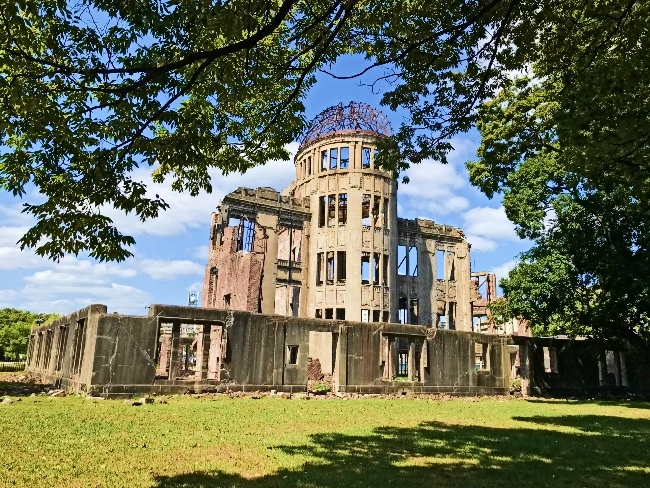
Hiroshima Prefectural Industrial Promotion Hall. Built in 1915, it was designed by Czech architect Jan Letzel. It is located in what is now Hiroshima Peace Memorial Park. It was almost directly below the August 6, 1945 atomic bomb blast’s hypocenter. Because the blast pressure came largely from straight above, the reinforced concrete and steel frame managed to stay upright while everything around it within a circle having a diameter of one mile was destroyed.
The music:
There are four parts to “Ad Lib on Nippon”: Part 1 Fuji; Part 2 Igoo; (3); Part 3 Nagoya; Part 4 Tokyo. “Ad Lib on Nippon” was composed by Ellington and Duke’s long-time clarinetist Jimmy Hamilton. Fugi and Nagoya are largely piano pieces, which showcase Ellington, with assists from bassist John Lamb. Igoo was composed for an American Airlines short advertising film entitled Astrofreight, then later incorporated into “Ad Lib on Nippon.” Hamilton’s playing and his oral history comments on the Tokyo section strongly suggest that this was his composition.(5) It appears from listening to this performance that much of it was improvised. That could be the reason why Duke called it “Ad Lib on Nippon.” Each part has a main theme which provides the basis for the variations played by Ellington at the piano on the first three parts, and Hamilton on clarinet on the last part.
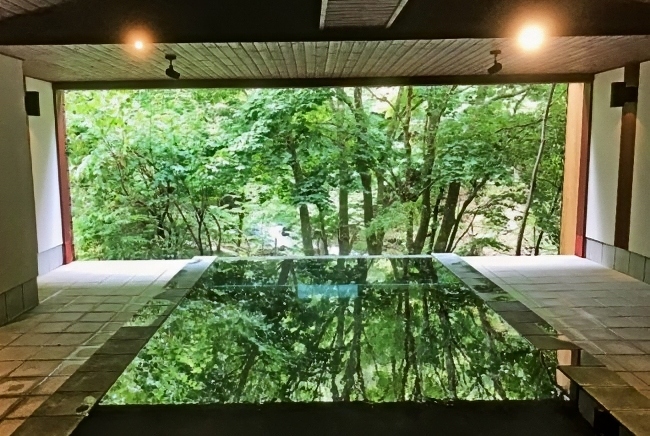
One of the baths at the Tabira Onsen resort in the mountains near Matsumoto.
For the sheet music publication of “Ad Lib on Nippon,” the piano part is a largely a transcription of what Duke Ellington played. The Nagoya section (the middle piano interlude), is based on a copyright deposit sheet and Ellington’s sketch score. This is presented as written by Ellington, though the pianist is encouraged to interpret these sections freely.(5)
The performance presented here is one of the longest and most moving Ellington piano solos on record. But beyond its length, this solo contains some of Duke’s greatest playing. He was a masterful and brilliantly creative pianist.

I will quote from the excellent liner notes written by Ralph J. Gleason for the Fantasy LP (F-9462) entitled: Duke Ellington …The Pianist, most of which was recorded on July 18, 1966, but with three more tracks recorded later, on January 7, 1970. This album, and the earlier (1953) Capitol LP Piano Reflections, are indespensible for anyone who wants to get a deeper appreciation of Ellington’s talent as a pianist.
 Anyone even minimally conversant with Duke knows that he was also a master showman who loved being onstage, interacting with audiences. To say that he did things with a theatrical flair would be an understatement. “When Duke Ellington came onstage to open the show in a nightclub, he would walk out just as the band was finishing the theme, ‘Take the A Train,’ welcome the audience, thank them, tell them that the boys in the band (and he) loved them madly, and then say: ‘And now, we’d like you to meet the pianist.’ …He would then extend his arm toward the piano, turn his palm up and look expectantly toward the empty piano bench. …Then, of course, as appreciative applause arose, Duke would smile his elegant smile, stride to the piano, and sit down gracefully. He would stretch out his arms, sometimes touch his hands together and look down at the keys. Then he would play.”
 “Duke dominated the keyboard. He played all of it, sometimes his long arms extending from the bottom of the bass to the top of the treble. He not only had the scope to play the entire instrument, but he understood, as very few pianists understand, the use of the pedals for special effects. He played the piano in a constantly shifting way. I don’t mean he had different styles. He did not. He had his own personal, unique style, and what is even more important, he had a personal sound on the piano. Let Duke strike a chord or a note and you knew it was Ellington and no one else.”
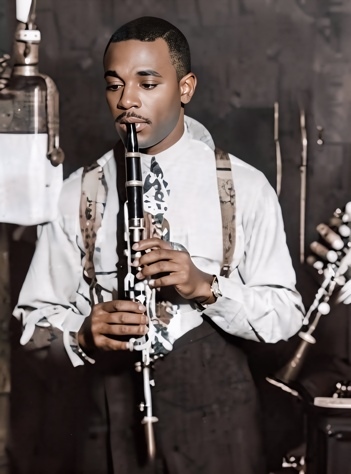 Jimmy Hamilton’s bright-toned clarinet solo is a brilliant technical display that packs strong musical content, both in its improvised parts and its dialogue with the ensemble.
P.S. Don’t miss the sequence at approximately 4:15 where lead trumpeter Herbie Jones masterfully employs doits (upward rips). This is almost certainly a Strayhorn touch.
The recording presented with this post was digitally remastered by Mike Zirpolo.
Notes and links:
(1) The information about Duke Ellington’s 1964 tour of Japan was derived from an article that appeared in Variety on August 12, 1964, 47.
(2) The information about the CBS documentary Duke Ellington Swings Through Japan for the CBS documentary series “The Twentieth Century,” hosted by Walter Cronkite comes from Duke Ellington …Day-by-Day and Film-by-Film (1992), by Dr.Klaus Stratemann, 484-489.
(3) https://www.genkijacs.com/blog/nippon-versus-nihon-versus-japan/
(4) “Igoo” in Japanese (or “Igo”), if used in a conversation or a sentence is not a standalone noun. It is an adverbial noun that means “after this,” “from now on,” “hereafter.”
(5) https://www.ejazzlines.com/ad-lib-on-nippon-from-the-far-east-suite-arranged-by-duke-ellington
Here are links to other great recordings by Ellington that you will enjoy:
https://swingandbeyond.com/2019/01/04/430-blues1969-duke-ellington-with-russell-procope/
https://swingandbeyond.com/2017/06/24/reflections-in-d-1953-duke-ellington-and-1978-bill-evans/


Be the first to comment