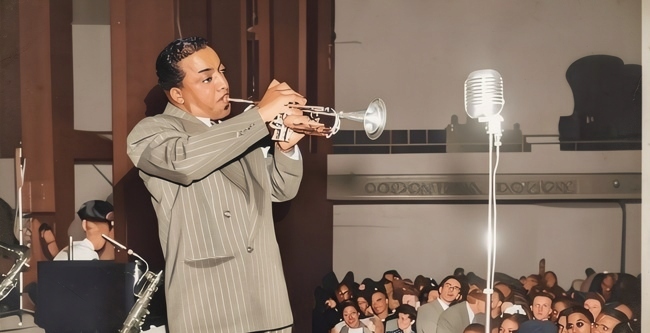
“Uncle Bud”
Composed and arranged by William Johnson.
Recorded by Erskine Hawkins and His Orchestra for Bluebird on May 15, 1941 in New York.
Erskine Hawkins, trumpet, directing: Sammy Lowe, first trumpet; Wilbur “Dud” Bascomb, Marcellus “Monty” Green, trumpets; Bob Range and Edward “Captain” Sims, trombones; William “Bill” Johnson, first alto saxophone; Jimmy Mitchelle, alto saxophone; Paul “Bad” Bascomb and Julian Dash, tenor saxophones; Haywood Henry, baritone saxophone and solo clarinet; Avery Parrish, piano; William McLemore, guitar; Leemie Stanfield, bass; James Morrison, drums.
The story:
 The Erskine Hawkins band, like that of drum legend Chick Webb, was managed by Moe Gale (Moishe Galewsky), and was often featured at the Savoy Ballroom in Harlem. In fact, as the Webb band reached a place of substantial success in various venues outside of the Savoy starting in 1938, Gale often used the Hawkins band as a fill-in at the Savoy for the touring Webb band. This resulted in long spells when the Hawkins band was in residence at the Savoy, long enough in fact so that they slowly became a favorite in their own right there.
After Chick Webb died in June of 1939, his band continued under the titular leadership of their girl vocalist Ella Fitzgerald, who had increasingly become the focus of public attention in that band before Chick’s death. This continued after Chick was gone, when the old Webb band was used more and more as just a back-up for Ella. But Ella had built-up a name for herself, and she was able to continue and increase the success that Chick Webb had labored so long and hard to start. Consequently, she and her band were very often touring, leaving the Savoy to be covered by Erskine Hawkins’s band.

A typical night of dancing at the Savoy Ballroom in Harlem. Post Chick Webb, the most popular band there year-in and year-out was Erskine Hawkins’s.
It appears that Moe Gale tried to replicate Ella Fitzgerald’s success with the Webb band by using various talented girl singers who were featured with Erskine Hawkins’s band including Ida James and Dolores Brown. Both were fine singers and were popular at the Savoy, but Ella Fitzgerald, for many reasons, paramount of which was that she was a magnificent singer, was sui generis. Instead, the Hawkins band found success by doing what they did so well: soulful swinging.
The big break for the Hawkins band came as the result of an easy-swinging instrumental written by Erskine and two of his sidemen, alto saxophonist Bill Johnson and tenor saxophonist Julian Dash – “Tuxedo Junction.”  That tune was recorded by the Hawkins band in the summer of 1939, and achieved fairly good sales. Then, the success of “Tuxedo Junction” leapt from fairly good to sensational as the result of Glenn Miller’s recording of it in early 1940. (The story of that can be found at the post here at swingandbeyond.com on “Tuxedo Junction,” which can be accessed at endnote 1.) (Bill Johnson, shown at left, was not only an excellent lead alto saxophonist and soloist, he was also a fine arranger and creative composer. He added much to the music of the early Erskine Hawkins band.)
Another hit recording that also came from within the Hawkins band was the bluesy piano feature “After Hours,” composed by Avery Parrish, Erskine’s pianist. (The story of that can be found at the post here at swingandbeyond.com on “After Hours,” which can be accessed at endnote 2.)
Slowly, the Hawkins band became successful, so successful that they were presented on the stage of that mecca of swing, the Paramount Theater on Times Square in Manhattan, in the summer of 1941. Their engagement at that venue was from July 30 to August 12, and it was a rousing success.

Erskine Hawkins and his band on the stage of the Paramount Theater in Manhattan: July 30 – August 12, 1941.
Indeed, insofar as their recordings for RCA/Bluebird were concerned, the period of 1940 and into 1941 represents an early creative peak for Erskine Hawkins and His Orchestra. By mid-1941, the Hawkins band was so popular that they were often being featured in theaters, either for split-week or full week engagements. These gigs were extremely profitable. The unfortunate side-effect of all of this popularity was that many commercial pressures began to be applied to Hawkins and his band that resulted in them deviating somewhat from their chosen creative course, which had always been to present original compositions, usually by members of the Hawkins band which included jazz solos, as the core of their repertoire. Many more mainstream current pop tunes, often as vocals, entered the Hawkins band’s book of arrangements in 1941. The balance then became weighted in favor of pop tunes. In the short-run, this provided the Hawkins band with growing popularity with increasingly mainstream (that is white) audiences. The cross-over process for the Hawkins band had begun. But all of this was still in the future when “Uncle Bud,” which is quintessential Hawkins band material, was recorded.

The music:
Simplicity and soul. That was the formula for success for Erskine Hawkins and his band’s music. That, and a generous helping of the blues. The Hawkins band also made sure that whatever music they played was tailor-made for dancing.
 After a short, brassy introduction, the Hawkins band moves into the first chorus. The riffy and soulful main melody is played by the saxophone quintet, in unison at first and then harmonized. Trumpeter Wilbur “Dud” Bascomb, who handled the jazz trumpet duties in this band, plays a growling improvised obbligato to the saxophones using a plunger cup to mute his growl for the first eight bars. (This is a 32 bar AABA tune.) This sequence is repeated on the second eight bars, but Bascomb varies his improvisation here. The open trombones play the eight bar bridge, supported by the humming saxophones, which provide a sonic contrast to the sounds of the first sixteen bars. Bascomb continues his muted trumpet obbligato in this sequence as yet another contrasting sound to the other instruments. The final eight bars of chorus one returns the music to the main melody, with Bascomb once more varying his improvisation. (Above right: Dud Bascomb.)
 The descending brass interlude, with lead trumpeter Sammy Lowe as the top voice, brings Julian Dash to the microphone. Dash’s playing was characterized by a rich, resonant tenor saxophone sound, deep soul no matter what the tempo, good jazz ideas and solid swing. His big sound is complemented by oo-ah brass, an effect that was achieved by the trumpeters and trombonists flexing their hands holding a plunger cup in front of the bells of their instruments to create the oo sound, and then by them extending their hands to open those bells to create the ah sound. (Julian Dash shown at left.)
 Trombonist Edward “Captain” Sims plays an open horn solo on the bridge and last eight bars of this chorus, backed by the humming sounds of the saxophone quintet, led by composer/arranger Bill Johnson’s singing alto. Sims effectively adds his funky sound and jazz ideas to this spicy musical stew. Notice how he sets up the rhythmic bounce in the final bar of his solo which leads into the next chorus. (Shown at right: Edward “Captain” Sims and Julian Dash in back; Bill Johnson in front.)
The next chorus has the riffing ensemble perking up dynamically and rhythmically, with Haywood Henry, in dialogue with them, adding bright clarinet notes to the intensifying music. Maestro Hawkins then appears with a cup-mute softening his trumpet sound on the eight bar bridge, backed by softly played saxophones. This is a quiet contrast – the calm before the storm. Then the hot, riffing brass then return forcefully, now heard alternately with the singing and surging saxophones. (Below: Haywood Henry. He was an excellent clarinet soloist in addition to handling the baritone saxophone with panache.)
The final climactic sequence has the ensemble layering sounds – oo-ah trumpets, forceful open trombones, and surging saxophones, building up rhythmic momentum and taking the music to its climax.

“Uncle Bud”
Composed and arranged by William Johnson.
Recorded by Erskine Hawkins and His Orchestra in August of 1943 in Hollywood.( 3)
Erskine Hawkins, trumpet, directing: Sammy Lowe, first trumpet; Robert “Bobby” Johnson, William Moore, and Charles Jones, trumpets; Edward “Captain” Sims, Norman Greene, Donald Cole and David “Jelly” James, trombones; Bobby Smith, first alto saxophone; Jimmy Mitchelle, alto saxophone; Aaron Maxwell and Julian Dash, tenor saxophones; Haywood Henry, baritone saxophone and solo clarinet; Ace Harris, piano; Leroy Kirkland, guitar; Lee Stanfield, bass; Kelly Martin, drums.
More story and music:
Tempo. It is an important component of music. Musicians can be very intense in their views about tempo. Tommy Dorsey stormed off the bandstand on May 30, 1935 when his brother Jimmy questioned the tempo he set for a song that was being played by the Dorsey Brothers Orchestra. He did not speak to Jimmy for several years after that incident.
It is remarkable how tempo can affect music. Setting a suitable tempo is a talent that many great bandleaders had. Some bandleaders did not have this talent, and consequently they often found themselves in push-and-pull contests with the musicians in their bands, usually drummers and bass players, over where the tempo should be. One well-known swing era bandleader’s sense of tempo was so questionable that the band he led would simply ignore his count-offs, and play the music at the tempo they thought was right. To his credit, he knew what they were doing, and agreed that they, not him, were best suited to set the best tempos.

The reed and rhythm sections of Erskine Hawkins’s band on the bandstand of the Savoy Ballroom in the mid-1940s. Probable personnel identifications: L-R front: Lee Stanfield, Aaron Maxwell, Bobby Smith, Jimmy Mitchelle, Paul Bascomb, Haywood Henry; back: Ace Harris (seated at the piano), Leroy Kirkland and Kelly Martin.
This second version of Bill Johnson’s original tune “Uncle Bud,” which is played by a slightly different Erskine Hawkins band personnel than the first one, is played at a faster tempo. The reasons why this is so are basically that the Hawkins band had played this tune a lot between the time the Bluebird recording was made in mid-1941, and the date of this performance, which was more than a year (possibly two) later, and that it had simply evolved into more of a driving interpretation. Also, there were several new musicians in the band when this performance was recorded, and their approach reflected a rhythmic intensity that was rather different from the laid-back, relaxed, soulful approach that permeates the Bluebird commerical recording. Those musicians were trumpet soloist Bobby Johnson, trombone soloist Donald Cole, lead alto saxophonist Bobby Smith and drummer Kelly Martin. The other soloist, Julian Dash and Haywood Henry, in addition of Hawkins, who returned for this performance, swing along quite comfortably in this romp. Lead trumpeter Sammy Lowe, as always, made sure that the trumpets were popping.

Erskine Hawkins with his brass in the mid-1940s at the Savoy Ballroom. Probable personnel identification, L-R front: Hawkins, Captain Sims, Donald Cole, Norman Greene and David “Jelly” James; back: Bobby Johnson, Sammy Lowe, William Moore and Charles Jones.
The recordings presented with this post were digitally remastered by Mike Zirpolo.
Notes and links:
(1) Here is a link to the story and music of “Tuxedo Junction”: https://swingandbeyond.com/2017/11/22/tuxedo-junction-erskine-hawkins-1939-and-glenn-miller-1940/
(2) Here is a link to the story and music of “After Hours”: https://swingandbeyond.com/2025/02/23/after-hours-1940-erskine-hawkins-with-avery-parrish-1958-glen-gray-with-ray-sherman/
(3) There is some uncertainly about the provenance of this recording. Regrettably, I cannot find my very rare and detailed Erskine Hawkins print version discography. Per swing era historian Christopher Popa, who has a copy of that discography, this recording is a transcription made in Hollywood, California in August of 1943. Thank you Christopher!
Here are links to other great performances by Erskine Hawkins and His Orchestra:
https://swingandbeyond.com/2019/06/20/norfolk-ferry-1940-erskine-hawkins/
https://swingandbeyond.com/2017/01/16/song-of-the-wanderer-1940-erskine-hawkins/
https://swingandbeyond.com/2016/08/26/soft-winds-erskine-hawkins-1940/


Be the first to comment