
“I Was Doing Allright”
Composed by George Gershwin; head arrangement.
Recorded live in performance by Artie Shaw’s Gramercy Five on Bing Crosby’s NBC Kraft Music Hall radio show on March 15, 1945 in Los Angeles.
Artie Shaw, clarinet; Michael “Dodo” Marmarosa, piano; Barney Kessel, electric guitar; Morris Rayman, bass; Lou Fromm, drums.
The story:
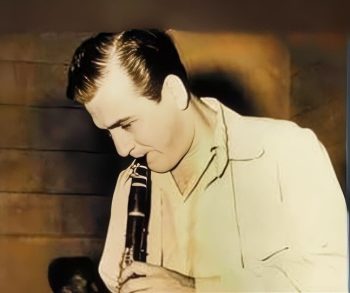 Despite various reports in the contemporary media to the contrary, it appears that Artie Shaw did not actually start hiring musicians for his new post-Navy civilian band until late October or early November of 1944. The band was fully organized and sufficiently rehearsed to undertake a two-week break-in tour of west coast ballrooms, beginning in mid-November. They made their first Victor recording session on November 23-24, 1944, then headed east. They began a lucrative but back-breaking tour of theaters in the Midwest, eventually arriving at the Strand Theater in Manhattan, where they opened what would be a five-weeks stay at that venue on January 26, 1945. That engagement ended on March 1. The band then worked their way back to Los Angeles. They then took a vacation of unspecified length.
Artie and his rhythm section played on Bing Crosby’s Kraft Music Hall NBC network radio show on March 15, 1945 doing a Gramercy Five sans trumpeter Roy Eldridge. This particular Crosby radio show came at a time of great importance in Bing’s career. Crosby had slowly but surely built his reputation as a triple-threat entertainer through the 1930s. First and foremost, he was a singer. His recordings throughout the 1930s are a catalog of examples of of American Popular Song, and are also a window into pop music in general from those years. Crosby’s recordings had a lot to do with introducing many new songs that went on to be evergreens. 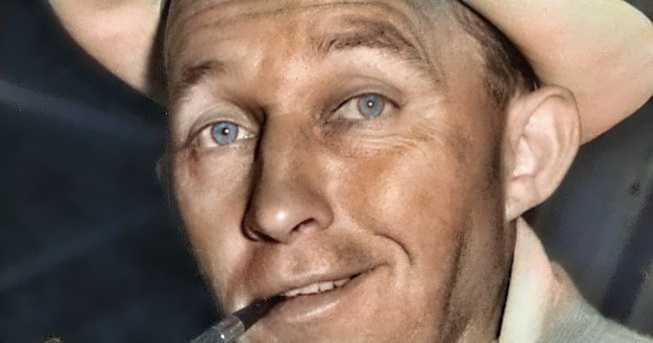 He also helped to popularize or repopularize many songs that were oldies.
Radio was Crosby’s second important career activity. The folks who were running the burgeoning network radio industry in the early 1930s recognized that Bing, as a great singer of popular songs, and droll, hip host, would with his resonant voice be an ideal radio personality. Crosby’s popular weekly radio shows provided ongoing promotion for Crosby’s records. Consequently, throughout the mid and late 1930s and into the 1940s, Bing was the best-selling artist on the Decca Records roster.
Finally, Crosby had fashioned a successful career as a Hollywood film actor. Throughout the 1930s and into the 1940s, he appeared in many light-weight film entertainments, his collaborations with comedian Bob Hope being most successful. But he gradually acquired a good bit of screen acting technique along the way, and by the mid-1940s was prepared to take on roles that had a bit more dramatic depth. A major step in this direction was Crosby’s role in the 1944 Paramount film Going My Way.
Going My Way was directed by Leo McCarey, and it starred Bing Crosby and Barry Fitzgerald. Written by Frank Butler and Frank Cavett, but based on a story by McCarey, the film is about a young priest taking over a declining Roman Catholic parish from its elderly pastor, who had been there for many years. Although the film is not a musical, it nevertheless has a lot of music in it. Crosby sings five songs in the film, with other songs performed onscreen by opera mezzo-soprano Rise Stevens, and the Robert Mitchell Boys Choir.
 Going My Way was the highest-grossing Hollywood feature film of 1944, and was nominated for ten Academy Awards. It won seven, including best picture. Crosby won for best actor in a leading role; Fitzgerald for best supporting actor; McCarey for best director; and “Swingin’ on a Star,” for best original song. (1)
The great success of Going My Way led movie exhibitors to choose Crosby as their biggest box-office draw of the year, a distinction he would hold for the remainder of the 1940s.
I recently watched Going My Way again, and found it to be largely a series of vignettes calculated to get audiences to know and like Crosby’s character, Father Chuck O’Malley. In addition, the film is loaded with stereotypes about the Roman Catholic Church and the Irish, courtesy of the creator of the film’s story and its director, Leo McCarey, who was both Catholic and of Irish-American ancestry. Perhaps the most important factor in the great success of the film however, was the superb, gently comedic performance by Barry Fitzgerald as the elderly Father Fitzgibbon. Crosby profitably spends much of his screen time acting as a low-key straight-man for Fitzgerald.
Part of the film’s success at the box office in 1944 can be attributed to its sentimentality. World War II weary Americans flocked to theaters to see “Going My Way” to bask in its schmaltz as an emotional respite from the grim stories of battles in Europe and the Pacific that dominated the daily news.
A follow-up, The Bells of St. Mary’s, also directed by Leo McCarey, was quickly brought into production at Paramount. It paired Crosby, again cast as a priest, with the stunningly beautiful …and when required quite funny, Ingrid Bergman, playing a nun.
“On March 15, McCarey closed the Paramount set (of The Bells of St. Mary’s) early. It was Thursday, so Crosby was rehearsing The Kraft Music Hall airing that evening after which Leo, Ingrid, (Bing) and everyone else of note in Hollywood would be at Grauman’s Chinese Theater at eight sharp for the seventeenth annual presentation of the Academy Awards.” (2) As noted above, that turned out pretty well for Going My Way, and for Bing Crosby.
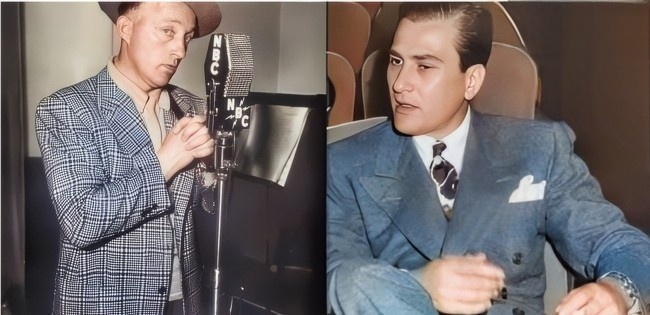 Despite all of Crosby’s hard work as a very busy film actor, he nevertheless continued producing his very popular weekly network radio show throughout World War II. Here is the line-up for his Kraft Music Hall show of March 15, 1945, featuring Artie Shaw: 1. “McNamara’s Band” (Bing); 2. “I Didn´t Know About You” (singer Eugenie Baird); 3. “I Was Doing Allright: (Shaw); 4. “You Belong To My Heart” (Bing); 5. “I´m Beginning To See The Light” (Charioteers singing group); 6. “You Took Advantage Of Me” (Shaw); 7. “Beautiful Love” (Bing); 8. “Double Or Nothing” film medley: “Smarty,” “All You Want To Do is Dance,” “The Moon Got In My Eyes.” (Following this live broadcast, Bing attended the Academy Awards ceremony where he received the Oscar for best actor for his 1944 film Going My Way.)(3)
The music:
We get a taste of what network radio was like in the mid-1940s with the comedic introduction to the tune Artie Shaw would play as featured guest on Bing’s radio show, George Gershwin’s lovely melody “I Was Doing Allright.”(4) It was one of two songs played by Shaw on that show, as noted above. “I Was Doing Allright” was one of the last songs George Gershwin wrote, being composed in 1937 as a part of the music for the feature film called The Goldwyn Follies. Gershwin died on July 11, 1937, while the film was still in production. Vernon Duke assisted with the film’s music after that. The movie was released on February 20, 1938.
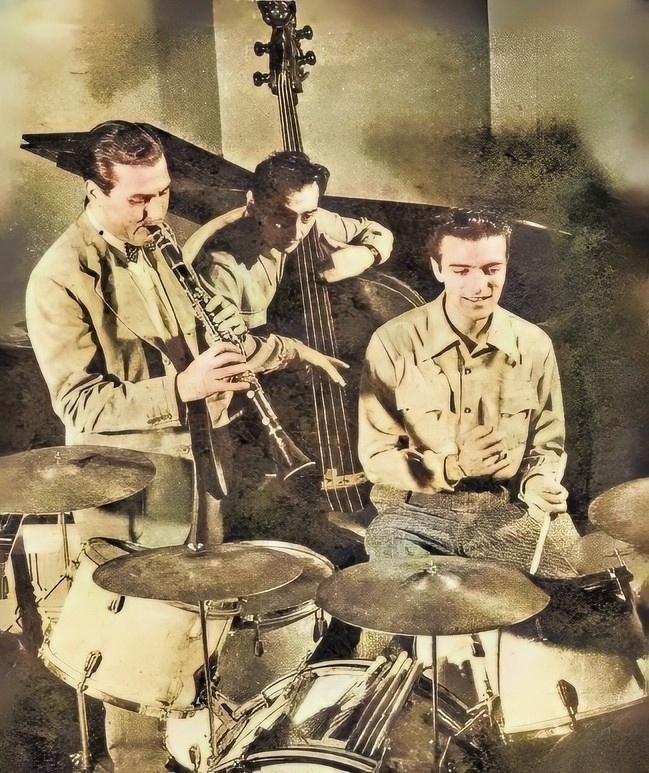
Artie Shaw with Morris Rayman and Lou Fromm – 1945.
This performance was by a quintet Artie Shaw used on this occasion which consisted of the four-man rhythm section from his big band supporting his featured clarinet. (Trumpeter Roy Eldridge, an important member of the sextet called Artie Shaw and his Gramercy Five, was precluded for performing on this show for some reason, but that reason is unknown to me.) (5) Nevertheless, Roy is not missed – his colleagues step-up and deliver a first-class performance.
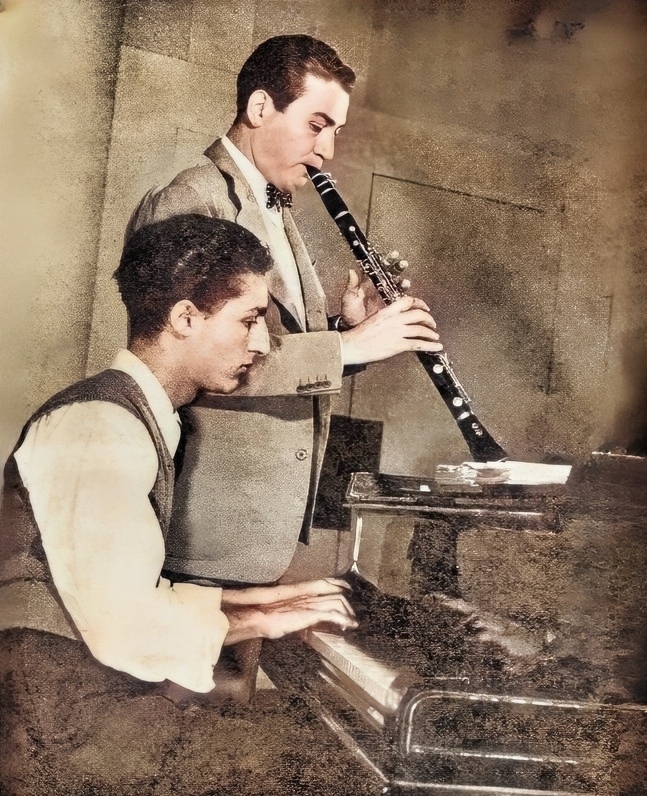 Pianist Dodo Marmarosa, who was playing brilliantly in 1945, plays Mr. Shaw on with a short but beguiling introduction. Artie does here what he did so often, plays the melody, embellishing it here and there. His instrumental sound was personal, warm yet resonant. His technique, demonstrated here in a number of understated ways, is flawless. Guitarist Barney Kessel plays solo on the bridge, and like his leader, he stays close to Gershwin’s melody. This paid musical dividends: the last four bars of the bridge are as beautiful as anything Gershwin ever wrote. (Listen to the accompaniment Kessel gets from Dodo.) Artie finishes the first chorus in stylish fashion.
The jazz solo in this performance was played by Marmarosa, and what a solo it is: a complete yet cogent abstraction of Gershwin’s melody, delivered with virtuoso technique, superb touch and gentle swing. (Above right: Dodo Marmarosa and Shaw in 1945.)
Shaw returns for an exquisite melodic paraphrase on the bridge, then on the last eight bars of the main theme, and a lovely finale. (6)
This is excellent swing style jazz that sounds as fresh today as it did when it was created eight decades ago. Great music inhabits its own present tense.
A bit more story:
 In the spring of 1945 after having made a lot of money on his recently concluded three month tour of theaters, Artie Shaw settled down in Los Angeles for a time. Although some work for his band continued to come his way, he was discovering that there were also open spots in his band’s work schedule over the next few months. He used those open spots to check-in at Victor’s Los Angeles recording studio frequently and make commercial recordings. Shaw was in the recording studios on an astonishing 23 dates from April 5 to September 2, 1945. After that, Shaw and Victor unfortunately came to an acrimonious parting.
Shaw’s personal life during this time was as happy as it ever was. Ava Gardner was living with him in his Beverly Hills home then, and from time-to-time, he was hosting salons there which included many people from the Hollywood film-making industry, most often writers. He also liked to have other writers there who did not work in the film industry.
Artie’s relationship with Ava Gardner (shown above left) was complicated. Despite the fact that he reveled in the excitement she invariably caused simply by walking into any room, he gradually began to destroy their relationship by trying to “improve” Ava intellectually. At the same time, he began to say and do things that degraded her as a person. She endured this rather weird situation longer than most women would have because she loved Artie, and admired him as a musician. Still, by mid-1946, their relationship was essentially over. While it lasted, I think Ava inspired Artie to make a lot of wonderful music.
The recording presented with this post was digitally remastered by Mike Zirpolo.
Notes and links:
(1) The information presented in this post about the film Going My Way was extracted from the Wikipedia post on it.
(2) Bing Crosby – Swinging on a Star …The War Years – 1940-1946 (2018), by Gary Giddens, 508.
(3) The information about the March 15, 1945 Kraft Music Hall comes from: http://stevenlewis.info/crosby/kraft.htm
(4) The “something so thin” that Bing referred to is a singer who was then experiencing considerable success in his show business career, Frank Sinatra.
(5) Shaw used the same personnel as a quintet after Eldridge left his band around September 20, 1945.
(6) When I met Mr. Shaw in December of 1983, he was conducting a new band which was playing for dancers at Glen Island Casino in New Rochelle, New York. One of the tunes his band played that night was “I Was Doing Allright.” I asked him about this. He said: “I really like that tune.” Indeed: he also made a recording of it for Victor with his full band on July 14, 1945 in an arrangement written by George Siravo.


Ava and Artie married in late ’45 and moved from his BH mansion to Burbank in Spring ’46. Artie thought she could move her slowly developing career more quickly if they lived closer to the studios where she would be starring for the firtst time in a film called The Killers w Burt Lancaster in his first starring role. Living in a little two bedroom house she later described “as a piece of shit” house (where I now live), she grew tired of his disdain for her lack of sophistication and she moved out in August ’46 and was granted a divorce a few months later in ’46. Artie may have moved her to Burbank to avoid any claim she might have made to a share from the sale of his BH mansion (highly unlikely) but that was a rumor he may have started. The Killers set up her and Burt as stars for the rest of their careers.
Is there away to hear the music? I love your information. The best ever.
Hi Robert. Thanks for the kind words.
To hear the music, just click on the white triangle in the red box in the center of the picture just below the top of the post with Dodo Marmarosa’s image in it.
Michael, this is a favorite post (and performance). Curious though, where did you find this great sounding air-check from “The Kraft Music Hall”? All others in circulation sound rather dismal.
Jim, I’m away from my home base for a few days so I can’t get that exact info to you now. I will follow-up however.